Mason, Madison Lee, Vatral, Caleb, Cohn, Clayton, Davalos, Eduardo, Jessee, Mary Ann, Biswas, Gautam, & Levin, Daniel T. (2025). Eye movements as predictors of student experiences during nursing simulation learning events. *Cognitive Research: Principles and Implications, 10*(1), 37. https://doi.org/10.1186/s41235-025-00640-7
The “eye-mind link” idea suggests that where and how we move our eyes can directly show what we are thinking. However, it’s been hard to connect specific eye movements to exact thoughts in real-life situations. One reason is that eye movement measures like how long we look at something (fixation duration), how big our pupils get, and how far our eyes jump (saccade amplitude) are often averaged over time periods that include many different types of events, making it hard to interpret.
To tackle this, researchers tested whether looking at eye movements during specific events, chosen by the participants themselves, could better show how focused someone is and how well they perform a task. Nursing students wore special head-mounted eye trackers while doing simulation exercises. Later, they watched videos of their simulations and divided them into meaningful events, describing what they were doing, how well the task went, and what they were thinking during each event.
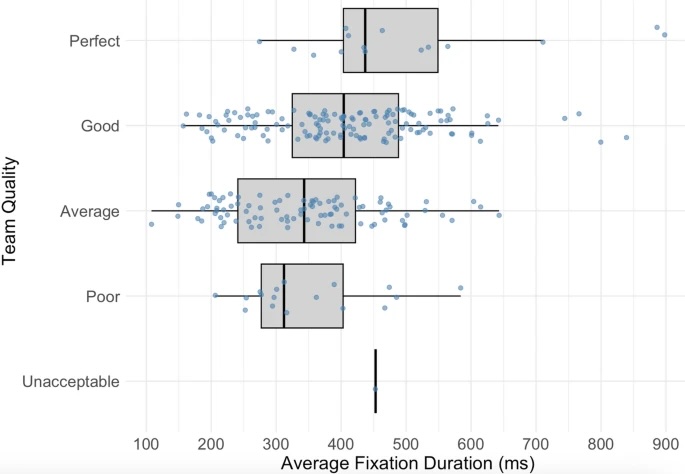
The study found that when students spent more time looking at things and had larger pupil sizes, they rated their teamwork as better. Larger pupil size also predicted better communication. On the other hand, when students made bigger eye jumps (larger saccades), they felt more confident about their abilities. These patterns were consistent across different types of events, and eye movement measures didn’t change much during an event. However, eye fixations were longer during the first five seconds of a new event compared to the last five seconds of the previous one, suggesting people focus more when starting a new activity.
In conclusion, looking at eye movements during specific events is a good way to understand how focused people are and how they explore their environment while learning naturally, and this works across different kinds of tasks.
Figure 4
The relationship between mean fixation duration and team quality