Roy, Ethan, Harriott, Emily M., Nguyen, Tin Q., Richie-Halford, Adam, Rokem, Ariel, Cutting, Laurie E., & Yeatman, Jason D. (2025). Development of the arcuate fasciculus is linked to learning gains in reading. *Imaging Neuroscience, 3*, imag_a_00542. https://doi.org/10.1162/imag_a_00542
Previous research has explored how the structure of white matter in the brain relates to academic skills like reading and math. Some studies have suggested that white matter—specifically, how it allows signals to travel through the brain—can predict a child’s academic abilities, while others have found no connection. However, studies that follow children over time (called longitudinal studies) have found that changes in white matter within the same child may be linked to learning progress.
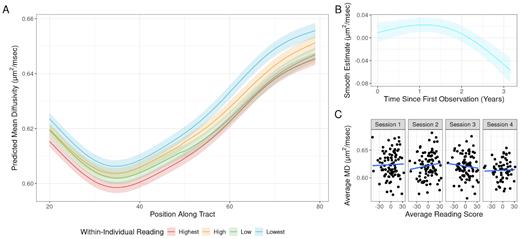
This study aimed to replicate and expand on earlier findings by looking at how changes in a specific white matter pathway in the brain, called the left arcuate fasciculus, relate to reading development. The researchers followed 340 students from first through fourth grade, using diffusion MRI scans to measure white matter and tracking their reading and math scores over time. The results showed that year-to-year improvements in reading—but not math—were connected to changes in the left arcuate fasciculus. These findings offer more evidence that the brain’s white matter can change along with learning, and they underscore the value of long-term studies in understanding how children develop academic skills.
Fig 1
(A) Average estimated tract profiles for MD in the left arcuate fasciculus generated by the GAMM for four different quartiles of reading score change (reading state). Each color represents the magnitude of change relative to the average individual reading score. Shaded areas represent the standard errors of the predictions. (B) The estimated smoothing effect of time elapsed since the first study observation on average MD in the left arcuate. (C) Relationship between overall mean Woodcock–Johnson reading scores and MD in the left arcuate at each time point in the study.