Zhang, Ningyu, & Biswas, Gautam. (2019). Defining and assessing students’ computational thinking in a learning by modeling environment. In *Computational Thinking Education* (pp. 203-221). https://doi.org/10.1007/978-981-13-6528-7_12
Researchers in learning sciences have suggested that there is a strong connection between learning STEM subjects (science, technology, engineering, and math) and developing computational thinking (CT) skills. Studies have shown that CT and STEM learning support each other, but not enough work has been done to clearly define the core CT knowledge and skills that should be taught in K-12 schools to improve both STEM and CT learning. As a result, many important CT concepts are often missing or underrepresented in classrooms for children from kindergarten through 12th grade.
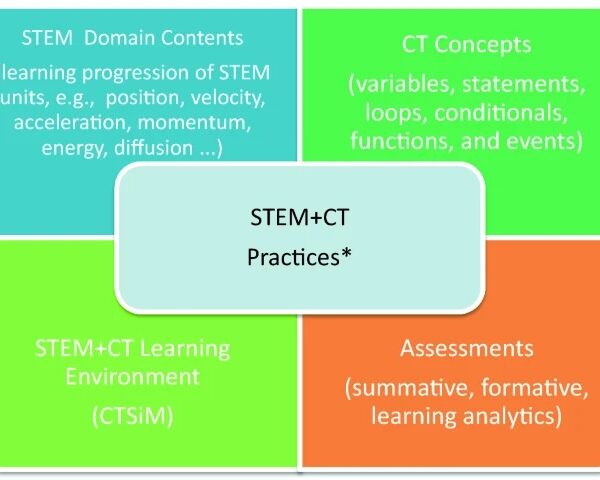
We believe that CT ideas and practices are not only essential for computer science education but also help students build important modeling and problem-solving skills that apply to STEM subjects. In this chapter, we build on our previous framework to promote combined learning of science content and CT skills in middle school classrooms. We explain the main STEM and CT ideas and practices that we have introduced into science classes through our specially designed lessons. We also describe CTSiM, a computer-based learning tool created in our lab, which helps students learn these skills.
We share results from studies in middle school classrooms using CTSiM, showing that students made strong progress in both science and computational thinking concepts. Our assessments also help us understand how students learn and practice these skills, revealing important connections between their learning behaviors and their growth in STEM and CT knowledge.
Fig. 12.1
The STEM + CT framework