Hostetter, Logan, Brown, Leah M., Rajagopalan, Srinivasan, Dulohery-Scrodin, Megan M., Edell, Eric S., Lester, Michael G., Maldonado, Fabien, Lentz, Robert, Bartholmai, Brian J., & Peikert, Tobias. (2025). Bronchoscopic lung volume reduction: Model for assisted target lobe selection. *BMJ Open Respiratory Research, 12*(1), e002903. https://doi.org/10.1136/bmjresp-2024-002903
Bronchoscopic lung volume reduction using endobronchial valves (EBV) is an effective treatment for patients with severe emphysema, helping to improve lung function, exercise ability, breathlessness, and quality of life. Choosing the right patients and the specific part of the lung (called the treatment lobe) to treat is very important for success. Although doctors use strict clinical guidelines, many hospitals rely on teams of specialists and past experience to make these decisions. To make this process more objective and easier, we developed a mathematical model to help select patients and the best lung lobe for treatment.
A team of specialists reviewed detailed lung scans (high-resolution CT scans) from 119 patients to decide who should get EBV treatment and which lung lobe to treat. Using four key measurements from these scans—how complete the lung fissures are, how much of the lung tissue is very damaged (measured by specific density values), and the size of each lung lobe—we created two prediction models: one to identify who is a good candidate for EBV, and another to select the target lung lobe. We then tested these models on a separate group of 50 patients to see how well they worked.
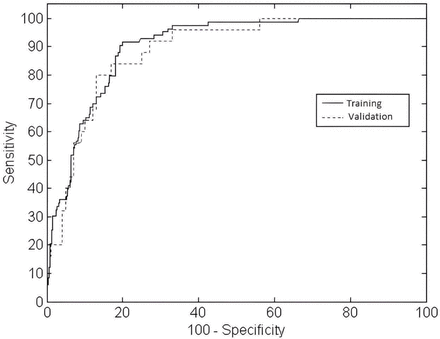
The models performed very well, matching the decisions made by specialist teams with about 80-85% accuracy and strong ability to correctly identify suitable patients and lobes. This shows our model can support doctors by providing an objective tool to guide patient and lung lobe selection for EBV treatment.
In conclusion, EBV remains a valuable way to improve life for patients with severe emphysema. Our mathematical model, based on expert team experience and lung scan data, helps make patient and treatment decisions more objective. Future research is needed to see how well the model can predict lung lobe collapse and functional improvement after treatment.
Fig 1
Receiver operating characteristic of sensitivity and specificity for the training and validation cohorts. AUCs were 0.91 and 0.89, respectively. AUC, area under the curve.