Friends,

As the sun stretches every day to its limit, we find VALIANT brimming with energy. In labs across campus, our Scholars and Fellows are fine-tuning new GPUs, curating ever-richer data sets, and trading insights that push the boundaries of what AI can achieve. Their enthusiasm was matched city-wide when the 2025 Conference on Computer Vision and Pattern Recognition (CVPR) arrived in Nashville. Friends, old and new, sparked collaborations only a short walk from our doorstep.
Hallway conversations dance between edge-computing breakthroughs or the next generation of vision-language models capable of reasoning across images, audio, and text. That momentum is propelling us outward: this month we welcomed HP, Image Assist, and the Eqol Institute into our Industry Affiliates Program, expanding partnerships that span local startups to multinational corporations. My calendar is filling with fresh ideas, new partnerships, and efforts to drive discovery, including preparations for the Medical Imaging with Deep Learning (MIDL) conference in Salt Lake City, which we are co-organizing the workshop with colleagues at Voxel51.
We are also proud to announce a new National Science Foundation award with Tennessee Tech, UT Knoxville, and Meharry Medical College. Together, we will host a series of “Mid-South Cyber-Infrastructure for Health AI” workshops over the next two years aimed at strengthening regional expertise in trustworthy, data-driven healthcare. This effort builds on our Mid-TN Alliance.
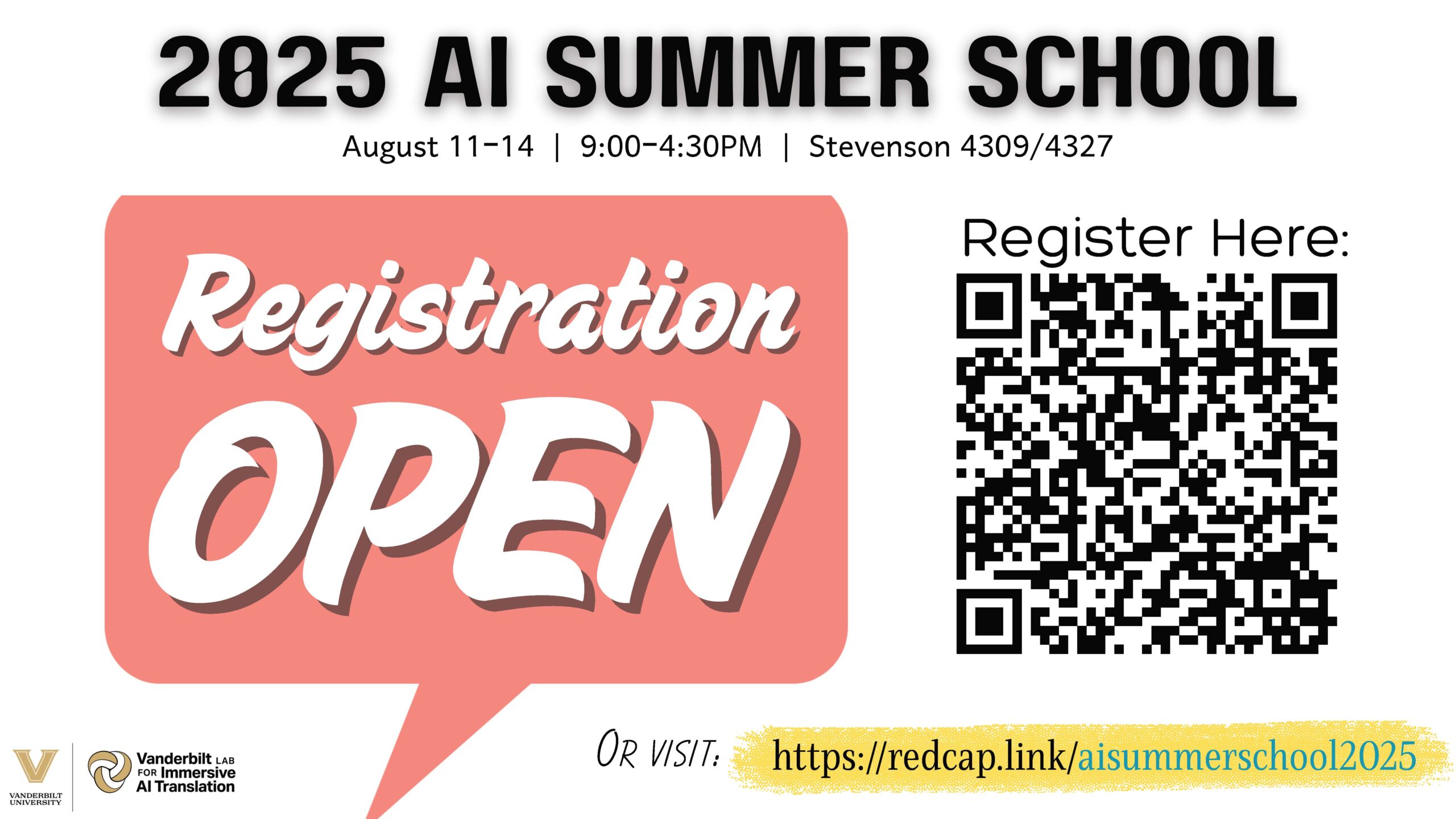
Closer to home, registration just opened for the 2025 AI Summer School (Aug 11–14). Alongside our tried-and-true lecture series on interdisciplinary AI, we are debuting a parallel hands-on track led by our AI Scholars—these hands on sessions provide practical insights on how to accelerate research skills for every level of learner. We look forward to seeing you there and forging even stronger connections through shared problem-solving.
Finally, innovation thrives when minds have room to wander. Between model training runs, code reviews, and paper drafts, I encourage everyone to step outside: paddle our waterways, hike one of Tennessee’s 59 state parks, or visit Radnor Lake’s bald-eagle chicks testing their wings. A quick breath of fresh air often seeds the next big idea.
With gratitude for your partnership and excitement for what comes next,
Bennett
VISE Fellow to Copilot Power-User: Meg Bobo’s AI-Driven Journey at Optum

For this Notes from the Field, Meg Bobo (B.E. ’20, Electrical Engineering) entered industry during the pandemic and has already worn two very different hats at Optum. “I’ve been with Optum as a whole for five years … two-and-a-half as a software engineer,” she notes, tracing a path that began in healthcare consulting and led to writing production code for the company’s NaviHealth division.
That pivot grew from a desire “to be more hands-on, learning new technical skills all the time.” A LinkedIn search revealed an internal opening, and a former high-school contact connected her to a hiring director. “They hired me despite not having that software-engineering background,” she recalls—proof, she says, that curiosity and networking can trump formal titles.
Today Meg’s workbench is Microsoft-centric—PowerShell, GitHub, and, increasingly, Copilot. “Optum has done a huge push for people to use AI in their daily lives,” she explains. Copilot now drafts scripts that automate repetitive tasks, letting her replace manual clicks with one-line prompts. “It’s faster than researching how to do it—and basically as quick as doing the task by hand—so I automate a lot more than I used to.”
Looking back, Vanderbilt’s research culture proved a decisive asset. Interviewers “were fascinated by the research on my résumé,” especially her VISE fellowship on AI for surgical imaging—experience that gave her “a much deeper understanding of how AI works” long before corporate trainings arrived. She urges current students to chase projects with clear real-world impact: “Medical applications let you do so much good, and employers notice.”
Community still tops her checklist for a great workplace. A director’s willingness to discuss career goals before she applied signaled a culture “focused on taking talent and building better engineers.” Outside the office, she stays connected through Vanderbilt alumni panels and mentors engineering students, proof that the network “is always willing to help.”
AI Summer School Registration
VALIANT Ventures
- Prof. Yuankai Huo gave an invited talk at HIMA Imaging Science Workshop at 2025 Pathology Informatics Summit on Monday, May 19, 2025.
- Huo gave an invited talk at the 3rd Acute Kidney Injury: From Bench to Bedside Conference on Tuesday, May 6, 2025
Welcome, HP

Welcome, Image Assist
Welcome, Eqol
Building Vision, Together

Bridging Modalities, Advancing Medicine

Medical Vision at CVPR 2025

Thank You to Blank Rome

Postdoc Service Award

Faculty Mentor of the Year Award

VALIANT Pulse Summer Series Continues

Alchemists’ Corner
- Diagnostic Yield and Synergistic Impact of Needle Aspiration and Forceps Biopsy With Electromagnetic Navigation Bronchoscopy for Peripheral Pulmonary Lesions: A Randomized Controlled Trial
- Systematic cross-sectional age-associations in global fMRI signal topography
- The relationship of white matter tract orientation to vascular geometry in the human brain
- Rotationally Driven Ultraviolet Emission of Red Giant Stars. II. Metallicity, Activity, Binarity, and Subsubgiants
- CT Contrast Phase Identification by Predicting the Temporal Angle Using Circular Regression
- FDG PET of the brain to screen for neurodegenerative disease in older liver transplant candidates
- Using collaborative interactivity metrics to analyze students’ problem-solving behaviors during STEM+C computational modeling tasks
- Influence of early through late fusion on pancreas segmentation from imperfectly registered multimodal magnetic resonance imaging
- Catalyzing Teachers’ Evidence-Based Responses to Students’ Problem-Based Learning in STEM
- Developing Ethics and Equity Principles, Terms, and Engagement Tools to Advance Health Equity and Researcher Diversity in AI and Machine Learning: Modified Delphi Approach
- Plasma proteomic analysis of intermuscular fat links muscle integrity with processing speed in older adults
- The Interplay of Affective States and Cognitive Processes in an Open-Ended Learning Environment: A Case Study
- A Swarm of WASP Planets: Nine Giant Planets Identified by the WASP Survey
- Advancements in Ligand-Based Virtual Screening through the Synergistic Integration of Graph Neural Networks and Expert-Crafted Descriptors
- 1000DaySim: Open-Source Traffic Simulation With Real Data Over Long Time Horizons
- Dipeptidase-1–knockout mice develop invasive tumors with features of microsatellite-unstable colorectal cancer
- KALM: Knowledge-Driven Active Learning for Medical Image Segmentation Using Localized Similarity
- Exploring Artificial Intelligence Supported Interaction Analysis
- Design and Implementation of a Week-long, High School Curriculum Unit Integrating Physics and Computational Modeling
- Transformer-Based T1-Tractography
- A Comparison of Computational Practices and Student Challenges Across Three Types of Computational Modeling Activities Integrating Science and Engineering
- Free-water: A promising structural biomarker for cognitive decline in aging and mild cognitive impairment
- SynStitch: A Self-Supervised Learning Network for Ultrasound Image Stitching Using Synthetic Training Pairs and Indirect Supervision
- Behavior Shifts in Patient Portal Usage During and After Policy Changes Around Test Result Delivery and Notification
- Functional MRI signals exhibit stronger covariation with peripheral autonomic measures as vigilance decreases