Nomi, Jason S.; Bzdok, Danilo; Li, Jingwei; Bolt, Taylor; Chang, Catie; Kornfeld, Salome; Goodman, Zachary T.; Yeo, B.T. Thomas; Spreng, R. Nathan; Uddin, Lucina Q. “Systematic cross-sectional age-associations in global fMRI signal topography.” Imaging Neuroscience 2 (2024): 1-13. https://doi.org/10.1162/imag_a_00101.
In brain imaging studies using resting-state fMRI, scientists often detect a signal called the global signal (GS). While this signal is known to include noise and artifacts (like breathing or head motion), it also carries important information about brain activity that reflects a person’s mental state and traits.
This study looked at how the GS changes with age, using data from people aged 6 to 85. Researchers found that different brain regions contribute to the GS in different ways across the lifespan.
- Subcortical areas (deep parts of the brain), such as the thalamus and putamen, showed linear changes. The thalamus contributed more to the GS as people got older, while the putamen contributed more in younger people.
- Another deep brain structure, the nucleus basalis of Meynert, showed a U-shaped pattern: stronger contributions in children and older adults, and weaker in middle-aged adults. A similar pattern was seen in cortical regions (outer brain areas), especially in networks related to attention and thinking (like the frontoparietal network).
These patterns suggest that the GS is made up of two layers: one from subcortical areas and another from cortical areas, and that their roles in the GS change with age.
Overall, this research shows that the GS isn’t just noise—it contains meaningful brain activity that changes throughout life. Because of this, scientists should be cautious when choosing to remove it in studies that explore how the brain develops or ages.
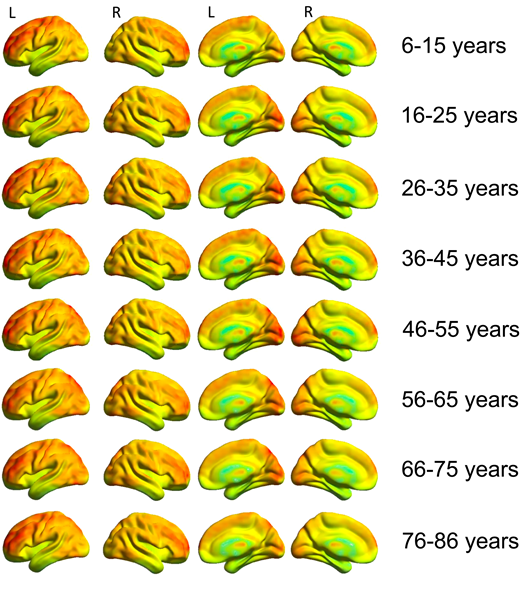
Fig. 1.
Average global signal topography across 10-year age groups. Increased associations between the GS with visual, sensorimotor, and prefrontal cortical regions are found across each age group.