Tanaka, Toshiko; Rosano, Caterina; Huang, Xiaoning; Tian, Qu; Landman, Bennett A.; Moore, Ann Z.; Miljkovic, Iva; Perry, Andrew; Khan, Sadiya; Kalhan, Ravi; Carr, John Jeffrey; Terry, James G.; Yaffe, Kristine; Walker, Keenan A.; Candia, Julián; Ferrucci, Luigi. “Plasma proteomic analysis of intermuscular fat links muscle integrity with processing speed in older adults.” Alzheimer’s and Dementia 21, no. 5 (2025): e70261. https://doi.org/10.1002/alz.70261.
Having more fat stored between muscles (called intermuscular fat, or IMF) has been linked to slower thinking and lower mental performance, but scientists aren’t exactly sure how this happens.
In this study, researchers looked at over 7,600 proteins found in the blood of people from two large research groups: the Baltimore Longitudinal Study on Aging (with 941 people, average age about 67) and the Coronary Artery Risk Development in Young Adults Study (with 2,451 people, average age about 50). They wanted to see which proteins were linked to the amount of IMF and how this fat might be connected to how quickly people process information, measured by a thinking test called the Digit Symbol Substitution Test (DSST).
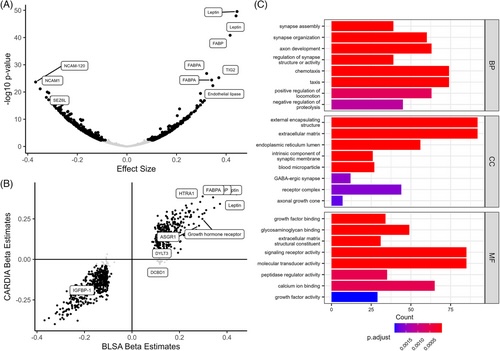
They found that 722 blood proteins were strongly linked to the amount of IMF in both groups. Of those, 26 proteins helped explain the link between IMF and lower test scores—meaning these proteins might play a role in how fat in the muscles affects brain function. These proteins were mainly involved in how brain cells communicate (synaptic function) and in growth factor binding, which helps cells grow and stay healthy.
In summary, having more intermuscular fat is consistently linked to slower thinking speed in people of different ages and backgrounds. Certain proteins in the blood seem to help explain this connection, suggesting that IMF may affect brain function by influencing communication between brain cells and how growth factors work. Reducing this type of fat may help improve mental processing speed.
FIGURE 1
Plasma proteomic profile of intermuscular fat (IMF). Associations between IMF and plasma proteins were tested in participants of the BLSA (n = 941) and validated in the CARDIA study (n = 2445). (A) In the discovery BLSA, of the 7268 SOMAmers assessed, 782 were associated with IMF. (B) Of the 782 SOMAmers, 722 were validated in the CARDIA study. The associations between the beta estimates from the regression between IMF and SOMAmers in the BLSA and the CARDIA study was high (r = 0.96). (C) Enrichment analysis of Gene Ontology (GO) biological process (BP), cellular component (CC), and molecular function (MF) of the 722 SOMAmers (representing 654 unique proteins) show enrichment in neurological pathways and growth factor binding. BLSA, Baltimore Longitudinal Study of Aging; CARDIA, Coronary Artery Risk Development in Young Adults; SOMAmers, Slow Off-rate Modified Aptamers.