Schanche, N.; Hébrard, G.; Stassun, K.G.; Hord, B.; Barkaoui, K.; Bieryla, A.; Ciardi, D.; Collins, K.A.; Collier Cameron, A.; Hartman, J.; Heidari, N.; Hellier, C.; Howell, S.B.; Lendl, M.; McCormac, J.; McLeod, K.K.; Parviainen, H.; Radford, D.; Rajpurohit, A.S.; Relles, H.; Sharma, R.; Baliwal, S.; Bakos, G.; Barros, S.C.C.; Bouchy, F.; Burdanov, A.; Budnikova, P.A.; Chakaraborty, A.; Clark, C.; Delrez, L.; Demangeon, O.D.S.; Díaz, R.F.; Donnenfield, J.; Everett, M.; Fukui, A.; Gillon, M.; Hedges, C.; Higuera, J.; Jehin, E.; Jenkins, J.M.; Kiefer, F.; Laloum, D.; Livingston, J.; Lund, M.; Magain, P.; Maxted, P.; Mireles, I.; Murgas, F.; Narita, N.; Nikitha, K.J.; Opitom, C.; Palle, E.; Patel, Y.G.; Rose, M.; Sousa, S.G.; Strakhov, I.A.; Strøm, P.; Tuson, A.; West, R.; Winn, J. “A swarm of WASP planets: Nine giant planets identified by the WASP survey.” Astronomical Journal 169, no. 6 (2025): 334. https://doi.org/10.3847/1538-3881/adccc6.
The Wide Angle Search for Planets (WASP) survey was one of the first projects to discover “hot Jupiters”—giant planets that orbit very close to their stars and pass in front of them, creating a small dip in brightness known as a transit. Now, thanks to newer data from NASA’s Transiting Exoplanet Survey Satellite (TESS), many of these early WASP planet candidates have been re-examined and given more accurate measurements.
In this study, scientists looked at nine planets that were first spotted by the WASP survey, all orbiting stars similar to the Sun (known as FGK stars). These planets were confirmed to be real through a method called radial velocity, which measures how a planet’s gravity slightly “wobbles” its host star. The team combined new space-based data from TESS with ground-based telescope observations to better understand the properties of these planets.
The planets studied—WASP-102 b, WASP-116 b, WASP-149 b, WASP-154 b, WASP-155 b, WASP-188 b, WASP-194 b (also called HAT-P-71 b), WASP-195 b, and WASP-197 b—are all large, ranging in size from about 0.9 to 1.4 times the radius of Jupiter and in mass from 0.1 to 1.5 times Jupiter’s mass. They orbit their stars very quickly, completing one orbit in just 1.3 to 6.6 days.
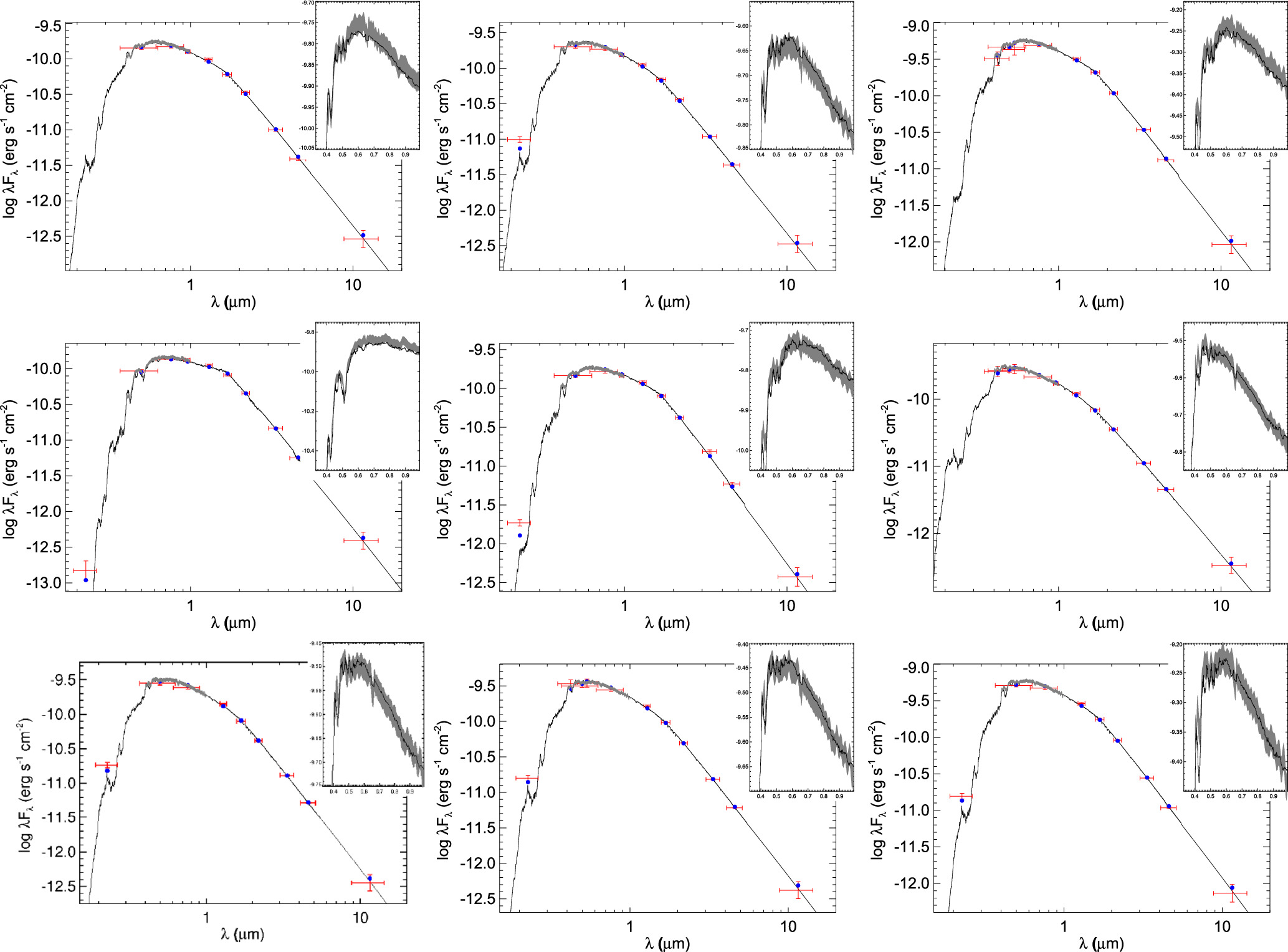
Figure 1. Spectral energy distributions of WASP-102 (top row, left), WASP-116 (top row, middle), WASP-149 (top row, right), WASP-154 (second row, left), WASP-155 (second row, middle), WASP-188 (second row, right), WASP-194 (bottom row, left), WASP-195 (bottom row, middle), and WASP-197 (bottom row, right). Red symbols represent the observed photometric measurements, where the horizontal bars represent the effective width of the passband. Blue symbols are the model fluxes from the best-fit PHOENIX atmosphere model (black). The absolute flux-calibrated Gaia spectrum is shown as a gray swathe in the inset figure.