
Friends,
This month we have the honor of celebrating the one‑year anniversary of the VALIANT Discovery Center. In our firstyear VALIANT has brought together an amazing community of researchers, scholars, scientists—borrowing the language of Babylon 5—dreamers, shapers, singers, and makers. With every issue of this newsletter I get to review the remarkable progress our members are making through scientific publication, rigorous peer review, and careful discovery. Those efforts are already reflected in more than 100,000 citations—evidence of daily inspiration and innovation as much as formal accolades.
I spent a few days this month at the International Society for Magnetic Resonance in Medicine meeting, the very first conference I ever attended as a new doctoral student. It was electrifying to reconnect with imaging physics: bright young minds programming novel pulse sequences on incredibly high‑field magnets, tuned with state‑of‑the‑art electronics and AI‑based signal processing. I came home with more ideas than we can possibly explore in the next several years.
Yet titles that resonate in a convention center full of physicists, engineers, and clinicians often feel opaque outside that hall (for example, even our own Michael Kim’s award winning “White Matter Microstructure and Macrostructure Brain Charts across the Human Lifespan: 23,971 Participants from 25 Studies” is quite imposing). These conferences are, in many ways, the field talking to itself—an act of scientific self‑discovery. To paraphrase Carl Sagan, science is a candle in the dark, but only if we let its light reach beyond our own circles. The necessity of these fundamental, transformative efforts can look mysterious to the wider community that ultimately supports them.
In discussions with our steering committee, we decided to launch a pilot outreach program to shed light on the importance of these nuanced, highly technical advances. Communicating across technical, clinical, and general audiences is hard; our training focuses on depth of knowledge, not cross‑field storytelling. But we are an AI center, and one thing AI does brilliantly is translation—of language and of ideas. My phone can already flip spoken English into dozens of languages at the press of a button; why not use the same power to translate our domain‑specific innovations for a broader public?
After running the idea past my teenager—who pronounced, “seems like a cool science podcast”—we are rolling out VALIANT Pulse, a summer series of short, AI‑assisted, human‑curated episodes that capture why our work matters. The inaugural episode, produced with Google Gemini and hosted by our own Dr. Nancy Newlin, is now live wherever podcasts are found. I welcome your feedback, your ideas for guest episodes, and your special‑episode pitches.
As we enter year two, I remain committed to fostering collaboration, advancing rigorous science, and sharing our collective insights with the world. Thank you for continuing on this journey with me—together, as dreamers, shapers, singers, and makers—toward ever‑brighter horizons of joyful discovery.
With gratitude and excitement,
Decoding Cancer’s Chaos in Madrid
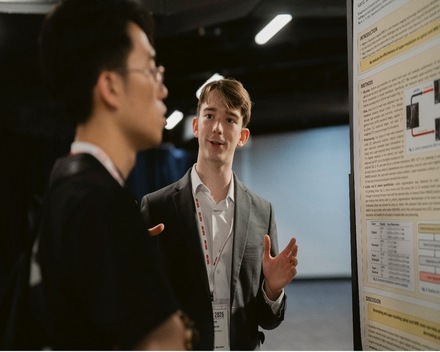 Greyson Wintergerst (B.S. ’25, Computer Science & Mathematics; Spanish minor) has never shied away from a tough puzzle. This fall, he’ll take on one of biology’s knottiest riddles—chromosomal instability in cancer—as a Fulbright Predoctoral Research Fellow at Spain’s Centro Nacional de Investigaciones Oncológicas (CNIO).
Raised on curiosity and coding, Greyson cut his research teeth across Vanderbilt—from summer projects in biomedical engineering to machine‑learning pipelines—discovering “just how much we can contribute when we keep learning and adapting.” At the CNIO, he’ll leverage long‑read DNA sequencing and graph‑based algorithms to map the chain reactions that let rogue chromosomes propel tumor growth. The work builds on CNIO’s recent discovery of distinct “chromosomal instability signatures” that flag dangerous cancer subtypes, setting the stage for precision therapies.
“Cancer is not only one of the most pressing challenges of our time—it’s an incredibly interesting puzzle that I believe has a solution in our future,” Greyson wrote after learning of his award.
The nine‑month fellowship (Sept. 2025 – Jun. 2026) will also let Greyson tap into Madrid’s thriving biotech ecosystem and sharpen the Spanish fluency he honed as a medical interpreter. After his time at the CNIO, he plans to enter medical school—carrying fresh insights from computational oncology straight into the clinic.
His advice for future VALIANT explorers? “Talk with as many people as possible; the relationships you build—and the questions they spark—are what make Vanderbilt extraordinary.” As Greyson packs for Spain, our community cheers him on and stands ready to collaborate on the next chapter of decoding cancer, together.
Alumni Lookout: From Lab Bench to Bedside Alerts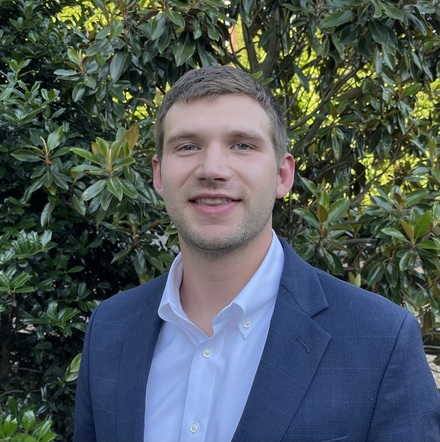
At OneOncology, Curtis Schunkhelps transform raw patient data into life-saving decisions. As a senior analyst working on precision medicine, Curtis applies AI to solve one of cancer care’s most persistent challenges: unstructured data buried deep in clinical notes. “We’re using Llama 4 to dig through MD visit notes and structure data into a format that we can work with,” he explains. These tools identify missed mutations, stage classifications, and trial eligibility criteria—critical signals that can trigger a new treatment option for a patient who might otherwise fall through the cracks.
Curtis’ role spans both direct clinical decision support and broader real-world data (RWD) projects. One recent tool alerts physicians when new therapies are approved, matching them to archived genetic test results: “We’ll pull a list of patients that qualify for newly approved therapies and send it out to doctors across our network… you tested this patient three years ago, and there’s a new approved treatment to consider.” That tight feedback loop links data engineering directly to improved patient care. “If we spend a month pushing an update, we know that tens of thousands of cancer patients could be positively affected.”
The pace is fast. OneOncology functions like “a big company that still works like a startup,” cycling through new tools in two-week sprints. “I feel like every meeting I’m in, someone’s asking, could we use AI for this?” With a push from the CTO and built-in LLM support via Databricks, AI has moved from aspiration to expectation across the organization.
Curtis credits his time at Vanderbilt—and in particular, Maizie’s lab—with giving him the foundation to thrive. “We were really building the models out,” he recalls, which taught him not just how to structure data, but how to question it. That grounding now informs how he collaborates across teams in industry. “Knowing which questions to ask, and knowing potential issues that may come up, is a really big thing.”
Curtis encourages current students to take full advantage of their time at Vanderbilt. “There are so many smart people and resources around you,” he says. “If you’re curious about something, there’s always someone willing to explore it with you—that kind of environment is rare and incredibly valuable.”
Now based in Nashville with OneOncology, Curtis is part of a new kind of medical AI ecosystem—one where meaningful outcomes are just a sprint away. “It’s pretty cool… doctors will come up to you and say, hey, this software helped me. I looked at the genomic report and skipped over this mutation… and now this patient is on a precision therapy with better outcomes.”
VALIANT Ventures
- Draper Witherspoon earned third place for her project “The Imaging and Mapping of Perivascular Space in Healthy Adults” in the Middle Tennessee Science and Engineering Fair (MTSEF).
Research Rank Joins VALIANT

Welcome, Liverpool
 We’re excited to announce a new international academic affiliate: the University of Liverpool has officially joined VALIANT! This partnership strengthens our global collaboration in AI for healthcare.
Landmark Study on Structural Variant Detection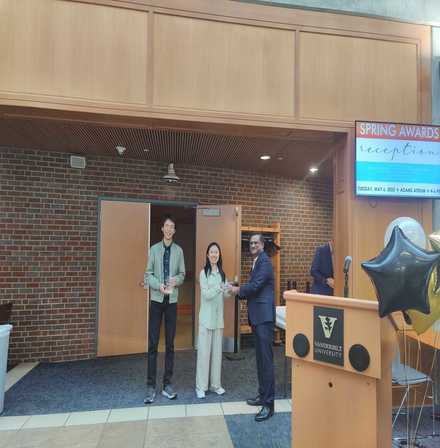
TensorFlow-er Power Hour
 With pop art vibes, a scientist cat leading the charge, and bite-sized treats to fuel creativity, the Stevenson Courtyard bloomed with laughter, painted pots, and potted succulents. It was the perfect way to de-stress after finals and welcome the summer sun. A big thank you to everyone who joined—your energy made it unforgettable!
VALIANT Celebrates VINSE Nano Day!
VALIANT Students at ISMRM
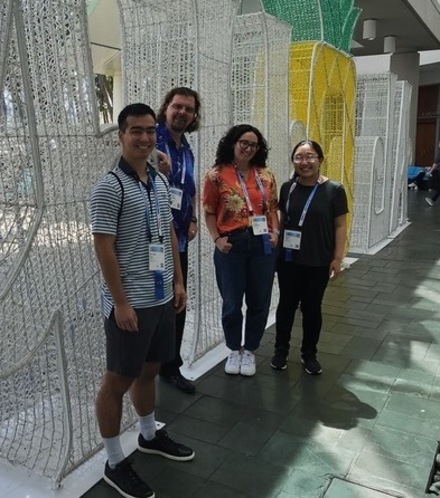 PhD students Michael Kim, Elyssa McMaster, and Chloe Cho (left to right… with Landman behind/left) received ISMRM Trainee (Educational) Stipend awards to attend in Honolulu, Hawaii.
Brains, Charts, and Science Wins
Alchemists’ Corner
- The effect of Alzheimer’s disease genetic factors on limbic white matter microstructure
- White matter hyperintensities and relapse risk in late-life depression
- Towards Trustworthy Knowledge Graph Reasoning: An Uncertainty Aware Perspective
- Optimizing Biomarker Models for Biologically Heterogeneous Cancers: A Nested Model Approach for Lung Cancer
- Introducing QuantConn: Overcoming Challenging Diffusion Acquisitions with Harmonization
- Autonomic physiological coupling of the global fMRI signal
- Leveraging large language models for accelerated learning and innovation in biogenic tissue-engineered vascular grafts
- Ts-FWE: Token-Aware Single-Shell Free Water Estimation for Brain Diffusion MRI
- ReAL: Machine Learning Detection of Reflective Attacks Against Lidarometry
- Towards Machine Learning Based Fingerprinting of Ultrasonic Sensors
- Insulin-like growth factor 2 as a driving force for exponential expansion and differentiation of the neonatal thymus
- Tecovirimat for Clade I MPXV Infection in the Democratic Republic of Congo
- A Spatiotemporal Data Cube Approach to Classification of Variable Stars: A Catalog of Candidate Variable Stars from the TESS Full-frame Image Raw Data
- MAISI: Medical AI for Synthetic Imaging
- Behavioral Effects of Stimulated Dopamine Release and D2-like Receptor Displacement in Parkinson’s Patients with Impulse-Control Disorder
- The PLATO mission
- Searching for Value Sensitive Design in Applied Health AI: A Narrative Review
- Unsupervised discovery of clinical disease signatures using probabilistic independence


valiant@vanderbilt.edu | https://vanderbilt.edu/valiant | @VandyValiant | LinkedIN