Pearcy, Leigh B.; Karim, Helmet T.; Butters, Meryl A.; Krafty, Robert; Boyd, Brian D.; Banihashemi, Layla; Szymkowicz, Sarah M.; Landman, Bennett A.; Ajilore, Olusola; Taylor, Warren D.; Andreescu, Carmen. “White Matter Hyperintensities and Relapse Risk in Late-Life Depression.” Journal of Affective Disorders 383 (2025): 298–305. https://doi.org/10.1016/j.jad.2025.04.116.
White matter hyperintensities (WMHs) are small areas of damage in the brain’s white matter that show up on MRI scans. They are often linked to depression in older adults, called late-life depression (LLD). However, it’s not clear how these brain changes affect whether depression comes back after treatment.
This study looked at 145 older adults over two years. At the start, brain scans measured the amount of WMHs. Among the participants, 102 had depression that had improved (remitted), and 43 did not have depression. Researchers examined whether the amount of WMHs at the beginning could predict if the depression would return, taking into account factors like age, sex, race, education, and health conditions.
People with late-life depression had more WMHs compared to those without depression, but this difference was linked to other health problems like heart disease. Those who had depression come back within 8 months had more WMHs than people without depression, but their WMH levels were similar to those whose depression stayed away. Over the full two years, the amount of WMHs did not predict how quickly depression returned.
These findings suggest that WMHs may be related to depression coming back soon after recovery, but they don’t seem to affect longer-term relapse. This highlights how complex the brain changes are that influence depression and its treatment in older adults.
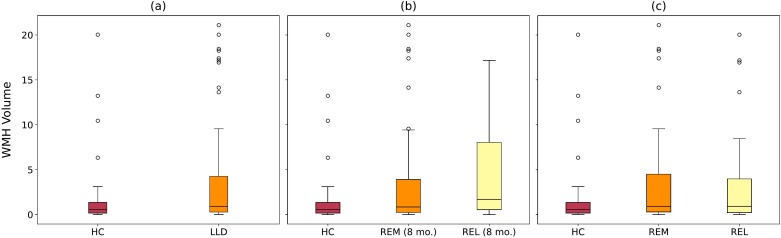
Fig. 1. Baseline WMH comparison by group. We report the mean (SD) WMH volume for each group with units cm3, where (a) HC: 1.9 (3.9); LLD: 3.4 (5.1); (b) REM (8 mo): 3.1 (5.0); REL (8 mo) 4.7 (5.5); (c) REM: 3.4 (5.2); REL 3.4 (5.0). Note HC is identical across figures.