Yao, Tianyuan; Archer, Derek; Li, Zhiyuan; Cai, Leon Y.; Kanakaraj, Praitayini; Newlin, Nancy; Liu, Quan; Deng, Ruining; Cui, Can; Bao, Shunxing; Schilling, Kurt; Landman, Bennett A.; Huo, Yuankai. “Ts-FWE: Token-Aware Single-Shell Free Water Estimation for Brain Diffusion MRI.” Lecture Notes in Computer Science 15171 LNCS (2025): 132–142. https://doi.org/10.1007/978-3-031-86920-4_12.
Recent advances in deep learning have made it possible to more accurately measure “free water” in the brain using a type of MRI scan called single-shell diffusion-weighted imaging (DWI). Free water refers to fluid in the brain that isn’t contained within cells, and being able to measure it helps doctors and researchers better understand brain health, especially in conditions like stroke or neurodegenerative diseases.
Older methods for measuring free water often required more complex scan data (multi-shell), but newer deep learning techniques can do this using simpler, single-shell scans. However, these newer methods still have a big limitation: they are usually designed for one specific type of scan and don’t work well when used on different scan settings or equipment, making them harder to apply in real clinical situations.
To solve this, the researchers created a new method called token-aware single-shell free water estimation (Ts-FWE). This method is designed to work across many different scan types using just one model. It uses a modern deep learning system called a Vision Transformer (ViT) and includes a “token” that tells the model what kind of scan it’s working with. It also processes small 3D sections of the brain (called patches) instead of just looking at individual points (voxels), which helps improve accuracy.
The researchers tested their model on data from several brain scan datasets, including young and older adults, and found that Ts-FWE worked better than existing methods. This approach brings us closer to having a flexible and reliable tool that can be used in many different brain imaging settings.
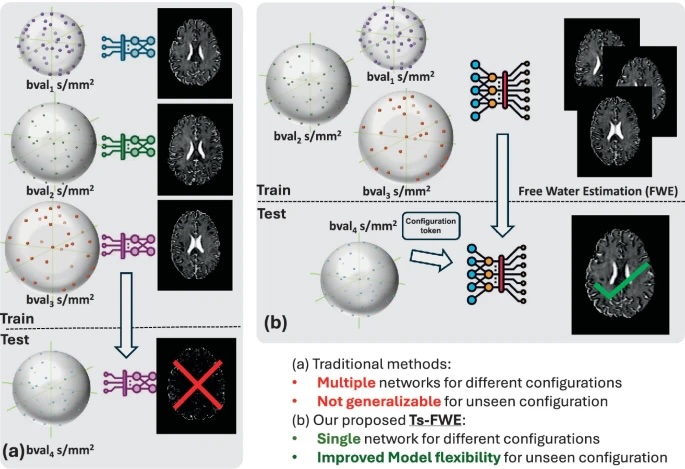
Fig. 1.
Compare traditional methods and our proposed Ts-FWE method. For deep-learning-based diffusion MRI estimators, previous deep-learning approaches can achieve accurate model fitting. However, the “case-by-case” approach did not allow for variations in the input data acquisition scheme and therefore did not achieve a generalizable model for different data configurations. The proposed framework takes in a configuration token that encapsulates the shell configuration to improve accuracy over conventional deep estimators and improve model flexibility when dealing with unseen data configurations.