Solanki, Abhijeet; Beirne, Luke; Hasan, Syed Rafay; Al Amiri, Wesam. “ReAL: Machine Learning Detection of Reflective Attacks Against Lidarometry.” Conference Proceedings – IEEE SoutheastCon (2025): 1309–1313. https://doi.org/10.1109/SoutheastCon56624.2025.10971487.
LiDAR technology, which helps devices like self-driving cars “see” their surroundings by using laser-based sensors, is becoming more and more common. However, LiDAR can sometimes be tricked or confused by shiny, reflective surfaces—like mirrors or glass—which can cause errors in how the system detects objects.
This study introduces a new way to protect LiDAR systems from these kinds of reflective interference. The researchers used a type of machine learning called a Support Vector Machine (SVM) to teach the system how to recognize and handle these shiny surfaces. By combining this smart detection model with the LiDAR’s sensor data, the system becomes much better at avoiding mistakes caused by reflections.
As a result, self-driving cars and other devices using LiDAR can keep working smoothly and safely, even when they encounter surfaces that are normally hard for sensors to measure. The code for this system is freely available at: https://github.com/ChiefAj23/ReAL-ReflectiveAttack-Detection-Lidar.git.
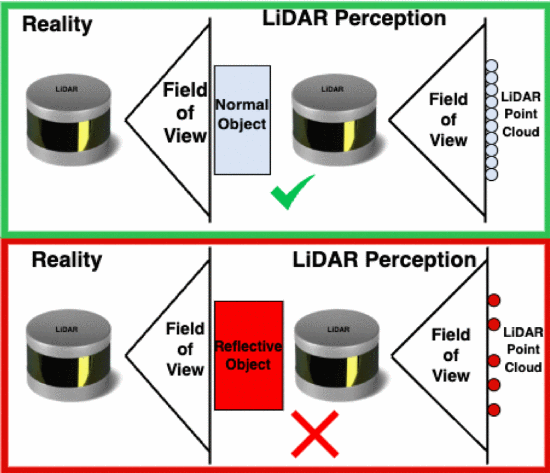
Fig. 1.
Real attack overview- illustration of how reflective surfaces interfere with lidar perception. the top green panel shows normal lidar operation, accurately detecting objects. the red panel shows how a reflective object disrupts lidar, causing errors in detection that lead to missing or distorted lidar data. notice the reduction in the point cloud data (number of red dots vs number of blue dots) in the bottom half of the figure.