Guo, Pengfei; Zhao, Can; Yang, Dong; Xu, Ziyue; Nath, Vishwesh; Tang, Yucheng; Simon, Benjamin; Belue, Mason; Harmon, Stephanie; Turkbey, Baris; Xu, Daguang. “MAISI: Medical AI for Synthetic Imaging.” Proceedings – 2025 IEEE Winter Conference on Applications of Computer Vision, WACV 2025 (2025): 4430–4441. https://doi.org/10.1109/WACV61041.2025.00435.
Medical imaging, like CT scans, is extremely valuable for diagnosing and treating health conditions. But creating these images for research or training AI tools comes with big challenges — such as not having enough data, the high cost of having experts label the images, and concerns about patient privacy.
This study introduces a new tool called MAISI (Medical AI for Synthetic Imaging), which uses AI and a technique called diffusion modeling to create realistic, 3D synthetic CT scans. These synthetic images can be made in high resolution and with flexible sizes to match different medical needs.
MAISI also includes a tool called ControlNet, which allows the system to generate CT scans that already have important organs labeled — up to 127 anatomical structures — saving time and effort for researchers and doctors.
The results from tests show that MAISI can create very lifelike and medically accurate images for a variety of body parts and conditions. This suggests that synthetic images created with MAISI could help solve major problems in medical imaging by reducing the need for real patient data and expensive manual labeling.
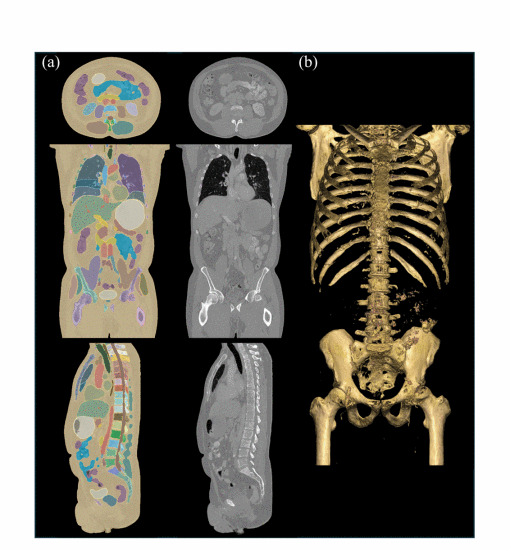
Figure 1.
(a) a generated high-resolution ct volume (with volume dimensions of 512 × 512 × 768 and voxel spacing of 0.86 × 0.86 × 0.92 mm3) by the proposed method and its corresponding segmentation condition overlaid on generated volume. we show the axial, sagittal, and coronal views from top to bottom, respectively. (b) 3d volume rendering of generated ct by maisi. the rendering setting is tuned to highlight bone structures and demonstrate the realism of the generated ct volume.