Qiang, Harry; Kounkel, Marina; Bass, Sally; Lingg, Ryan; Sizemore, Logan; Carroll, Dylan; Hutchinson, Brian; Stassun, Keivan G. “A Spatiotemporal Data Cube Approach to Classification of Variable Stars: A Catalog of Candidate Variable Stars from the TESS Full-frame Image Raw Data.” Astrophysical Journal 984, no. 1 (2025): 49. https://doi.org/10.3847/1538-4357/adc2fc.
A new technique is introduced for identifying variable stars—stars that change in brightness over time—using not just simple light curves but a spatiotemporal data cube, which captures how brightness varies across both space and time. This method allows for better handling of background noise and makes it possible to detect variability across the entire point-spread function. Such an approach is especially useful for large astronomical surveys like the Transiting Exoplanet Survey Satellite (TESS).
The technique was applied to TESS full-frame images to search for eclipsing, pulsating, and rotating variable stars. A neural network, trained on known variable stars from other surveys, was used for classification. Approximately 3.1 million candidate variable sources were identified. While these candidates require further validation using traditional methods, compiling a catalog of the most promising ones can greatly reduce the number of light curves that need to be manually examined.
As future sky surveys such as the Legacy Survey of Space and Time (LSST) begin large-scale photometric monitoring, this type of analysis—with improved training data—could offer an efficient and scalable way to classify variable stars.
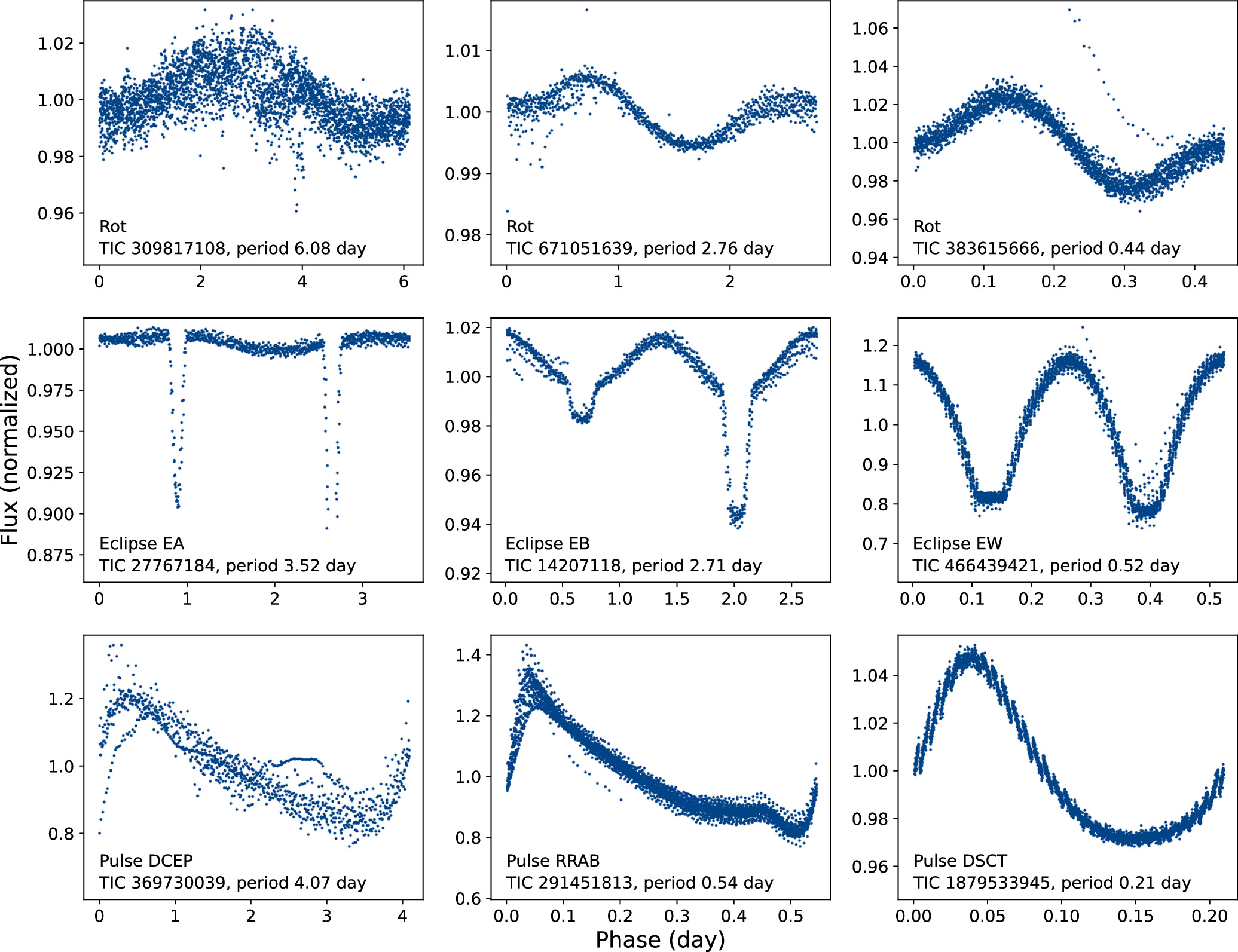
Figure 1. Example of phase-folded TESS light curves extracted with eleanor (A. D. Feinstein et al. 2019) of different types of variables in the training set.