
Friends,
April 2025
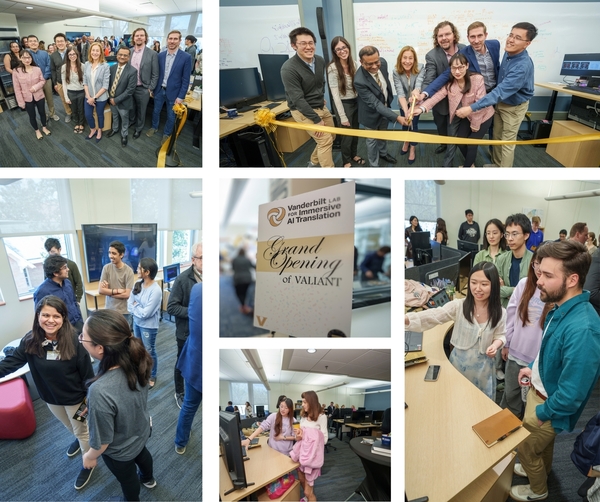
Thank you to everyone who joined us for the grand opening of the VALIANT — it was truly a celebration to remember. From the
packed house in Featheringill 385 to the livestream crowd downstairs (yes, by the cake!), the energy was palpable. I’m grateful for the many conversations, spontaneous collaborations, and shared moments of joy that reminded me why this community is so special.
While our new physical footprint is impressive, what really powers VALIANT is the human footprint — your ideas, your enthusiasm, and your commitment to pushing boundaries. From dissertation committees to startup launches, summer programs to CVPR plans, we’re moving fast and dreaming big. And yes, even our giant AI cats and dogs have a purpose: to remind us that joy, curiosity, and wonder are part of the work, too.
We’re building a space where translation meets inspiration — and we’re just getting started. If you have an idea, a project, or even just a question about how AI fits into your work, come by this summer. Join a lunch, bring a student, suggest a topic, or just sit in and listen. This community grows stronger with every new voice.
-Bennett
 Alumni Lookout: From Tracks to Heartbeats — AI in Motion
This month’s spotlight lands on Steve Damon, a Vanderbilt research alum whose journey across startups, streaming platforms, and clinical imaging reflects the expanding role of AI in industry — and the growing energy of the Nashville tech scene.
Steve began his post-Vanderbilt career at Trinisys, where he helped design long-term storage systems for electronic health records. “It was sink-or-swim,” he recalls. “You learn fast when the pace is high and the stakes are real.” That early experience shaped his ability to tackle tough engineering problems with clarity and resilience.
At Optum, he worked with healthcare claims data at scale. The structured environment offered new lessons in system design and deployment. “There’s value in repeatable processes,” Steve notes. “It taught me how to see a project all the way through —from idea to execution — while balancing performance and compliance.”
He later joined Paramount (formerly CBS Interactive) to support machine learning for content recommendation, before landing at iHeartRadio, where he led a complete transformation of their music ingestion pipeline. “We went from a 24-hour legacy batch system to a real-time streaming pipeline that ingests and processes up to 100,000 tracks a day,” he says. “That project pulled together everything I’d learned — reverse engineering, cost optimization, scalability.”
Now, as co-founder of HeartVue.AI, Steve is bringing AI back to medicine, helping build tools that automatically quantify cardiac structures and blood flow from imaging data. “We’re not just building algorithms — we’re structuring data so it’s useful for clinicians and ready for future analysis,” he explains. “This isn’t just smart software. It’s about making healthcare work better.”
Steve remains grounded in the values he learned at Vanderbilt: testing, curiosity, and community. “Nashville’s where I’ve met the smartest people I know. It’s where my network is. And it’s where the ideas keep growing.”
Tracing Connections: From Environmental Data to AI-Driven Imaging
Andre Teixeira da Silva Hucke’s journey into AI didn’t start in a computer lab — it started in Brazil, sorting through streams of hydrological data and wondering how to make sense of the complex systems around us. Today, he’s a PhD student in Electrical and Computer Engineering at Vanderbilt, exploring how imaging, omics, and artificial intelligence can come together to reveal new insights into human health. “I love seeing how it all connects,” he says. “It’s not about one field — it’s about finding where they intersect.”
Andre’s path to VALIANT was anything but traditional. Originally trained in environmental science in Brazil, he built his early research around hydrological datasets, using artificial intelligence to model and predict water system behaviors. But it wasn’t until an opportunity to volunteer at Mayo Clinic that his interest in biology, omics, and data converged. His mother had been working with Dr. Veronique Belzil, a specialist in Amyotrophic Lateral Sclerosis (ALS or Lou Gehrig Disease) research, who needed help organizing complex genetic and methylation datasets. Andre stepped in — unpaid at first — combining his databasing skills with a growing curiosity about how environment and disease intersect.
That initial effort evolved into a project on cell-free DNA and methylation profiling in ALSpatients. By analyzing genetic fragments released into the bloodstream by dying neurons, Andre aimed to trace the signals of neurodegeneration — ultimately identifying a key biomarker linked to gut microbiota and environmental factors. “It brought everything together,” he reflects. “Genetics, environment, and disease pathways. That’s where I knew I wanted to go.”
When Dr. Belzil accepted a position at Vanderbilt, Andre followed— and soon after, he was introduced to VALIANT. Now a PhD student in Electrical and Computer Engineering, he finds himself immersed in medical imaging, deep learning, and a collaborative culture that feels like home. “Everyone here works together, in person, and openly shares what they know,” he says. “It’s the most welcoming and intellectually generous environment I’ve ever been in.”
While he’s found a new passion in imaging, Andre hasn’t forgotten his roots. His long-term vision is to integrate environmental data, omics, EHRs, and imaging into a unified framework for understanding disease. “I have a whole plot,” he jokes. “I want to merge these fields and close it all with a golden key.”
Beyond the lab, Andre has embraced Nashville life — praising the city’s balance of vibrant culture and easy access to nature. “It has that small-town vibe, but it’s also active and international,” he says. “And the food — so many delicious options, from Indian to Mexican to dumplings, all within walking distance.”
His advice for others considering a PhD? “Only do it if you really want to. It demands a lot, but if you love research, it’s incredibly rewarding,” he says. “And Vanderbilt… it feels like home, even though I’m thousands of miles away from mine.”
VALIANT Ventures
- Prof. Maizie Zhuo was selected as Guest Editor for a Benchmark Collection in Genome Biology, a leading journal in the field of computational biology.
- Prof. Bennett Landman was featured in VU News, elevated to Distinguished University Professor, and interviewed on NewChannel 5 Plus.
- AI Scholar Zhengyi Lu has defended his Master thesis. He will join HRLB lab as a ECE PhD student from May 2025
- Prof. Yuankai Huo presented his research project with undergraduate students, Michael Tung and Ridley H Wills, at Anchor Day 2025.
- AI Scholar Neda Sardaripour was chosen through a competitive process to attend a fully paid trip to the Allen institute for a computational omics workshop.
Celebrating our Newest Neural Networks
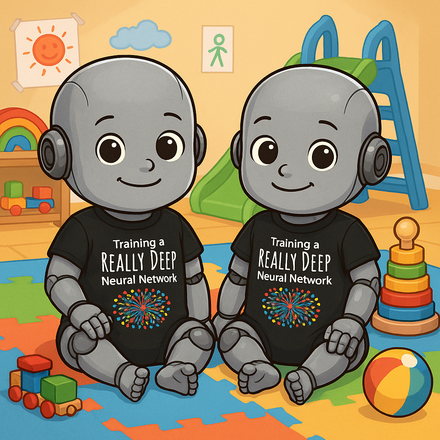 Our early stage member gear has been delivered. Congratulationsto the new moms and dads! The next batch of onsies (pictured left) just arrived. If you (AI Fellows and AI Scholars) are expecting and/or would like the littlest one(s) among your friends and family to become Honorary VALIANTs, drop us a note.
S.L.I.C.E. // Summer Lunch for Interactive Conversation and Exchange

DSI AI Showcase
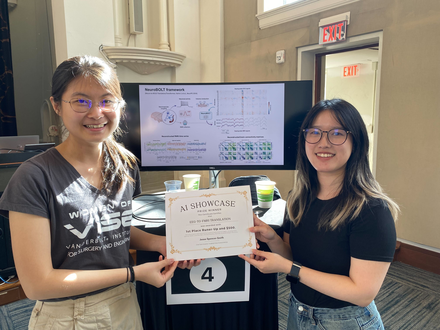 PhD students Yamin Li and Shiyu Wang presented their EEG-fMRI work at the DSI AI Showcase yesterday and received the 1st-place runner up award!
 Appreciating BrainHack

Bite-Sized Success
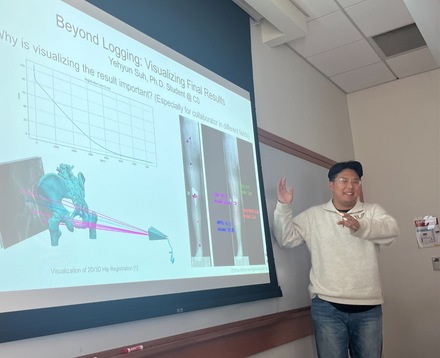 VALIANT Attempt student group shared bite-sized science with creativity and clarity — making big ideas accessible for us all.
Leveling Up Testing 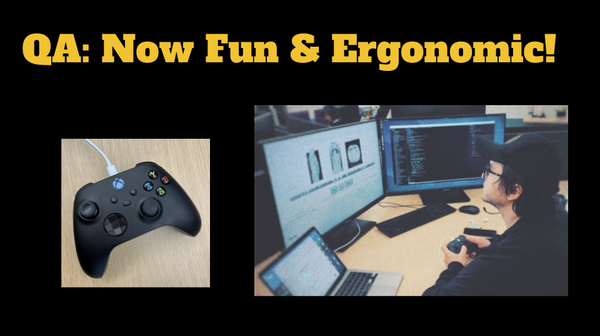
Alchemists’ Corner
- Large indel detection in region-based phased diploid assemblies from linked-reads
- How Difference Tasks Are Affected by Probability Format, Part 2: A Making Numbers Meaningful Systematic Review
- Evaluating Sex and Age Biases in Multimodal Large Language Models for Skin Disease Identification from Dermatoscopic Images
- Multiomic spatial atlas shows deleted in malignant brain tumors 1 (DMBT1) glycoprotein is lost in colonic dysplasia
- A Qualitative Analysis of Barriers to Evidence-Based Care in the Prehospital Management of Patients with Suspected Acute Coronary Syndrome
- Development of a machine learning-based tension measurement method in robotic surgery
- Leveraging Artificial Intelligence as a Safety Net for Incidentally Identified Lung Nodules at a Tertiary Center
- Conflicts of Interest in Bronchoscopy Research: Is Self-Reporting Sufficient?
- PySpatial: A High-Speed Whole Slide Image Pathomics Toolkit
- Interleukin-10 production by innate lymphoid cells restricts intestinal inflammation in mice
- Considerations and recommendations from the ISMRM diffusion study group for preclinical diffusion MRI: Part 2—Ex vivo imaging: Added value and acquisition
- Considerations and recommendations from the ISMRM diffusion study group for preclinical diffusion MRI: Part 1: In vivo small-animal imaging
- GloFinder: AI-empowered QuPath plugin for WSI-level glomerular detection, visualization, and curation
- Performance of Lung Cancer Prediction Models for Screening-detected, Incidental, and Biopsied Pulmonary Nodules
- mTREE: Multi-Level Text-Guided Representation End-to-End Learning for Whole Slide Image Analysis
- Associations between APOE-TOMM40 ‘523 haplotypes and limbic system white matter microstructure
- Write Sentence with Images: Revisit the Large Vision Model with Visual Sentence
- Rare damaging CCR2 variants are associated with lower lifetime cardiovascular risk
- Adaptive DecayRank: Real-Time Anomaly Detection in Dynamic Graphs with Bayesian PageRank Updates
- Edge Classification on Graphs: New Directions in Topological Imbalance
- Enhancing Physician Flexibility: Prompt-Guided Multi-class Pathological Segmentation for Diverse Outcomes
- Vision Foundation Models in Remote Sensing: A survey
- Programmer Visual Attention During Context-Aware Code Summarization
- Scale-up Unlearnable Examples Learning with High-Performance Computing
- Detunable wireless ladder resonator inserts for enhanced SNR of local array coil at 1.5T MRI
- Validation of qMT and CEST MRI as Biomarkers of Response to Treatment After Lumbar Spinal Cord Injury in Rats
- Segment Anything Model (SAM) for Digital Pathology: Assess Zero-shot Segmentation on Whole Slide Imaging

valiant@vanderbilt.edu | https://vanderbilt.edu/valiant | @VandyValiant | LinkedIN
“Vanderbilt” and the Vanderbilt logo are registered trademarks and service marks of Vanderbilt University.