Lu, Siqi; Guo, Junlin; Zimmer-Dauphinee, James R.; Nieusma, Jordan M.; Wang, Xiao; vanValkenburgh, Parker; Wernke, Steven A.; Huo, Yuankai. “Vision Foundation Models in Remote Sensing: A survey.” IEEE Geoscience and Remote Sensing Magazine (2025). https://doi.org/10.1109/MGRS.2025.3541952.
Artificial intelligence (AI) has dramatically changed how we collect, process, and understand data from satellites and other remote sensing technologies. In the past, experts had to manually analyze images or rely on models designed for very specific tasks. But now, powerful AI systems called foundation models—which are large, pre-trained models capable of handling many different tasks—are bringing major improvements in speed and accuracy.
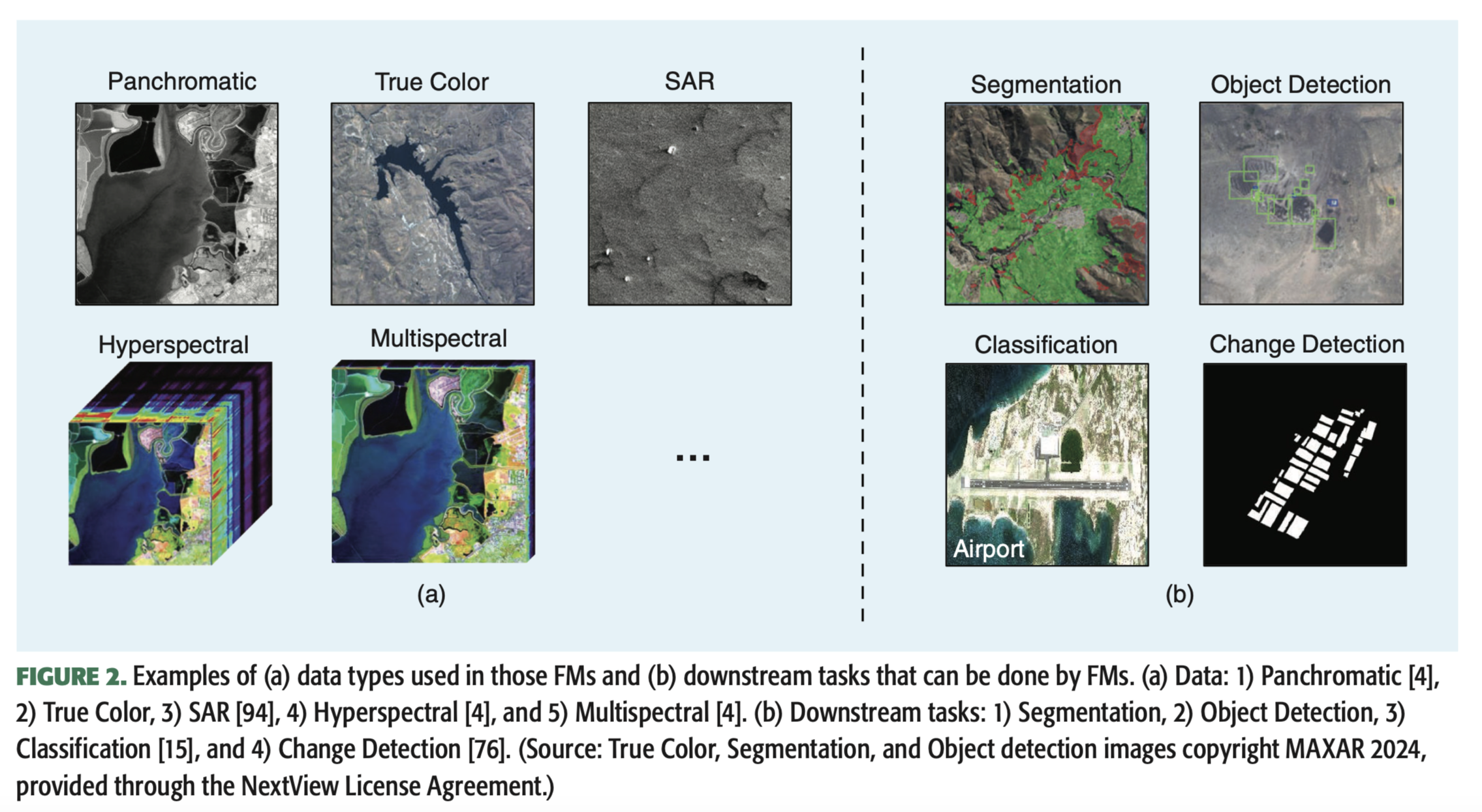
This article gives a full overview of how these foundation models are being used in remote sensing. We explain how they work, the types of data they’re trained on, and the different techniques used to build them. We also compare their performance and highlight key trends and breakthroughs in the field.
In addition, we discuss the challenges of using these models, like the need for high-quality data, large computing power, and better ways for the models to adapt to new tasks. Our review also finds that newer training methods—especially those that allow models to learn from data without needing labels (like contrastive learning and masked autoencoders)—make these AI systems even stronger and more reliable.
Overall, this article aims to help researchers and professionals understand the latest advances in AI-powered remote sensing and explore exciting directions for future work.