Georgakis, Marios K.; Malik, Rainer; Bounkari, Omar E.; Hasbani, Natalie R.; Li, Jiang; Huffman, Jennifer E.; Shakt, Gabrielle; Tack, Reinier W. P.; Kimball, Tamara N.; Asare, Yaw; Morrison, Alanna C.; Tsao, Noah L.; Judy, Renae; Mitchell, Braxton D.; Xu, Huichun; Montasser, May E.; Do, Ron; Kenny, Eimear E.; Loos, Ruth J. F.; Terry, James G.; Carr, John Jeffrey; Bis, Joshua C.; Psaty, Bruce M.; Longstreth, W.T.; Young, Kendra A.; Lutz, Sharon M.; Cho, Michael H.; Broome, Jai; Khan, Alyna T.; Wang, Fei Fei; Heard-Costa, Nancy; Seshadri, Sudha; Vasan, Ramachandran S.; Palmer, Nicholette D.; Freedman, Barry I.; Bowden, Donald W.; Yanek, Lisa R.; Kral, Brian G.; Becker, Lewis C.; Peyser, Patricia A.; Bielak, Lawrence F.; Ammous, Farah; Carson, April P.; Hall, Michael E.; Raffield, Laura M.; Rich, Stephen S.; Post, Wendy S.; Tracy, Russel P.; Taylor, Kent D.; Guo, Xiuqing; Mahaney, Michael C.; Curran, Joanne E.; Blangero, John; Clarke, Shoa L.; Haessler, Jeffrey W.; Hu, Yao; Assimes, Themistocles L.; Kooperberg, Charles; Bernhagen, Jürgen; Anderson, Christopher D.; Damrauer, Scott M.; Zand, Ramin; Rotter, Jerome I.; de Vries, Paul S.; Dichgans, Martin. “Rare damaging CCR2 variants are associated with lower lifetime cardiovascular risk.” Genome Medicine 17, no. 1 (2025): 27. https://doi.org/10.1186/s13073-025-01456-2.
Researchers have known that a molecule called CCL2 plays a role in heart disease by helping immune cells called monocytes move around the body, which can contribute to clogged arteries. But until now, it wasn’t clear whether blocking its partner, a receptor called CCR2, could actually help prevent heart disease in people.
In this study, scientists looked at the genetic data of over 450,000 people from the UK Biobank to find rare, potentially harmful versions of the CCR2 gene. They discovered 45 such variants, and people who had them were less likely to suffer from heart attacks or coronary artery disease.
One specific variant, called M249K, stood out. People who had this gene version (about 0.15% of those of European ancestry) had lower numbers of monocytes and a weaker biological response to CCL2. This means their bodies might be less prone to the kind of immune activity that leads to artery damage.
Importantly, people with this gene variant didn’t have a higher risk of infections—a common concern when altering immune function. These results were confirmed in more than a million people across six other studies.
In short, this research suggests that targeting the CCR2 receptor might be a promising new way to reduce the risk of heart disease without increasing infection risk
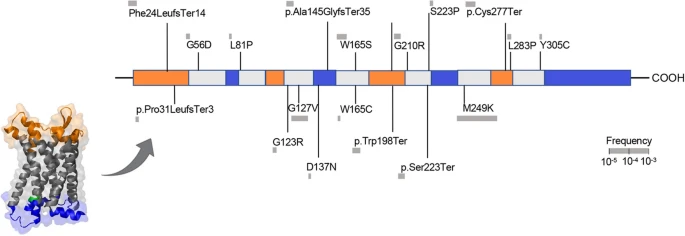
Fig. 1
Damaging CCR2 variants. Domain structure of the CCR2 protein and position of the predicted loss-of-function (LoF) or missense damaging (REVEL > 0.5) variants present in > 2 UK Biobank participants in the CCR2 exonic regions