Li, Thomas Z.; Xu, Kaiwen; Krishnan, Aravind; Gao, Riqiang; Kammer, Michael N.; Antic, Sanja; Xiao, David; Knight, Michael; Martinez, Yency; Paez, Rafael; Lentz, Robert J.; Deppen, Stephen; Grogan, Eric L.; Lasko, Thomas A.; Sandler, Kim L.; Maldonado, Fabien; Landman, Bennett A. “Performance of Lung Cancer Prediction Models for Screening-detected, Incidental, and Biopsied Pulmonary Nodules.” Radiology: Artificial Intelligence 7, no. 2 (2025): e230506. https://doi.org/10.1148/ryai.230506.
Doctors use different types of computer models to help predict whether a lung nodule (a small growth in the lung) might be cancerous. However, these models don’t always work the same way in every situation or at every hospital.
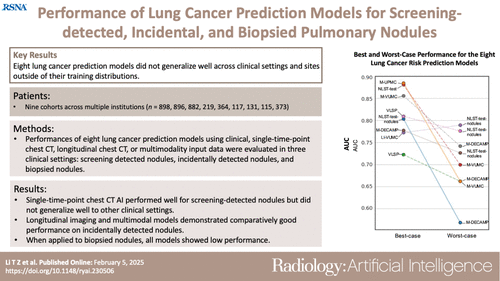
This study looked at how well eight different lung cancer prediction models worked when applied to three common clinical scenarios: (1) lung nodules found through routine cancer screening, (2) nodules found by chance during unrelated scans, and (3) nodules suspicious enough to require a biopsy.
Researchers reviewed real patient data from nine groups (over 4,000 patients total) collected between 2002 and 2021 at various hospitals. The models included both traditional statistical approaches and more advanced methods using artificial intelligence (AI) to analyze chest scans. Some models used just one scan, while others used multiple scans over time or combined scan results with other clinical information.
No single model was the best across all groups. AI models that analyzed just one scan worked well for nodules found during routine lung cancer screening but didn’t perform as well in other clinical situations. Models that used information from scans taken over time or combined data from different sources did better for nodules found by chance. For nodules that had already been flagged as suspicious and biopsied, none of the models worked particularly well.
Overall, the performance of lung cancer prediction models varied depending on where and how they were used. Most did not work well outside of the specific conditions they were originally designed for, showing a need for better, more flexible tools that can work reliably in different medical settings.