Mooney, Katelyn E.; Archer, Derek B.; Sathe, Aditi; Hohman, Timothy J.; Kadiri, Ose; Lamar, Melissa; Arfanakis, Konstantinos; Yu, Lei; Barnes, Lisa L.; Deters, Kacie D. “Associations between APOE-TOMM40 ‘523 haplotypes and limbic system white matter microstructure.” Alzheimer’s and Dementia: Diagnosis, Assessment and Disease Monitoring 17, no. 2 (2025): e70099. https://doi.org/10.1002/dad2.70099.
This study looked at how certain combinations of genes, known as APOE and TOMM40-‘523 haplotypes, are linked to the health of brain connections in areas important for memory and thinking. Researchers focused on two racial groups—non-Hispanic Black and White adults—to see if the relationships between these genes and brain structure were different across groups.
They used brain scans to measure the quality of white matter, which helps different parts of the brain communicate. The researchers then compared people with different genetic combinations within each racial group.
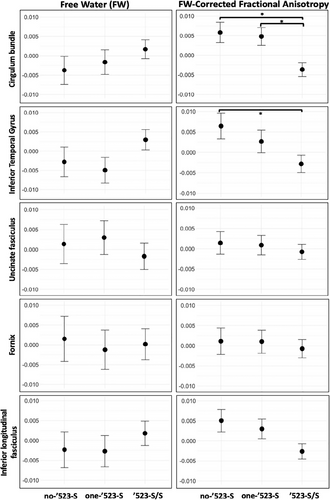
In Black individuals who had a specific version of the APOE gene (called ε4+) and carried one copy of a gene variation called ‘523-S, the white matter in memory-related brain areas appeared healthier compared to those without that ‘523-S variation. In contrast, for White individuals with a different APOE version (ε3/ε3), having two copies of the ‘523-S variation was linked to signs of less healthy white matter.
Overall, the study suggests that this particular gene variation (‘523-S) might affect brain aging differently depending on both genetic background and race. For some, it may increase risk, while for others it could have a protective effect.
FIGURE 2
Residualized beta estimates of ‘523-S copy number and WMM metricsacross limbic system tracts in non-Hispanic White ε3/ε3 participants, adjusted by age, sex, education, and clinical diagnosis. p−values < 0.05 are shown with *, p−values < 0.01 are shown with **. WMM, white matter microstructure.