Chang, Shuang; Wintergerst, Greyson A.; Carlson, Camella; Yin, Haoli; Scarpato, Kristen R.; Luckenbaugh, Amy N.; Chang, Sam S.; Kolouri, Soheil; Bowden, Audrey K. “Low-cost and label-free blue light cystoscopy through digital staining of white light cystoscopy videos.” Communications Medicine, vol. 4, no. 1, 2024, 269, https://doi.org/10.1038/s43856-024-00705-6.
Bladder cancer is the 10th most common cancer and has the highest treatment costs due to its tendency to come back often, which requires frequent check-ups. The standard method for checking the bladder for signs of cancer is white light cystoscopy (WLC), but it’s not very good at detecting early-stage cancer. Blue light cystoscopy (BLC), which uses a special fluorescent dye to highlight cancerous areas, improves detection by 43%. However, the cost of the equipment and the extra time needed to use the dye make BLC less accessible.
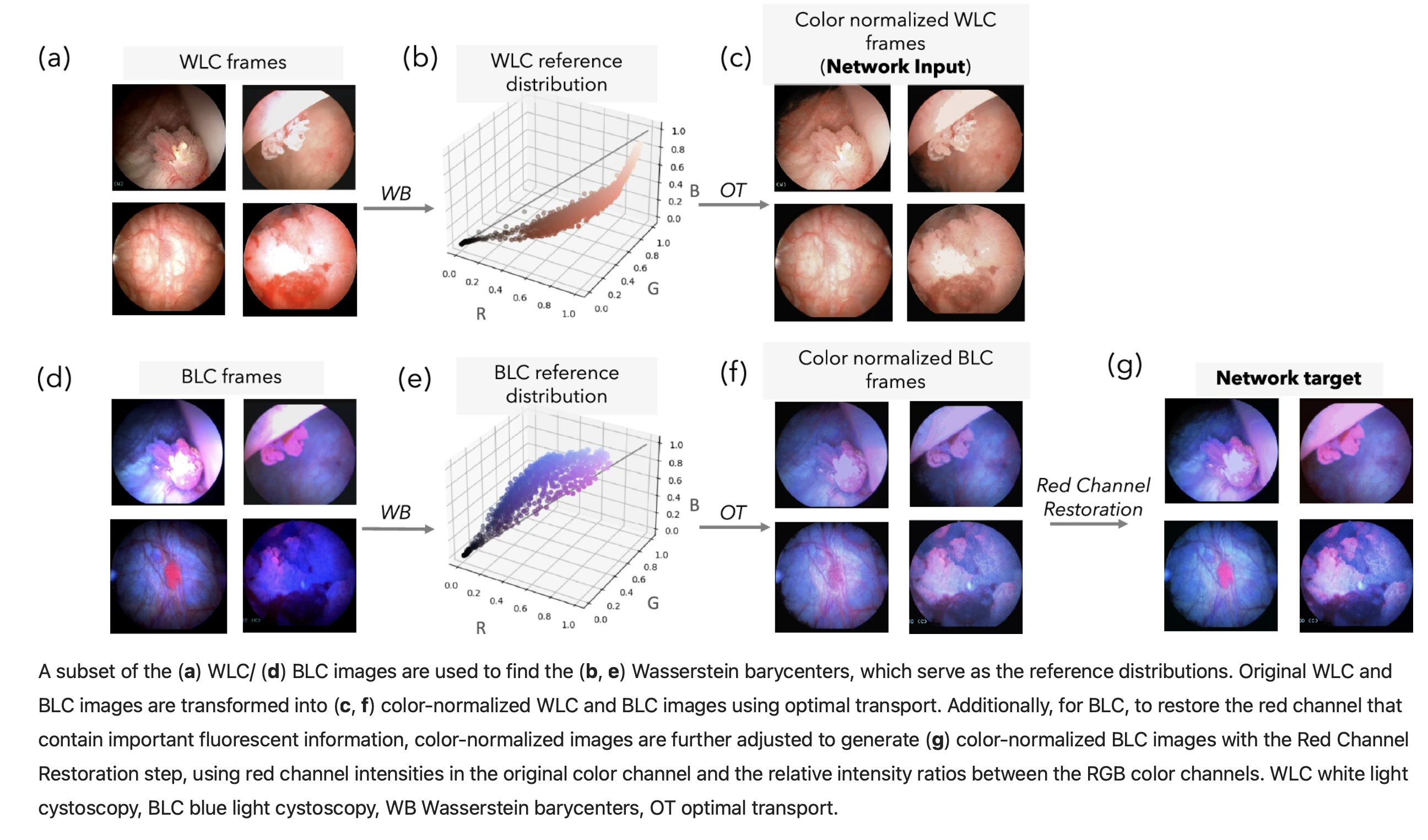
In this study, researchers demonstrated a new approach called “digital staining” to improve WLC images. This method uses standard clinical equipment to convert regular WLC images into images similar to those from BLC, making it easier to detect cancer without the additional costs or time of BLC. By adjusting for color and brightness differences in the data, the team achieved 80.58% accuracy in creating BLC-like images, with good agreement between the digital WLC images and actual BLC images.
The findings suggest that digital staining can offer a more affordable way to enhance bladder cancer detection, making it more accessible to patients. This approach could also be applied to other medical situations beyond urology, providing a cost-effective alternative to traditional methods and improving access to quality healthcare for more people.
Fig. 1: Color normalization and optimization process for WLC and BLC images to align color distributions of video datasets.