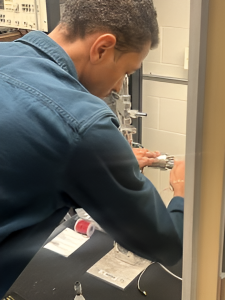
 Solomon Musibau, a final-year Ph.D. student at imec and KU Leuven in Belgium, recently spent 4 months at Vanderbilt University, collaborating with Dr. Sharron Weiss and Dr. Robert Reed on advanced radiation research. This experience provided him with fresh insights into radiation effects on semiconductor devices, a field that closely relates to his own work on electro-optical reliability.
Reflecting on his ISDE experience, Solomon credits his mentors and supervisors—Dr. Reed, Dr. Weiss, Dr. Schrimpf, and Dr. Fleetwood—with fostering an environment where ideas could evolve into actionable research projects. “The Vanderbilt academic environment makes every idea feel possible,” he shares, “Vanderbilt’s unique collaborative freedom with students and professors truly inspires new directions in research.”
During his stay, Solomon worked closely with students like Kellen, Anurag, Nathan, and Tianfang, learning from their unique approaches and experiences in radiation reliability studies. This cross-disciplinary teamwork strengthened his own expertise and brought a different perspective to his ongoing work on silicon photonic devices at imec. In Vanderbilt’s top-notch ECE department, he explored projects within the NSF EPICA program project, contributing to three main tasks: investigating radiation effects on Ge-on-Si photodiodes (Ge PD) using TCAD simulations, exploring the possibility to use low-frequency noise measurements to get insights into degradation mechanisms affecting silicon photonics devices, and collaborating to upgrade the ISDE optical setup to assess advanced photonic devices under radiation, including germanium-silicon electro-absorption modulators (GeSi EAM).
Solomon highlights the unique strengths of both academic and research environments, noting how imec and Vanderbilt each contribute to his professional development in different ways. “At imec, where we work very close with our semiconductor industrial partners, my research focus is heavily oriented towards electro-optical reliability physics—an essential foundation that grounds my work in practical devices and applications used nowadays in datacom/telecom industries. Vanderbilt, on the other hand, offers the freedom to dive into the evaluation of radiation effects from new perspectives, which is directly relevant to my photonic devices research,” he explains. “Combining the information from electro-optical stress and radiation induced degradation, we are able to build up a more detailed understanding of the underlying degradation mechanisms and defect kinetics.”
For Solomon, Vanderbilt’s smaller-scale setup provided the flexibility to take ideas from brainstorming to practical research, with academic freedom that allowed for broader exploration. “Both imec and Vanderbilt are incredible places to work,” he emphasizes, “each offering unique resources and perspectives that have broadened my skills and knowledge in ways I couldn’t have achieved in just one environment alone.”
“Vanderbilt offers a one-of-a-kind research experience,” Solomon reflects, “and it’s a place I would recommend globally for its commitment to fostering impactful research and discovery.”