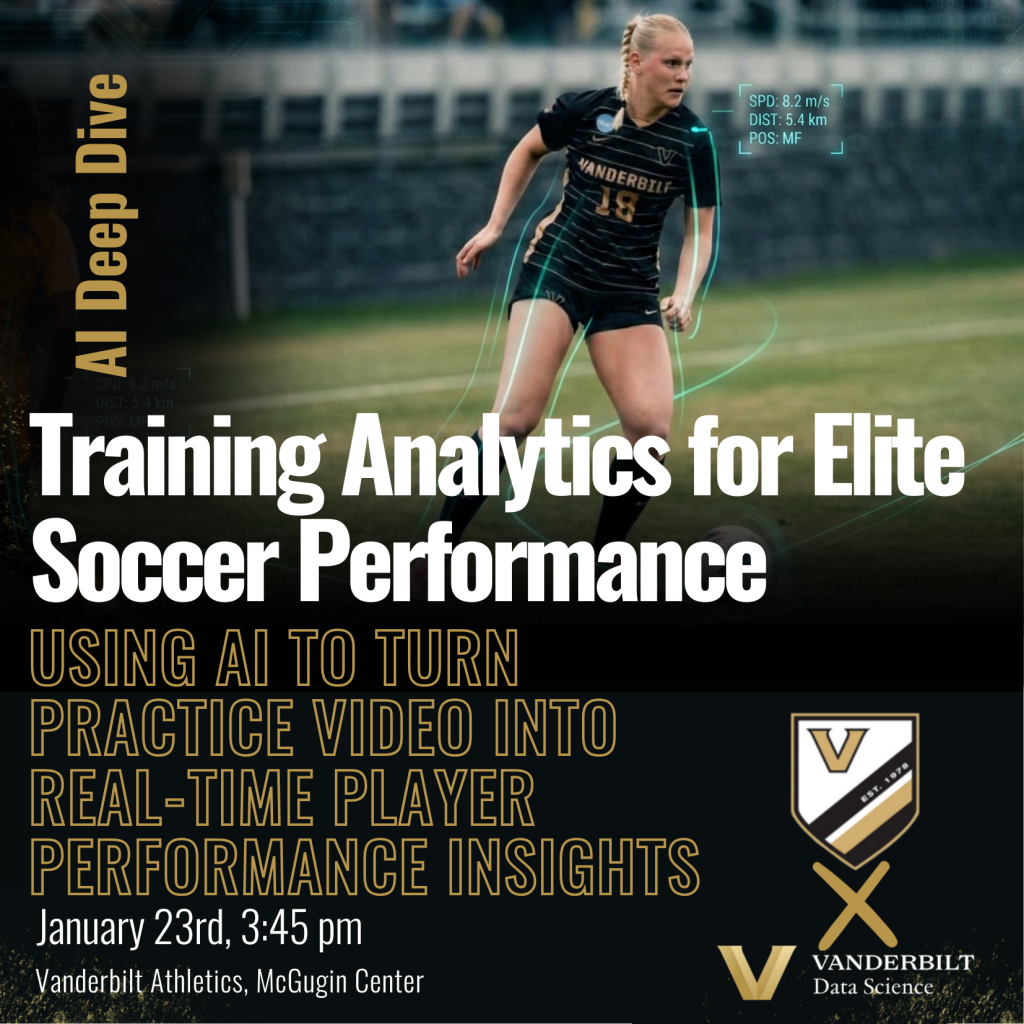
On January 23rd, we hosted an AI Deep Dive Session in collaboration with Vanderbilt Athletics with Darren Ambrose, Head Coach of Vanderbilt Women’s Soccer, where we explored how AI and computer vision could transform the collection and analysis of training data for elite athletes. Coach Ambrose has built Vanderbilt into one of the premier programs in the SEC since arriving in 2015—the 2018 SEC Coach of the Year has guided the Commodores to seven NCAA Tournament appearances, including the program’s first-ever No. 1 seed and Elite Eight appearance in 2025. His teams have won two SEC Tournament championships (2020, 2025), the 2018 SEC regular season title, and produced seven All-Americans while maintaining exceptional academic standards with eight Scholar All-America honorees. The program’s data-driven culture has demonstrably improved player performance, raising team shot-on-target percentage from 38% to 51% through targeted training feedback.
Highlights:
- Purpose: The program seeks to automate labor-intensive manual video tagging of practice sessions, which currently requires student analysts to watch every practice recording and tag individual events for each player—limiting the frequency and depth of feedback coaches can provide.
- Focus Areas: While commercial platforms serve game analytics well, the critical gap lies in training data—the daily practice sessions where player development actually happens. The ultimate vision is a pipeline that generates individual player dashboards within hours of training completion rather than days.
- AI Applications: Exploring whether modern multimodal AI models can identify soccer events and attribute them to individual players from practice video, with key technical challenges including player identification without jersey numbers and integration with the existing Spideo camera system.
Session Insights:
- The session explored which soccer events are easiest versus hardest for AI to detect, with shots and goals likely more accessible than tackles, 1v1 duels, and pass completions—informing a phased implementation approach.
- Hosting the session at the McGugin Center allowed participants to see the program’s facilities firsthand and understand how an automated system would connect with Spideo’s camera infrastructure and existing dashboard tools.
- Discussion covered whether to build a labeled dataset of human-tagged practice video to fine-tune a specialized model versus relying on prompt engineering with general-purpose models.
Conclusion:
The AI Deep Dive with Darren Ambrose and Vanderbilt Women’s Soccer showcased a compelling opportunity for AI to address a real operational challenge in elite athletics—transforming manual video review into automated, same-day performance insights. This session provided a unique opportunity for those interested in sports analytics, computer vision, and applied AI to engage in meaningful discussion about giving Vanderbilt a sustained competitive advantage in athlete development.
Are you interested in hosting a future AI Deep Dive? Contact us at datascience@vanderbilt.edu.