>

VTRAC

The Vanderbilt Travel Risk Assessment Committee (VTRAC) is responsible for reviewing the health, safety, and security of all proposed university-sponsored academic or service opportunities and providing a recommendation for the proposed travel.

VTRAC Changes Beginning February 9, 2026
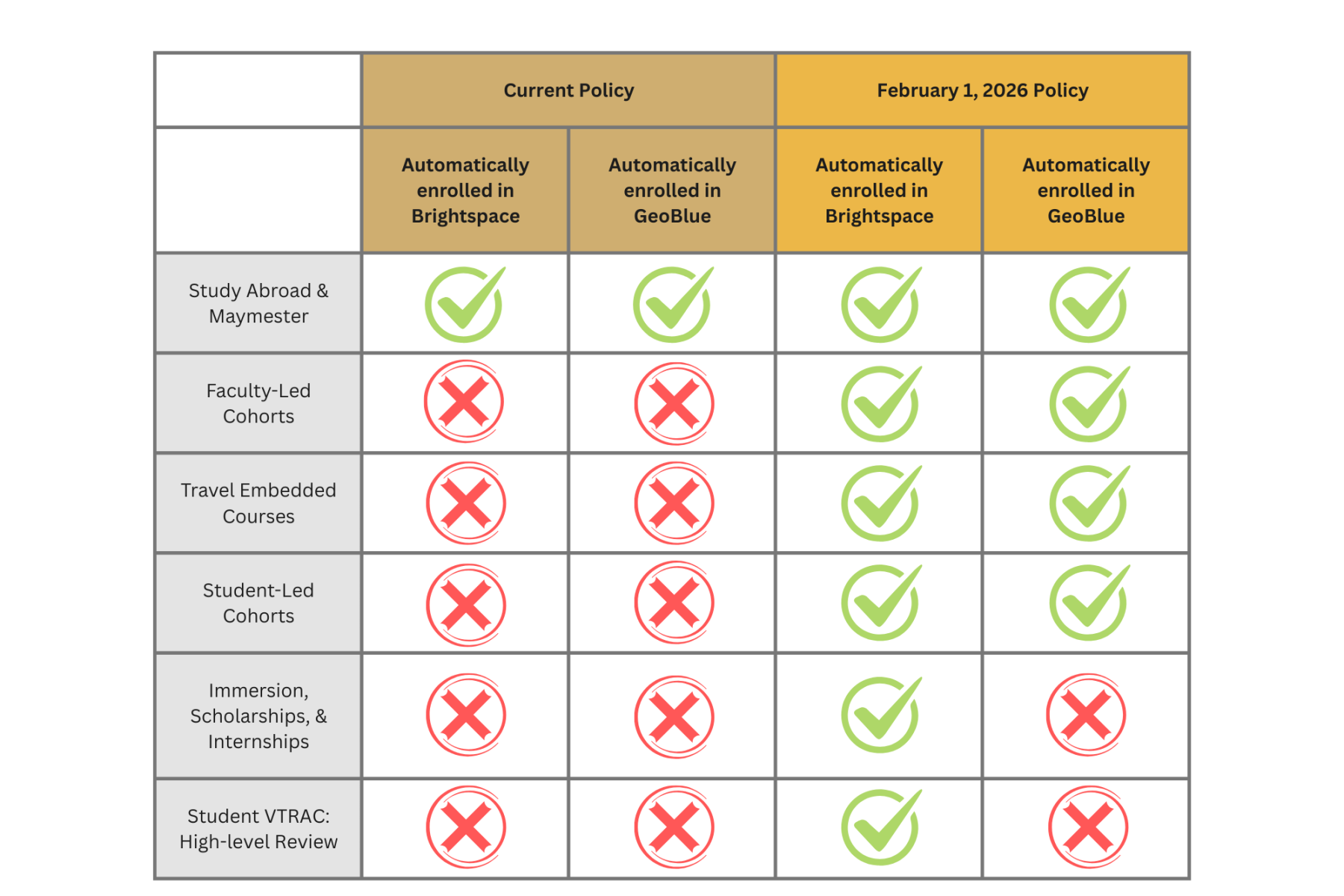
Policy Changes Explained

Changes coming up in 2026:

  • The VTRAC submission process will be streamlined and include only two form options: Students (Undergraduate & Graduate/Professional) or Faculty/Staff/Post-Doc.
  • VTRAC will be introducing a new travel recommendation. In addition to the recommendations to approve or deny travel, VTRAC will begin to include postpone travel as an official travel recommendation type. 
Have questions? Contact the GSH Team.

Student VTRAC Process

All students on non-credit bearing Vanderbilt-sponsored trips, with the exception of faculty/staff-led cohorts, are required to record their travel with VTRAC no less than 60 days prior to travel. 

Students traveling abroad on non-credit bearing VU-sponsored trips without a travel recommendation from VTRAC may be subject to disciplinary action. 

  • Student VTRAC FAQs
    1. How does VTRAC define students?
      • Students are defined as undergraduates, graduates, professional, and VU student works
    2. What does it mean for travel to be VU-sponsored?
      • VU-sponsored travel is defined as travel: funded fully or partially by Vanderbilt, associated with an academic requirement, or registered Vanderbilt organization
    3. What types of activities make up non-credit bearing travel at Vanderbilt?
      • Non-credit bearing trips include, but are not limited to, independent mmersion experiences, conferences, research, service/volunteer, clinical/medical shadowing, faith-based/missions, heritage trips, student organization trips, faculty/staff-led cohorts etc.
    4. What types of travel at Vanderbilt at credit-bearing?
      • Credit-bearing student travel includes VU Study Abroad programs, travel-embedded courses, and Maymesters
    5. What is a Faculty/Staff-Led Cohort?
      • Faculty/Staff-led cohorts are non-credit bearing VU-sponsored travel for students led by a Vanderbilt faculty or staff member
    6. Can I save my VTRAC and return to it?
      • Yes, a VTRAC form can be saved as a draft then returned to later by logging into the Kuali dashboard and selecting “My documents.”
  • Individual Student VTRAC

    Indivudual students traveling to High-level Review locations will be automatically enrolled Global Safety & Health's Health & Safety Pre-departure Course in Brightspace upon submission of a travel record to VTRAC.

    Course completion is required in order to receive a travel recommendation from VTRAC. 

  • Student-Led Cohorts

    Upon submission of a travel record to VTRAC Student-Led Cohorts will automatically be enrolled in:

    1. The GSH Health & Safety Pre-departure course in Brightspace upon submission of a travel record to VTRAC.
      • Course completion is required in order to receive a travel recommendation from VTRAC.  
      •  
    2. A plan with VU's international insurance provider
      • Per the Vanderbilt Student International Travel Policy, all students are required to enroll in a place with VU's international insurance provider priort to traveling abroad. For more information on this requirement visit our GeoBlue webpage

Faculty/Staff VTRAC Process

All faculty, staff, and post-docs are strongly encouraged to record their travel with VTRAC using the form linked below.

All faculty/staff leading non-credit bearing student cohorts are required to record their travel with VTRAC.

Faculty/Staff VTRAC records should be submitted at least 30 days prior to travel.

  • Faculty/Staff VTRAC FAQs
    1. What is a Faculty/Staff-Led Cohort?
      • Faculty/Staff-led cohorts are non-credit bearing VU-sponsored travel for students led by a Vanderbilt faculty or staff member
    2. What does it mean for travel to be VU-sponsored?
      • VU-sponsored travel is defined as travel: funded fully or partially by Vanderbilt, associated with an academic requirement, or registered Vanderbilt organization
    3. What types of activities make up non-credit bearing travel at Vanderbilt?
      • Non-credit bearing trips include, but are not limited to, immersion experiences, conferences, research, service/volunteer, clinical/medical shadowing, faith-based/missions, heritage trips, student organization trips, faculty/staff-led cohorts etc.
    4. What types of travel at Vanderbilt at credit-bearing?
      • Credit-bearing student travel includes VU Study Abroad programs, travel-embedded courses, and Maymesters
    5. Can I save my VTRAC and return to it?
      • Yes, a VTRAC form can be saved as a draft then returned to later by logging into the Kuali dashboard and selecting “My documents.”
  • Individual Faculty/Staff VTRAC

    VU Faculty and staff traveling to High-level Review locations are strongly encouraged to submit a travel record to VTRAC. 

  • Faculty/Staff-Led Cohorts

    Upon submission of a travel record to VTRAC Student-Led Cohorts will automatically be enrolled in:

    1. The GSH Health & Safety Pre-departure course in Brightspace upon submission of a travel record to VTRAC.
    2. A plan with VU's international insurance provider
      • Per the Vanderbilt Student International Travel Policy, all students are required to enroll in a place with VU's international insurance provider priort to traveling abroad. For more information on this requirement visit our GeoBlue webpage

VTRAC Reviews and Travel Recommendations

Types of Travel Reviews

  • High-Level Review

    Travel designated for high-level review meets at least ONE of the following criteria:

    • The proposed location(s) is a US Department of State (USDS) travel advisory level 3- Reconsider Travel or 4- Do Not Travel.
      • The advisory level may be country-wide or region-specific.
    • The proposed location(s) is a US Center for Disease Control (CDC) travel advisory level 3- Reconsider Nonessential Travel or 4- Avoid All Travel.
      • The advisory level may be country-wide or region-specific
    • The proposed location(s) is designated a high-risk by Vanderbilt University’s international assistance provider.
    • The proposed travel is to and/or includes an isolated location(s) or location(s) with limited access to emergency services.
    • The proposed travel includes one or more of the following on-site activities:
      • Community service, volunteering, and/or outreach
      • Clinical and/or medical shadowing
      • Faith-based and/or missionary travel
      • Social and/or political studies (gender/sexuality, race/ethnicity, immigration, human rights, etc)
    •  
  • Standard Review

    All proposed travel that does not meet the criteria for High-Level Review is classified as Standard Review.

    Examples of standard review travel include:

    • Any proposed travel to a US Department of State (USDS) advisory level 1- Exercise Normal Precautions or level 2- Exercise Increased Caution location(s).
    • Any proposed travel to a US Center for Disease Control (CDC) travel advisory level 1- Practice Usual Precautions or level 2- Practice Enhanced Precautions location(s).
    • Any travel that does not include the following on-site activities:
      • Community service, volunteering, and/or outreach
      • Clinical/Medical Shadowing
      • Faith-based/Mission Travel
      • Social/Policitical Studies (gender/sexuality, race/ethnicity, immigration, human rights, etc)

Types of Travel Recommendations

  • Approve

    A travel recommendation of approval is provide after VTRAC has reviewed the health, safety, and security risks associated with the proposed travel, determined the travel plan is sufficient, and recommend travel be approved by the appropriate leadership team

  • Postpone

    A travel recommendation of postpone may be issued if VTRAC has reviewed the health, safety, and security risks associated with the proposed travel, have identified a temporary risk to the traveler’s wellbeing, and feel the in-country situation will stabilize over a short period of time.

    A travel recommendation of postpone may be issued under the following circumstances (please note this list not exhaustive):

    • The proposed travel location is currently experiencing civil and/or social unrest that is believed to dissipate over a short period of time.
    • The proposed travel location is currently experiencing or has recently experienced a widespread disaster or delay in emergency services which has temporarily destabilized the region.
    • The proposed travel location is currently experiencing or has recently experienced an increase in political tension with another country which may result in or has resulted in an escalation in non-armed conflict between the two nations.


  • Deny

    Denials are issued when VTRAC has reviewed the health, safety, and security risks associated with the proposed travel, feels the travel represents a significant risk to the traveler’s wellbeing, and recommends travel be denied by the appropriate leadership team.

  • Suspension & Cancellation

    VTRAC is responsible for deciding whether to suspend or cancel an educational opportunity away from campus when health, safety, or security concerns emerge shortly before a program begins or while it is in progress. The Committee is expected to balance the educational and/or research merits of the travel opportunity with its associated risk, with an emphasis on risk mitigation.

    Suspension/cancellation of a program will be considered if on or more of the following events occur:

    • Declaration of war between the US against the host country or an adjacent neighbor
    • Declaration of war involving a third country and the country of the program’s location
    • Protracted or indefinite closure of the university where the program is located
    • Inability of the local staff to organize and carry out an academic program outside of the university
    • Disruption of public utilities and/or services
    • Declaration of martial law in the program city or country
    • Significant terrorist activity in the program city or country
    • Wide-spread civil unrest, violence, criminal activity and/or rioting
    • Recommendation for suspension/cancellation by the institution program staff in the host country
    • Specific directive by the US State Department and/or US Embassy
    • Recommended evacuation by local officials
    • Widespread disease or epidemic that is uncontrolled
    • Severe weather advisory such as hurricane warnings

    The decision to suspend/cancel a program or trip will be based on information from:

    • The in-country program staff
      • In the case of students studying with a partner organization, Vanderbilt University will generally follow our partner’s procedures but reserves the right to make an independent decision.
    • University officials at the overseas partner university
    • US Embassy officials in the host country
    • Vanderbilt’s international security provider and international health insurance provider
    • Other officials from US agencies and/or NGOs, as well as the appropriate US State Department Country Desk Officer(s)

Who makes up VTRAC?

  • Senior Director, Vanderbilt Global Opportunities
  • Assistant Director, Global Safety and Health
  • Deputy General Counsel, Office of General Counsel
  • Insurance and Risk Director, Risk Management
  • Export Compliance Manager, Export Compliance
  • Travel Manager, Travel and Finance
  • Director, International Student Scholars Services
  • Director, Employee Immigration Services