Recent News
Our structural health monitoring (SHM) research is developing techniques for:
- Detection, localization, and quantification of structural damage (damage diagnosis)
- Forecasting future damage growth and estimation of the remaining useful life of the structure (prognosis)
- Uncertainty quantification in damage diagnosis
- Uncertainty propagation to perform probabilistic system prognosis.
-
Applications
 Concrete Structural Health Monitoring
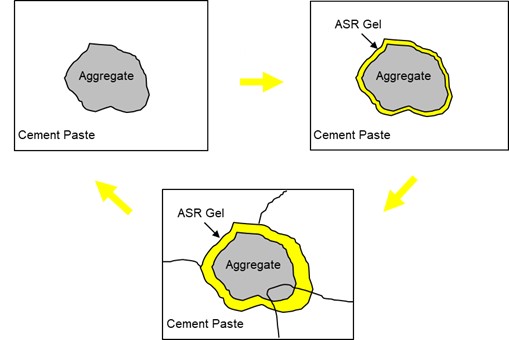
NDE Techniques are being studied to detect and localize damage due to alkali-silica reaction (ASR) in concrete specimens.
- ASR is a chemical reaction between highly alkaline cement paste and reactive aggregates in cement, produced over time.
- In the presence of moisture, ASR gel expands, producing cracks in the specimens.
Concrete Experimental Specimens
Plain Concrete
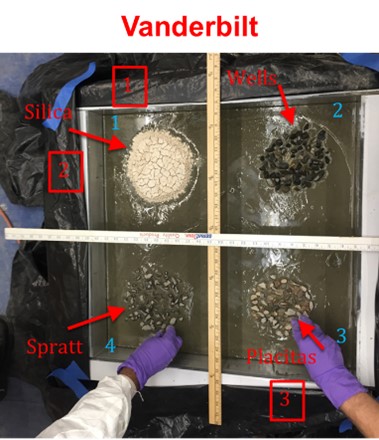
- Vanderbilt - 1 - 2’x2’x6”
- Alabama - 4 - 2’x1’x1’
Reinforced Concrete
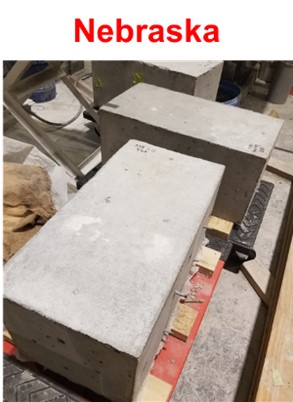
- Nebraska - 4 – 2’x1’x1’

Concrete Damage Diagnosis Techniques
- Vibro-acoustic modulation (VAM): Modulation of a higher excitation frequency by a lower excitation frequency caused by delamination or cracks in structural components, resulting in the appearance of sidebands in the linear spectral response. The sidebands are used to both detect and localize the damage.
- Harmonic Testing: Innovative damage-sensitive features for damage detection based on higher singular vectors. Deviation from sinusoid used to localize damage.
- Machine Learning: Training of machine learning models using finite element simulations. Both prediction and classification models are constructed, and used for damage localization with actual physical specimens.
Real-Time Cure Monitoring of Fiber-reinforced Polymer Composites using Infrared Thermography
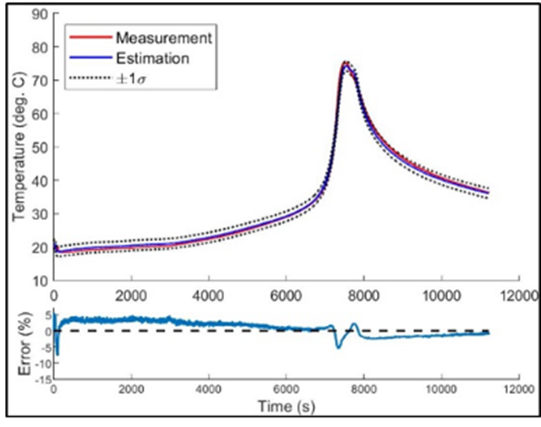
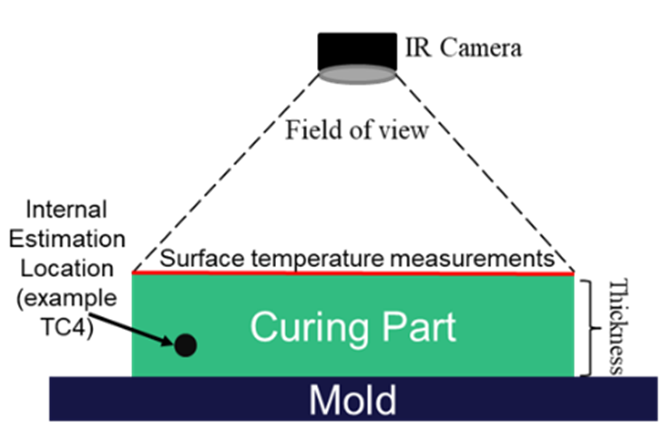 Higher cost and longer manufacturing lead times associated with FRP composites hinder their utilization in high-volume industries (wind, consumer automotive, and compressed gas storage). Real-time monitoring of the curing process can be crucial for adaptive decision-making to reduce cycle time, energy usage, and timely potential flaw identification and repair.
Bayesian information fusion for crack size diagnosis in thin plate structures
Ultrasonic guided waves are commonly used for monitoring fatigue-induced crack growth in thin metallic structures. We developed a methodology for fusing information from multiple actuator-sensor paths to compensate for environmental effects on a sensed signal, and to estimate crack size under varying environmental conditions.
- Guided waves actuated and sensed using piezoelectric transducers
- Changes in the sensed signal characteristics, as captured by the change in the damage index, and analyzed to estimate the crack size.
- Damage index defined based on short-time Fourier transform
- Computational modeling of the governing physics
- Sensitivity analysis, dimension reduction and surrogate modeling
- Bayesian technique to fuse information obtained from multiple actuator-sensor paths

Funding





Current People
- Sankaran Mahadevan, Professor
- Douglas Adams, Professor
- Pranav Karve, Assistant Research Professor
- Yanqing Bao, Postdoctoral Research Scholar
- Sarah Miele, Ph.D. Student
- Yulin Guo, Ph.D. Student
- Gbandi Nikabou, Ph.D. Student
- Christopher Nash
- Julia Finfrock, Undergraduate Researcher
- David Koester, Research Engineer
- Garrett Thorne, Staff Engineer
Publications
1. Bao, Y., & Mahadevan, S. (2015). Uncertainty quantification of thermal image-based concrete diagnosis. International Journal of Sustainable Materials and Structural Systems, 2(1-2), 77-95.
2. Bao, Y., & Mahadevan, S. (2019). Harmonic vibration testing for damage detection and localization in concrete. Structural Health Monitoring, 18(5-6), 1820-1835.
3. Karve, P., & Mahadevan, S. (2020). On the performance of vibro‐acoustic‐ modulation‐based diagnosis of breathing cracks in thick, elastic slabs. Structural Control and Health Monitoring, 27(3), e2470.
4. Karve, P., Miele, S., Neal, K., Mahadevan, S., Agarwal, V., Giannini, E. R., & Kyslinger, P. (2020). Vibro-acoustic modulation and data fusion for localizing alkali–silica reaction–induced damage in concrete. Structural Health Monitoring, 1475921720905509.
5. Karve, P. M., Guo, Y., Kapusuzoglu, B., Mahadevan, S., & Haile, M. A. (2020). Digital twin approach for damage-tolerant mission planning under uncertainty. Engineering Fracture Mechanics, 225, 106766.
6. Nash, C., Karve, P., Adams, D., Mahadevan, S., & Thorne, G. (2020). Real-time cure monitoring of fiber-reinforced polymer composites using infrared thermography and recursive Bayesian filtering. Composites Part B: Engineering, 198, 108241.