Recent News
Safety assessment is a critical element of air transportation system management. Our research in aviation safety is currently funded by a NASA ULI project. In support of safety assessment, our research investigates methods for:
- machine learning with accident and incident data,
- monitoring and prognosis of runway and landing safety,
- prediction of violation of inter-aircraft minimum distance separation requirements.
Our research is developing both data-driven and physics-based models for the above assessments.
-
Aviation incident risk prediction
Aviation safety reporting system (ASRS) is a record of historical aviation incidents and accidents, comprising text data, categorical data, and numerical data. Using these reports, a hybrid model (blending SVM and DNN techniques), with a novel probabilistic fusion rule, is developed to quantify the risk associated with abnormal events.

-
En-route safety assessment
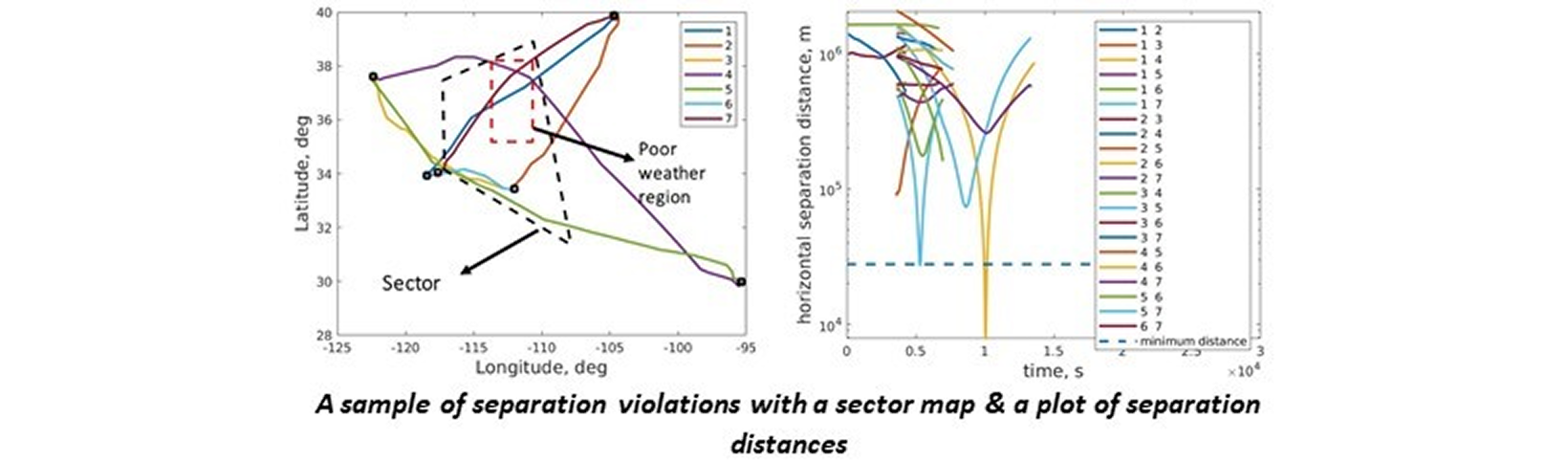
The deviation of aircraft from their planned trajectories is a consequence of adverse weather conditions, pilot-controller communications, component malfunction, or other causes. Such deviations could lead to separation violation, and trajectory prediction (TP) models can be formulated to predict these deviations. Both data-driven and physics-based models are being investigated for this purpose.
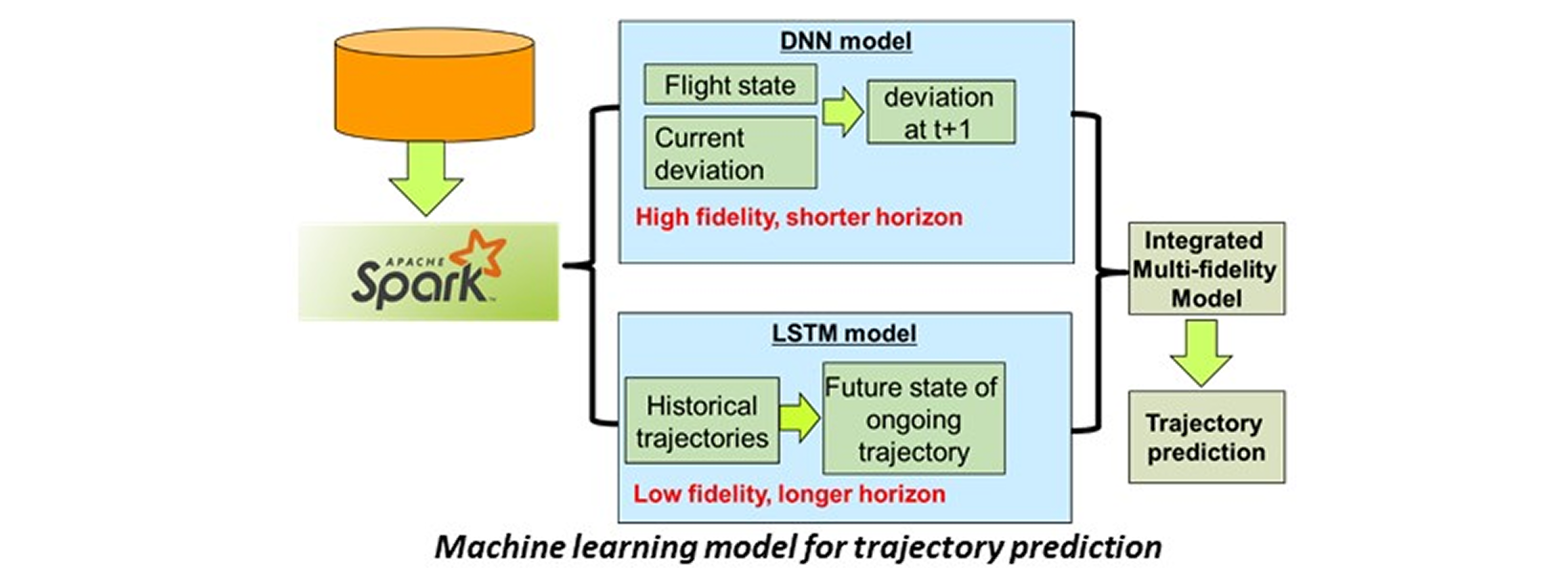
Machine learning model: A multi-fidelity trajectory prediction model is developed based on flight data from the FAA SWIM database, by combining DNN (one-step prediction) and LSTM (multi-step prediction) models.
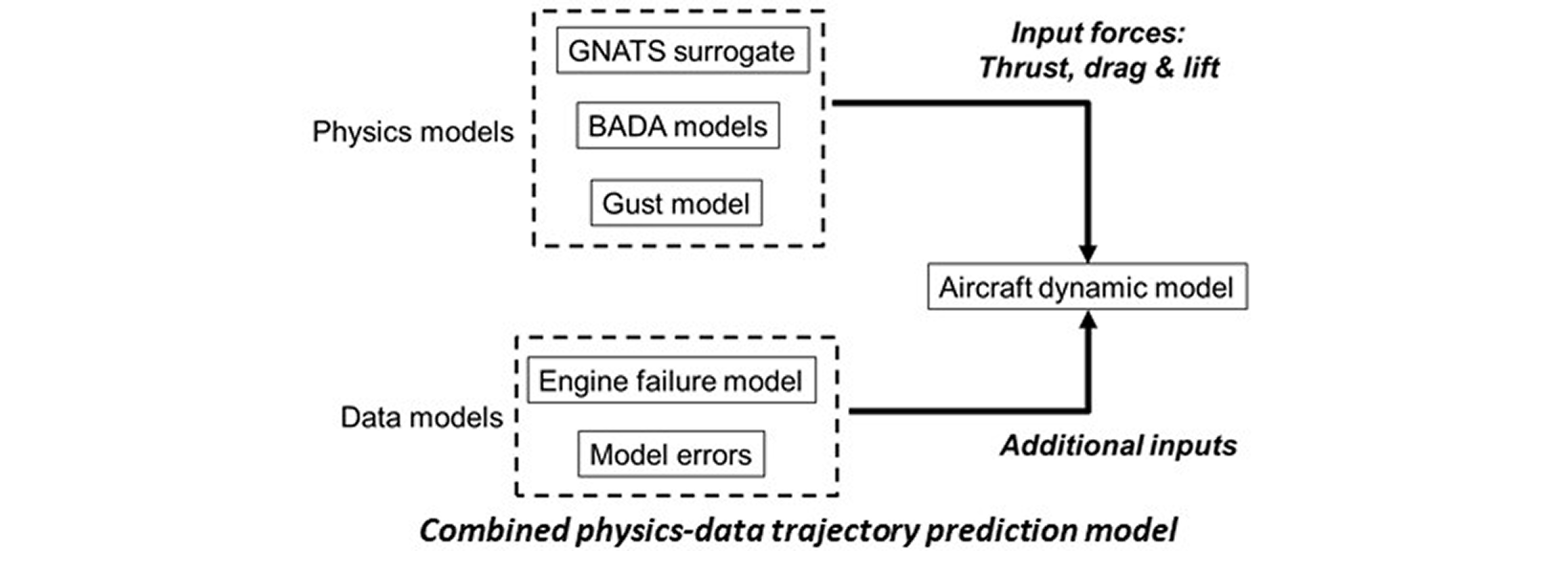
Physics-Based Model: An advanced hybrid trajectory prediction model is formed by combining existing physics-informed models (GNATS and BADA), with models for effects of gust and engine failure on aircraft trajectories. Model errors are estimated and corrected by updating this hybrid model with historical flight data using Bayesian state estimation.
-
Safety Assessment
An efficient importance sampling method is developed to assess low probabilities of en-route separation violations. This approach allows for safety assessment with multiple sources of uncertainty and multiple failure scenarios.
-
Data-driven model to predict violations in a sector over entire day
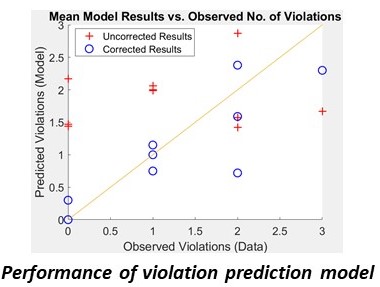 Using trajectory data from FlightAware, a library of deviations in latitude, longitude, and flight level is generated. Gaussian process regression (GPR) models are formulated to predict air speed and flight level at cruise, and the proportion of flight duration in cruise phase. By sampling from the library of deviations and the GPR models for flight parameters, the number of violations in a day is predicted. The data-driven model can be used to assist current daily scheduling, or to assist future planning regarding the introduction of additional new flights.
 -
Assessment of landing safety
Hard landing affects 1% of all flights and accounts for 35% of accidents. An LSTM model to predict hard landing is constructed using flight data from DASHlink. 186 parameters are monitored in the flight data; out of these 186, 12 important parameters (true air speed, pitch angle, engine fan speed, etc.) are identified as inputs to the LSTM model.
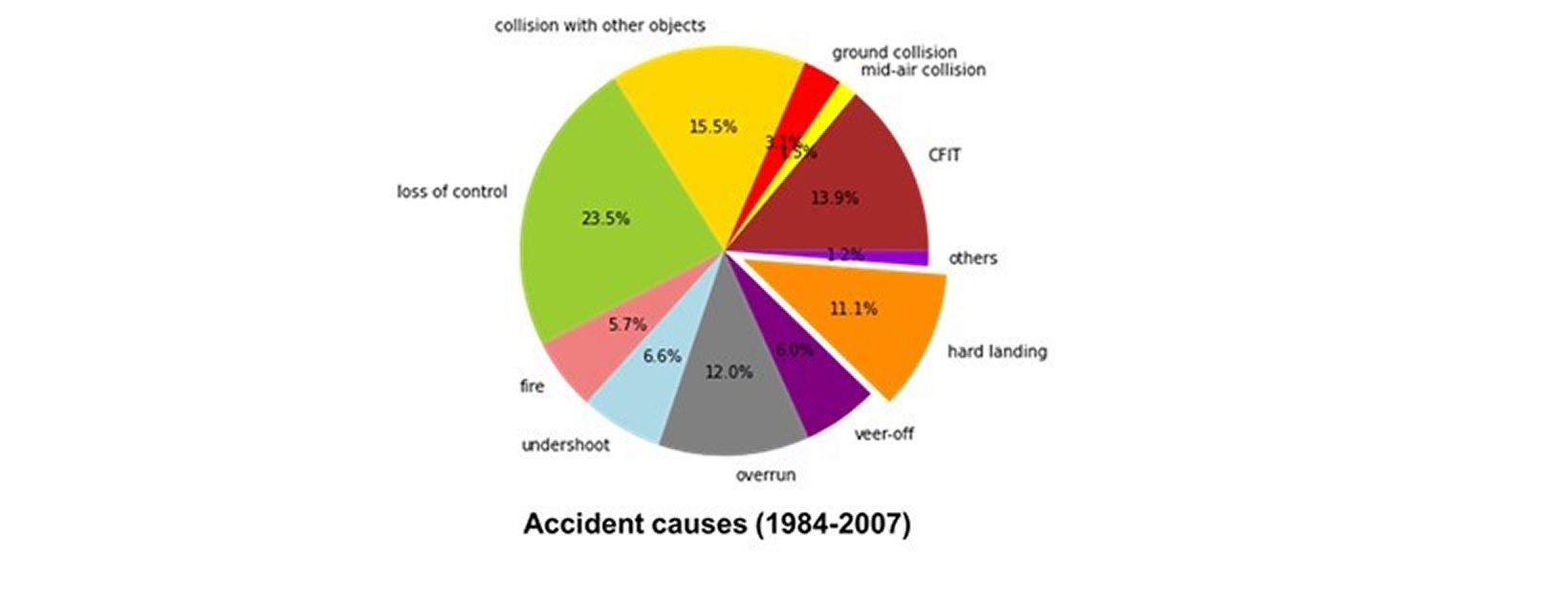
Source: Valdés, R. M. A., Comendador, F. G., Gordún, L. M., & Nieto, F. J. S. (2011). The development of probabilistic models to estimate accident risk (due to runway overrun and landing undershoot) applicable to the design and construction of runway safety areas. Safety science, 49(5), 633-650.
-
Landing Distance Prediction
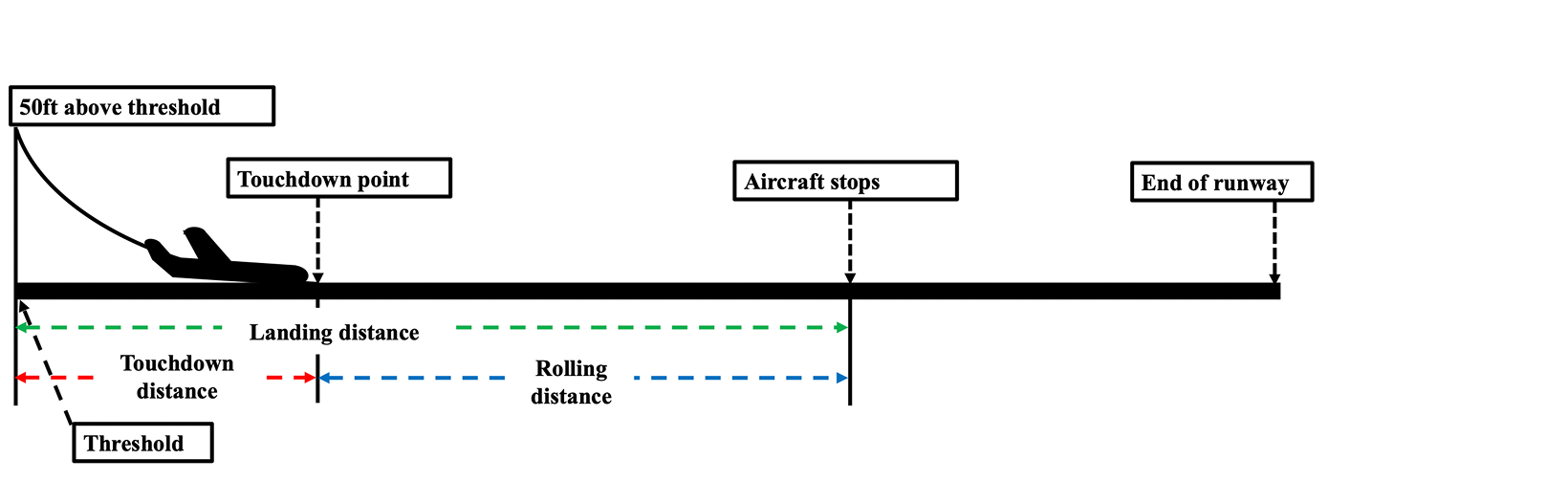
A long landing distance increases the risk of runway overrun, which has been observed in several landing accidents. In this study, we develop a landing distance prediction approach using DASHlink data. Time dependence in the time series flight data is captured by an LSTM neural network model. A multi-step recursive prediction strategy is developed to predict the landing distance, which captures the temporal variation of flight parameters better compared to a single step prediction. The methodology is accompanied by several pre-processing steps, such as up-sampling/down-sampling, data smoothing, removal of outliers, and standardization. Several different modeling options within the overall methodology are investigated to identify the best performing model. The proposed methodology is illustrated with landing data at the Detroit Metro Wayne County airport (KDTW), and the performances of several modeling options are compared with each other as well as with several other well-established modeling methods. Related publication
Funding

Current People
- Sankaran Mahadevan, Professor
- Pranav Karve, Assistant Research Professor
- Abhinav Subramanian, Postdoctoral Research Scholar
- Xiaoge Zhang, Postdoctoral Research Scholar
- Yingxiao Kong, Ph.D. Student
- Oliver Stover, Ph.D. Student
Publications
13. Kong, Y. and Mahadevan, S., "Aircraft Landing Distance Prediction: A Multistep Long Short-Term Memory Approach." Journal of Aerospace Information Systems, 2022.
12. Subramanian, A., & Mahadevan, S., "Importance sampling for probabilistic prognosis of sector-wide flight separation safety," Reliability Engineering & System Safety, Volume 222, 2022.
11. Subramanian, A., & Mahadevan, S., "Identifying transient and persistent errors in aircraft cruise trajectory prediction using Bayesian state estimation," Transportation Research Part C: Emerging Technologies, Volume 139, 2022.
10. Sisson, W., Karve, P., & Mahadevan, S., "Digital Twin Approach for Component Health-Informed Rotorcraft Flight Parameter Optimization," AIAA Journal, Vol. 60, No. 3, 2022.
9. Stover, O., & Mahadevan, S., "Data-Driven Modeling of Aircraft Midair Separation Violation," IEEE Transactions on Intelligent Transportation Systems, 2021.
8. Zhang, X., Srinivasan, P., & Mahadevan, S., "Sequential deep learning from NTSB reports for aviation safety prognosis," Safety science, Vol. 142, 2021.
7. Sisson, W., Mahadevan, S., & Smarslok, B. P., "Optimization of Information Gain in Multifidelity High-Speed Pressure Predictions," AIAA Journal, Vol.59, No. 8, 2021.
6. Zhang, X., & Mahadevan S., "Bayesian network modeling of accident investigation reports for aviation safety assessment," Reliability Engineering & System Safety, Vol.209, 2021.
5. Zhang, X. & Mahadevan, S., "Bayesian neural networks for flight trajectory prediction and safety assessment," Decision Support Systems, Vol. 131, 2020.
4. Zhang, X. & Mahadevan, S, "Ensemble machine learning models for aviation incident risk prediction," Decision Support Systems, Vol. 116, pp 48-63, 2019.
3. Srinivasan, P., Nagarajan, V., & Mahadevan, S. "Mining and classifying aviation accident reports," In AIAA Aviation 2019 Forum (p. 2938).
2. Zhang, X., & Mahadevan, S., "Aviation Safety Assessment Using Historical Flight Trajectory Data," In AIAA Aviation 2019 Forum (p. 3415).
1. Zhang, X., Kong, Y., Subramanian, A., & Mahadevan, S., "Data-driven Modeling for Aviation Safety Diagnosis and Prognosis," In Annual Conference of the PHM Society, 2018 (Vol. 10, No. 1).