On Friday, Nov. 7, Vanderbilt University’s Institute of National Security and the Naval Reserve Officers’ Training Corps (NROTC) Alumni Association partnered for the first time to host a full day of programming celebrating leadership, service, and pragmatic solutions to national security challenges—culminating in the 15th Annual National Security Symposium in Sarratt Cinema.
Leadership Breakfast with Scott Stalker
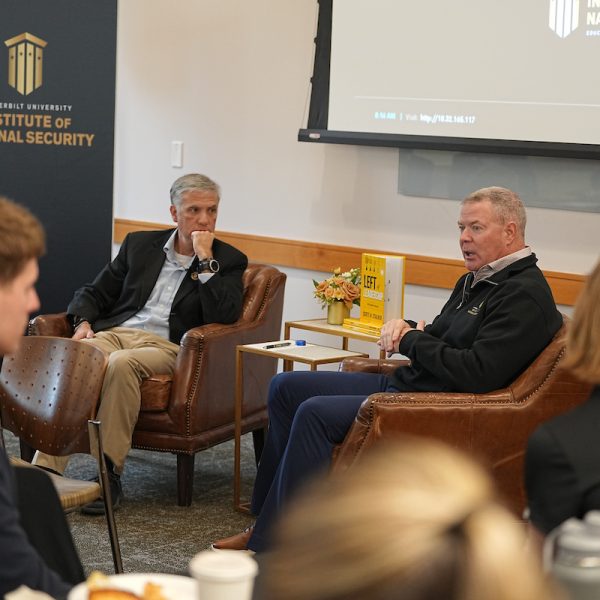
The day began with a student leadership breakfast featuring Scott H. Stalker, a decorated Marine with more than 30 years of service and former Command Senior Enlisted Leader for the Defense Intelligence Agency, National Security Agency, U.S. Cyber Command, and U.S. Space Command.
In a fireside chat with Gen. Paul M. Nakasone (Ret.), founding director of the Institute of National Security, Stalker reflected on lessons from his book Left of Leadership: The Prequel to Success. He emphasized the preparation, character, and daily consistency required to lead effectively—long before assuming command.
“If you don’t have a vision, what are you doing this for?” Stalker asked, highlighting the importance of vision and accountability in building leadership resilience. “You may not be number one at what you want to do today, but holding yourself accountable and being consistent in doing the work every single day will get you there.”
Students received complimentary signed copies of Left of Leadership following the discussion.
Commodore Classroom: Global Risks, Local Impact

Later that morning, Gen. Nakasone and Julian E. Barnes, national security reporter for The New York Times and member of the Institute’s inaugural class of National Security Fellows, led a Commodore Classroom session for Vanderbilt alumni as part of Reunion Weekend.
Titled Global Risks, Local Impact – The Imperative of National Security Today, the conversation explored the evolving media landscape, the role of artificial intelligence in journalism, and how experience informs critical judgment when using AI tools.
The discussion turned to recent research from the Institute’s Wicked Problems Lab, which uncovered GoLaxy, a Chinese company using AI to conduct large-scale influence operations—findings that Barnes helped bring to the New York Times op-ed and front page.
“Our researchers at the Institute of National Security found that China has perfected this with artificial intelligence,” Nakasone said. “They’re able to do it much quicker and in a far more convincing way.”
Barnes added, “The [Wicked Problems] Lab’s red-team approach—thinking counterintuitively about complex problems—has always fascinated me. Internally at The New York Times, I’ve said, we need a red team.”
National Security Symposium: Service and Strength
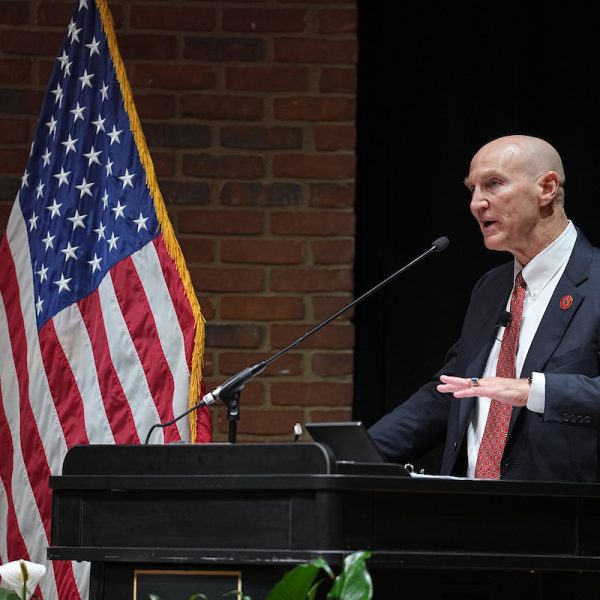
The day concluded with the 15th Annual National Security Symposium, co-presented by the Institute and NROTC. The event—first launched in 2009 under NROTC Alumni Association president Frank Walter—has become a hallmark of Vanderbilt’s commitment to cultivating national service and leadership.
Following a social hour for students and alumni, Chancellor Daniel Diermeier and Gen. Nakasone offered opening remarks before introducing Admiral James “Frank” Caldwell Jr. (Ret.), former Director of the Naval Nuclear Propulsion Program, as keynote speaker. Caldwell shared lessons from his four-decade career and encouraged students to embrace discomfort and growth.
“You grow professionally and personally when you do things that move you out of your comfort zone,” Caldwell said. “You learn by doing, not avoiding.”
Walter reflected on the importance of the new partnership:
“If the NROTC alumni group really wants to support the NROTC unit and its midshipman, we have to be viable, visible, and valuable,” he said. “Partnering with the Institute of National Security strengthens our mission to make Vanderbilt a leader in national security, service, and leadership.”
Caldwell closed by urging continued investment in naval capabilities and workforce innovation to meet the demands of great-power competition.
The collaboration between the Institute and NROTC marks a new chapter in national security education at Vanderbilt—one that will continue next year as both organizations build on their shared mission to educate, convene, and inspire the next generation of leaders.