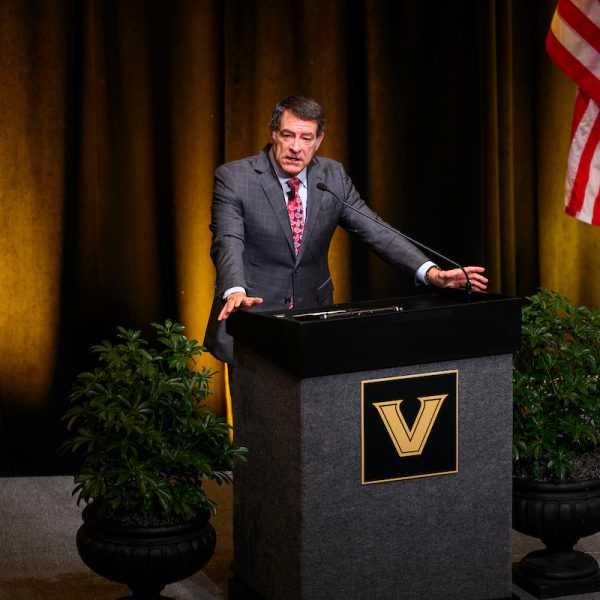
 Drawing on his military background and role as chairman of the House Committee on Homeland Security, U.S. Rep. Mark Green offered a frank assessment of artificial intelligence and its implications for the future of national security during the 2025 Vanderbilt Summit on Modern Conflict and Emerging Threats.
Green, who represents Tennessee’s 7th congressional district and is a former U.S. Army flight surgeon, opened the second day of the summit by outlining critical challenges facing the United States, including cybersecurity vulnerabilities, a shrinking technical workforce and increasing pressure to accelerate the translation of research into real-world impact.
He identified three focus areas for strengthening national resilience: developing the cybersecurity workforce, harmonizing government regulations to remove inefficiencies, and encouraging faster adoption of innovation.
“The cybersecurity workforce shortage of half a million people is our nation’s number one issue,” Green said, citing “legislation to create an ROTC-like program that would pay for kids and adults to go back to school, get a cybersecurity degree, and you pay back the obligation by working for the government” as a way to fix the issue.
Green was likely referring to the Cyber PIVOTT Act—short for Providing Individuals Various Opportunities for Technical Training to Build a Skills-Based Cyber Workforce Act.
He also called out fragmented and duplicative federal regulations as a key obstacle to both national defense and private sector progress.
“Right now, the federal government has all of these requirements for compliance that keep companies, universities, state and local governments from actually doing cybersecurity,” Green said. “The efforts are duplicated. They’re oftentimes contradictory. And many of them just simply don’t make sense.”
“We have got to get in there and harmonize all these requirements,” he added.
Green described the current environment as one of heightened risk, referencing Volt Typhoon—a cyberespionage group linked to the Chinese government that has targeted U.S. critical infrastructure since at least 2021—as a wake-up call for national security.
“They’re in our infrastructure. They’re in our telecommunications systems,” he said. “Imagine if the Russians took a satchel charge (an explosive) and placed it next to a cell phone tower and had a clacker (detonator) in their hand… With China still in our telecom systems, that’s exactly what we have.”
During a fireside chat moderated by Vanderbilt Vice Chancellor for Government and Community Relations Nathan Green, the congressman also emphasized the strategic role of academic institutions in addressing these threats.
“Having these kinds of dialogues, getting into the nuts and bolts of it all, is what we have to do,” he said.
He praised Vanderbilt’s partnerships with the military and challenged the university to continue staying ahead of the curve.
“You’re already at the tip of the spear with Fort Campbell,” he said. “What is the next problem the military is going to face, and can [Vanderbilt do] the research that gets the solution before they even ask for it?”
Green concluded by encouraging Vanderbilt students to take full advantage of the opportunities in front of them and to prepare for leadership in an increasingly complex world.
“Make yourself an expert at every single thing you can because someday, you just might be called on,” he said. “Build the foundation now in this place of incredible opportunity. Don’t squander it.”