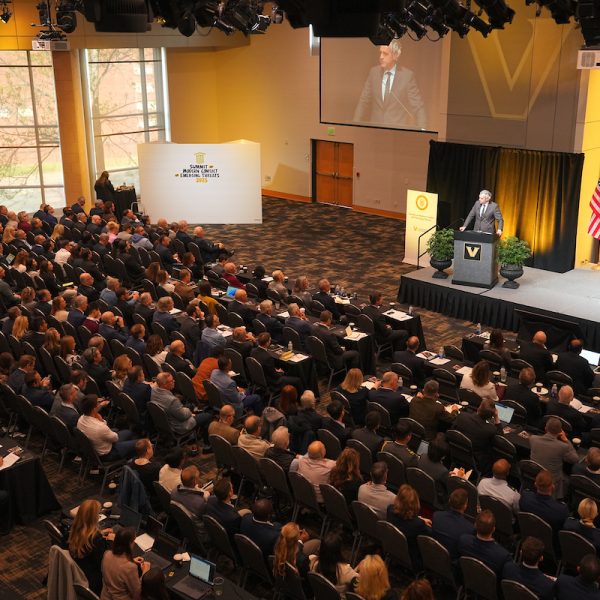
 Away from Washington but at the heart of critical conversations, Vanderbilt is fast becoming a national hub for security and strategy. A prime example: the 2025 Vanderbilt Summit on Modern Conflict and Emerging Threats, which brought together national and international leaders for two days of high-level dialogue.
“Places like Vanderbilt are not just places of learning and innovation. They are pillars of a free society,” Vanderbilt Chancellor Daniel Diermeier said in his welcome address. “At this moment, when security threats are evolving and when technology is changing everything, we need our universities to educate, to convene, and to lead. That is what this summit represents.”
That commitment took on a new form this year with the summit’s first installment connected with the newly launched Institute of National Security. “We’re not only bringing the world to Vanderbilt—we’re bringing Vanderbilt to the world,” said retired Gen. Paul Nakasone, founding director of the institute, who opened and closed this fourth annual summit with a clear message about the university’s growing presence in the national security space.
A summit grown up
Held April 10–11 at Vanderbilt’s Student Life Center, this year’s summit reached full capacity for the first time, drawing senior leaders from government, industry, academia and the military, along with international representatives from Japan, Singapore and Australia—plus early-career professionals and Vanderbilt students.
“Having been at the first one and now being at the fourth one,” Nakasone said, “[there is] a definite change in terms of the maturity of where the summit has gone.”
This year’s keynote speakers included OpenAI CEO Sam Altman, U.S. Sen. Marsha Blackburn, U.S. Rep. Mark Green, Tufts University professor and author Chris Miller, and Lakshmi Raman, director of the CIA’s Office of Artificial Intelligence. Panel discussions featured military officials, policy experts, industry leaders, researchers and technologists from the United States and allied nations.
Artificial intelligence at the center
With AI as the summit’s central theme, it was fitting that Altman, appearing by video, opened the event in a fireside chat with Nakasone. They discussed the importance of national security voices in shaping AI development, and Altman emphasized the need for U.S. leadership in the field.
“AI development, I think, very clearly involves supporting the U.S. and allies to uphold democratic ideals around the world and to be safe,” Altman said. “This is like an integral part of our mission. This is not some side quest.”
Throughout the summit, speakers returned to the question of how AI and advanced technology are reshaping national security—from military strategy to medical research.
Tufts professor Chris Miller, author of Chip War: The Fight for the World’s Most Critical Technology, delivered a keynote presentation focused on semiconductor supply chains, which he described as both essential to economic and technological strength and reliant on a fragile global network. “Understanding those supply chains is the key to both guaranteeing we’ve got ongoing access to the quantity that we require and also making sure that our adversaries can’t compromise the supply that we need,” Miller said.
Panels throughout the two-day event explored AI’s expanding role, and deeper questions were about how it should be used, who should shape it and what it means for the future of global security.
Two days of critical conversations
The panels and keynotes tackled emerging threats across multiple domains, including cyberattacks, disinformation, global competition in advanced technologies and the future of defense systems. Discussions ranged from technical capabilities to policy implications and from present-day challenges to what lies ahead. Throughout, speakers emphasized the need for collaboration across sectors and borders.
A panel on cybersecurity and AI explored how offensive and defensive strategies are being reshaped by automation and large-scale machine learning, raising questions about capability, governance, deterrence and accountability in systems that may operate with limited human intervention. A session focused on AI in medicine highlighted its potential to transform diagnostics and personalized care while also raising concerns around data security and ethical use. In both conversations, panelists stressed that human judgment, oversight and responsibility must remain at the center of any AI system.
Another recurring theme throughout the summit was the importance of strong alliances in meeting common threats. Speakers emphasized that nations can’t navigate the complexities of AI, cyber threats and global instability alone.
“Alliances matter. We cannot forget our friends. NATO and all the others—the traditional alliances—are critical to the security of this country,” Green said during his keynote comments.
With that in mind, the summit featured an Indo-Pacific partnerships panel, with military leaders from Japan, Singapore and Australia joining Nakasone to discuss how allies can stay aligned in the face of accelerating AI development. That discussion underscored a central theme: that AI is not just a tool, but a major factor in how countries work together—or against each other.
Throughout the summit, speakers repeatedly pointed to China as a central competitor in the race to develop and deploy advanced technologies. Panelists and keynote speakers alike framed the U.S.-China dynamic as a defining factor in global security, with concerns ranging from intellectual property theft to AI-enabled surveillance and military modernization.
“We have to look at these technologies and realize that China would like to dominate this market,” Blackburn said during her keynote. “That means that legislators have got to focus. It means that our private sector needs to be pushing forward with innovation so that we do not fall behind.”
The message was clear: maintaining a technological edge will require sustained investment, flexible guidance, close coordination with allies, and a clear understanding of how competitors are advancing in key technologies.
In the closing crystal ball session, experts were asked to forecast the national security landscape for the next five to 10 years. They identified emerging threats such as deepfakes, cyberattacks and the manipulation of biological systems through synthetic biology, which could be used to create new viruses or biological weapons. There was optimism, as well, particularly around the potential of predictive analytics and human-AI collaboration to enhance decision making and responsiveness.
Looking ahead
The summit closed with reflections from Nakasone and Brett Goldstein, special advisor to the chancellor on national security and strategic initiatives and research professor, who helped launch the event in 2022. They thanked speakers, staff, campus partners and attendees for shaping what the summit has become—and what it has the potential to be.
Nakasone confirmed the dates for the 2026 summit: April 22–23.
“This is how we bring Vanderbilt to the world,” he said. “And how we shape what comes next.”
Vanderbilt’s strategy: Preparing the next generation of security leaders
This year’s event was the first since the formation of Vanderbilt’s Institute of National Security, which Chancellor Daniel Diermeier announced at the 2023 summit. The institute leads the university’s strategic efforts in this area and is built around four core functions: educate, innovate, convene and advise.
The institute announced several new initiatives, including the Wicked Problems Lab, which brings together experts to tackle such real-world security issues as ransomware and critical infrastructure protection. Vanderbilt also recently approved a new undergraduate minor in national security, with a major, master’s and executive education programs being developed.
In October 2025, Vanderbilt will host a new event in Washington, D.C., titled “Convening in the Capital,” designed to bring together policymakers for deeper engagement on national security topics.
Nakasone announced the inaugural cohort of National Security Fellows, five professionals with deep expertise in areas including cybersecurity, journalism and law enforcement. The fellows will mentor students and support programming across the institute.
He also shared the launch of the 25 for 2025 initiative, which will place 25 undergraduate students each summer in national security internships.
“The Institute of National Security is an academic proving ground for the next generation of national security leaders,” Nakasone said. “We must develop the next generation of national security professionals with the unique knowledge, skills and abilities to succeed and change the world.”