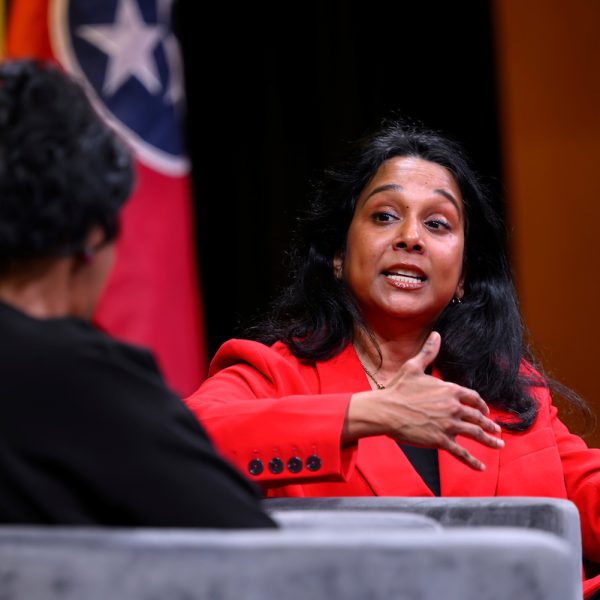
 Artificial intelligence is no longer just a tool—it’s a strategic imperative, according to Lakshmi Raman, director of the CIA’s Office of Artificial Intelligence. During her keynote address and fireside chat at Vanderbilt’s fourth annual Summit on Modern Conflict and Emerging Threats, Raman described how the CIA is adapting to a rapidly evolving technological landscape.
“I see AI not just as an emerging technology, but as a strategic necessity,” Raman said. “Our adversaries recognize this and are moving quickly to exploit these technologies in ways that challenge our national and economic security like never before.”
Raman emphasized that AI is a top concern at the CIA that affects every mission area and increasingly shapes how intelligence work is conducted.
“I can tell you that AI is something that people across the CIA think about on a daily basis,” she said. “Working as a part of a team that serves at the forefront of a fast-changing global landscape with the common goal of trying to keep our country safe is what makes me want to come to work each and every morning.”
Raman, who started at the CIA in 2002, began her career as a software developer and has since led major efforts in data science, analytics and intelligence integration across the intelligence community.
Much of Raman’s presentation focused on how the CIA is integrating AI internally. She outlined a three-pillar strategy: AI as an intelligence topic, AI as a mission enabler, and AI as a capability requiring strong governance.
To support AI adoption, Raman’s office created a centralized platform for deploying AI models and a searchable repository of tools and datasets. Her team also helped establish the agency’s internal AI Learning Center and launched partnerships with universities to expand education and training.
“Our focus going forward will be to continue these initiatives because … the field is moving so quickly,” Raman said. “It’s hard to keep up week to week.”
She described her approach to AI governance: “We understand when it’s important to have a human in the loop to ensure that our AI aligns with our mission, our laws and our intelligence community standards.”
During Raman’s chat with Vanderbilt Vice Provost for Research and Innovation and Chief Research Officer Padma Raghavan, she touched on the importance of partnerships with academia and industry. “We’re not a research organization, so working with academia and labs to do some levels of applied research is really important,” she said. “I would say we really need both.”
Raman identified China as the United States’ primary competitor in AI—a view echoed by many speakers throughout the summit—and pointed to the 2025 Stanford AI Index as evidence of China’s rapid progress. “Chinese models have closed the quality gap,” she said. “China currently leads in the number of AI publications and patents, and there’s no doubt China is moving rapidly forward in this area.”
She discussed the threats that keep her up at night—cyberattacks, surveillance, disinformation and AI-assisted drug production among them. Still, she encouraged agencies like hers to advance the use of technology. “It behooves us to move forward as aggressively and assertively as possible, but also with care,” she said.
Raman concluded with a look at the future of generative AI, its potential role in hypothesis generation and large-scale analysis, and the uncertainties that still lie ahead, including the arrival of artificial general intelligence.
“I think it is still unclear when it’s going to hit, what the consequences will be—not only for the public at large, but also for national security,” she said. “It’s an exciting time to be a part of this space. Everything is moving so quickly. Every day we see something new.”