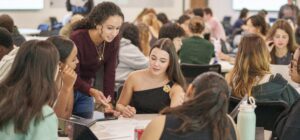
The Learning Assistant (LA)/Course Assistant (CA) Program prepares and supports undergraduate students to serve as peer educators who help facilitate meaningful student interactions in Vanderbilt science and math classes.
What is an LA?
Learning assistants, or LAs, are undergraduates who serve as peer educators in courses that they have previously taken. They facilitate small-group discussions, listen to students’ ideas, and prompt students to think deeper about challenging content. They often help in implementing active learning components of a course, helping students think through exercises in which they answer work in groups to answer conceptual questions, work on problems, discuss different scientific models/perspectives, or summarize/organize complex material. Thus, LAs’ role within the course is to promote student discussion and understanding in class; they do not grade or fill other administrative roles. The University of Colorado at Boulder was the first institution to develop an LA program and serves as an anchor in the Learning Assistant Alliance.
What is a CA?
The counterparts to LAs in math courses at Vanderbilt are Course Assistants (CAs). CAs work in pairs to facilitate discussion sections for math courses. Some CAs also support the Calculus Cafe, which provides drop-in help for students. Like LAs, CAs are undergraduates who serve as peer educators in courses they have previously taken (or in some cases have credit for in other ways). They facilitate small-group discussions, listen to students’ ideas, and prompt students to think more deeply about challenging content. In discussion sections where students are working on problems collaboratively, they help students think through the problems using a variety of discussion and active learning approaches. Also, like LAs, CAs do not grade or fill other administrative roles.
How are LAs and CAs prepared and supported?
LAs and CAs enroll in a 2-credit Learning Assistant Pedagogy course (cross-listed as SCED 2330 and BSCI 1400). In this course, LAs learn about both theories of learning and the practice of teaching, preparing them to interact with students and support productive discussions.
In addition, LAs participate in 1 to 1.5-hour weekly prep sessions led by the instructor(s) of the course in which they’re serving. In these sessions, the group reviews the week ahead, discussing challenging concepts, developing and engaging in upcoming lecture activities, and reflecting on student learning.
LAs also receive a stipend of $1500 per semester.
Impacts of the LA/CA Program
The LA Program helps strengthen teaching and learning across Vanderbilt by boosting student engagement, supporting deeper understanding, and encouraging more equitable participation in the classroom. Learning Assistants give instructors the hands-on support they need to bring active-learning practices into their courses, especially in larger introductory classes.
The program:
- Helps improve student learning through active engagement and peer support.
- Fosters a sense of community by making classes more interactive and welcoming.
- Offers undergraduates meaningful teaching experience that prepares them to be scientists, leaders, and educators.
- Provides faculty with reliable, in-class support as they implement evidence-based instructional practices.
- Improves access to campus resources particularly in large gateway courses.
Courses that the LA/CA Program Supports (as of AY 26-27)
- BSCI 1509: Biological Systems
- BSCI 1510: Molecules and Cells
- BSCI 1511: Organisms and Ecosystems
- BSCI 2210: Principles of Genetics
- BSCI 2520: Biochemistry
- CHEM 1601: General Chemistry I
- CHEM 1602: General Chemistry II
- CHEM 2212: Organic Chemistry II for Advanced Placement Students
- CHEM 2221: Organic Chemistry I
- CHEM 2222: Organic Chemistry II
- EES 1510/1515: The Dynamic Earth: Geological Sciences
- NSC 1400: Neuroscience
- NSC 2269: Developmental Neuroscience
- PSY 2100: Quantitative Methods
- PSY 2150: Principles of Experimental Design
- PSY 2220: Cognitive Psychology
- PHYS 1501: Introductory Physics for the Life Sciences I
- PHYS 1502: Introductory Physics for the Life Sciences II
- PHYS 1601: General Physics I
- PHYS 1602: General Physics II
- MATH 1200: Single-Variable Calculus I (CA Program)
- MATH 1201: Single-Variable Calculus II (CA Program)