Low-Resource Diagnostics
Delivery of diagnostic tools to low resource settings faces numerous challenges in areas where it is difficult to reach populations that are distributed sparsely over rural areas. Health workers dispatched from centralized facilities face difficult terrain, intermittent/lack of electricity, poorly equipped facilities, unskilled workforce, and limited financial resources. The consequences of these limitations are that diagnostic medical technologies common in industrialized regions are either not usable or affordable. With funding from the Bill and Melinda Gates Foundations, we are exploring interesting methods for the creation of low-resource diagnostic tools. This area of research in the lab is broken down into several projects:
1) Low-resource extraction and processing of biological samples
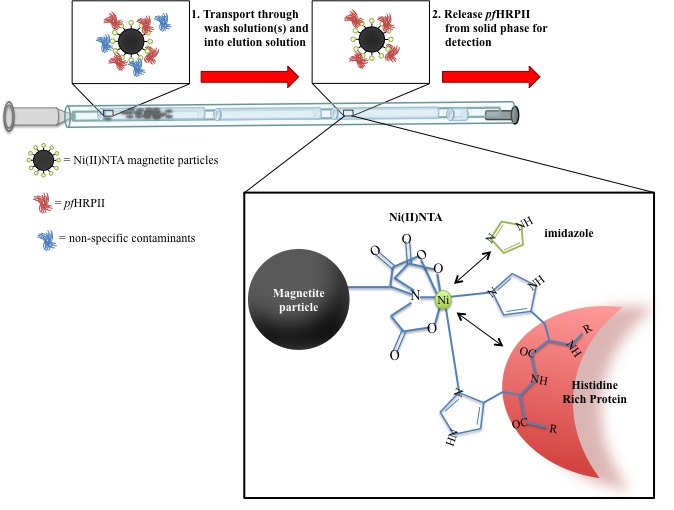
This Bill & Melinda Gates Foundation funded project (in collaboration with Dr. Rick Haselton of Vanderbilt's Department of Biomedical Engineering) is a sample collection, concentration and preparation component for integration with downstream detection components to form a general diagnostic platform suitable for low resource environments. This self-contained processing device captures targets of interest from complex biological matrices on the surface of a carrier bead. The biomarker-bound magnetic beads are then entrained by an external magnetic field and transported through each of the three wash solutions. Processing removes sample interferents, and the biomarker target is concentrated in the final chamber for subsequent analysis. The device has advantages over existing extraction technologies, mainly it that it can be implemented to: (1) require little or no power, (2) be suitable for an unskilled user, (3) have rapid time-to-extraction, (4) be low cost, and (5) be adaptable to multiple downstream detection designs. The modularity of this device toward targeting various biomarker targets is evidenced by the creation of several devices for the extraction of: (1) proteins (malaria), (2) nucleic acids (RSV, TB), (3) whole cells (HIV) and (4) small molecules (clincal chemistry) from a host of biological matrices (blood, plasma, saliva, urine, cells)
Graduate Students/Post-Docs on this project:
Dr. Joseph Conrad (HIV)
Nick Adams (RSV)
Keersten Davis (Malaria protein-blood)
Anna Bitting (Malaria DNA-saliva)
Wes Bauer (HIV)
Lauren Gibson (Clinical Chemistry)
2) Coffee Ring Diagnostics for Malaria
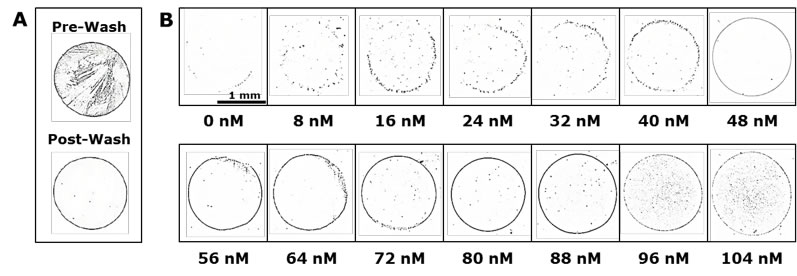
We have developed an antibody-free, malarial assay based on the phenomenon that forms coffee ring stains on a kitchen counter. The unique microfluidics present in an evaporating drop of colloidal solution produce a characteristic “coffee ring” stain of small particles visible with the naked eye. In the presence of a droplet of sample containing the histidine-rich protein-II (HRP-II) of P. falciparum, a readily visible colorimetric ring is produced indicating malarial infection upon aggregation with Ni(II)NTA-functionalized gold nanoparticles. In addition to studying the formation of the coffee ring itself, we are also exploring how the surface chemistry of the glass slide affects the formation of the ring structure. By conjugating a glass slide with varying concentrations of Ni(II)NTA and backfill ligands, we can fine-tune the contact angle of the droplet, and thus attenuate the formaiton of the ring. This robust approach addresses many of the problems currently associated with low-resource malarial diagnostics.
Graduate Students/Post-Docs on this project:
Chris Gulka
Keersten Davis
3) RDT Enhancement
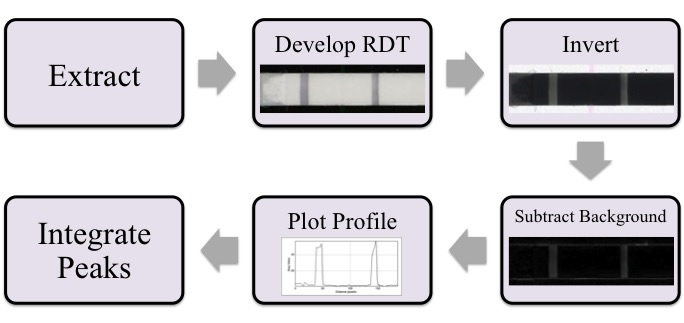
The advent of point of care (POC) diagnostic tools has changed the face of malaria eradication programs in low-resource areas that are often plagued by poverty, absent or intermittent electricity, hot and humid environmental conditions as well as a lack of skilled clinicians. Rapid diagnostic tests (RDTs) were developed to circumvent these challenges. Despite the many advantages of RDTs, diagnosing asymptomatic carriers presents a major hurdle for complete malaria eradication. This along with poor manufacturing standards and storage conditions render many brands inoperable and unreliable. We have recently reported the creation of a low-resource extraction cassette that can extract, purify and concentrate the most common sub-Saharan malarial biomarker, Plasmodium falciparum Histidine Rich Protein II (pfHRPII), from a blood sample, in less than 30 minutes. When the extraction cassette was coupled to commercially available RDTs, a marked increase in performance of the tests was observed. Regardless of the WHO detection score, we found all brands to be improved within asymptomatic levels of infection--a regime of diagnosis that RDTs have traditionally been unable to detect. The ability to transform RDTs from a confirmative test to a quantitative one would be invaluable for malaria eradication campaigns.
Graduate Students/Post-Docs on this project:
Keersten Davis
Lauren Gibson