Physics Demo Number: 133
Approximate
Run Time: 5 min
Faraday EMF Shown by Magnet Thrust Through Coils
Demo Description
Two coils and a galvanometer are mounted for use on an overhead projector.
Thrusting a bar magnet in and out of the coils yields observable currents on the galvanometer.
Scientific Principles
-
Changing magnetic flux generates emfs.
Equipment
-
Overhead projector module housing two coils and a galvanometer.
-
Bar Magnet
-
Matches for removing static charges on the meter housing surface
Equipment Location
-
Kit (133) on [B-2-6]
-
Magnets on [B-3-5].
Instructions
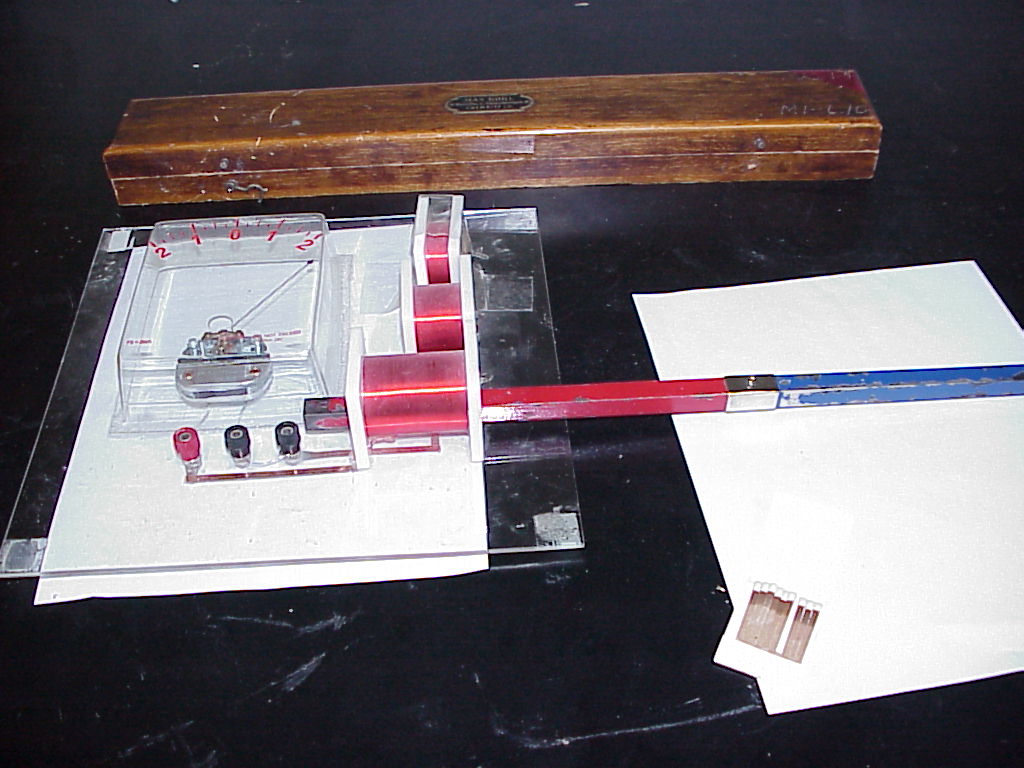
The
photo shows the original Overhead Projector device housing three
coils and a galvanometer. This device was in drastic need of help
due to less than rugged design parameters.
The Science Shop worked with us to morph the three coil device into a vastly improved two coil device, shown in the next photo:
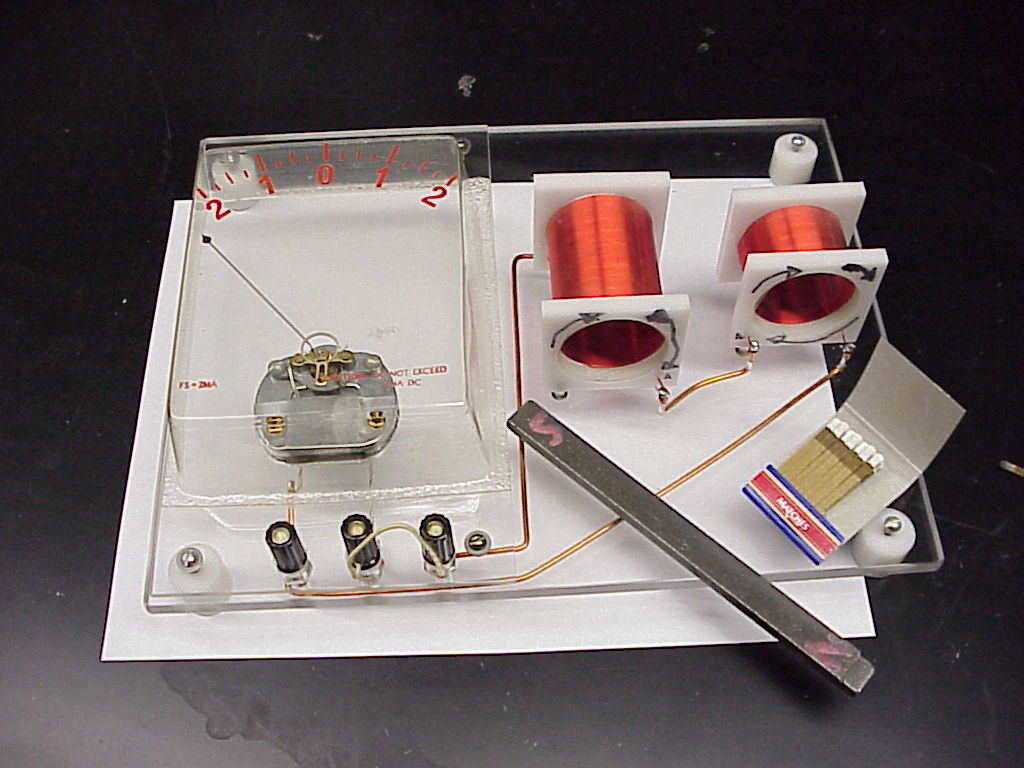
One may thrust one end of a bar magnet through the center of each coil at varying speeds and extract the magnet at varying speeds.
The magnet pictured in the first photo is one of a set of two housed in the wooden box at top of picture. The magnet pictured in the second photo is housed with Kit (133).
The box of magnets is on [B-3-5].
The book of matches pictured serves as a reminder that the Galvanometer Needle can become stuck (as it is in both photos) by accidental electrostatic charging of the meter's plastic housing.
The needle will then need restoring to “undeflected-zero” and a freely-responding-to-only “moving charges in its wires” or more simply “currents” type of operation. (Of course the stuck needle in both photos was deliberately induced.)
The housing for the needle was judged sufficiently important for protecting its functioning to keep the design and live with the static charging side effect,
The unwanted side effect is remedied by simply hovering a burning match over the plastic surface of the meter housing to generate ions in the air that discharge the net static charge on the surface and fix the meter's functioning.
Writeup created by David A. Burba
Copyright © 2011, Vanderbilt University. All Rights Reserved.