Physics Demo Number: 102 |
Approximate Run Time: 10 min |
||||
Archimedes, Flotation, Water Levels and Boats |
|||||
Demo DescriptionVarious observations of water levels can be correlated with changing states of floating or submerged objects.
|
|
Scientific PrinciplesDisplaced water exerts buoyant forces on the displacer.
|
|||
Equipment
|
|
Equipment Location
|
|||
|
Instructions
|
|||||
|
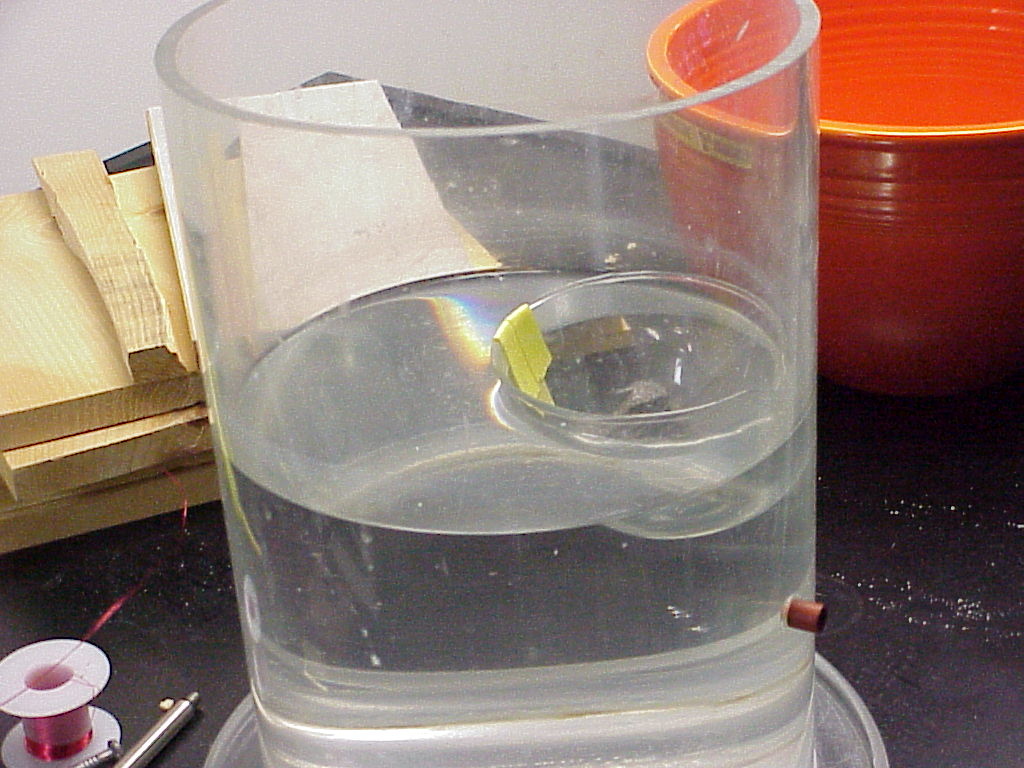
The mark may be made visible to the class with a video camera or by turning the document camera head through 90 degrees and letting it focus on the mark. Upon lifting the lodestone out of its boat and letting it drop to the bottom of tank, with the boat still floating in the tank, the camera documents a clear lowering of the water level for the class. One could bring an assortment of ice cubes from home , mark the water level with the cubes added to the tank, and verify that there is no change in the water level when the cubes melt.
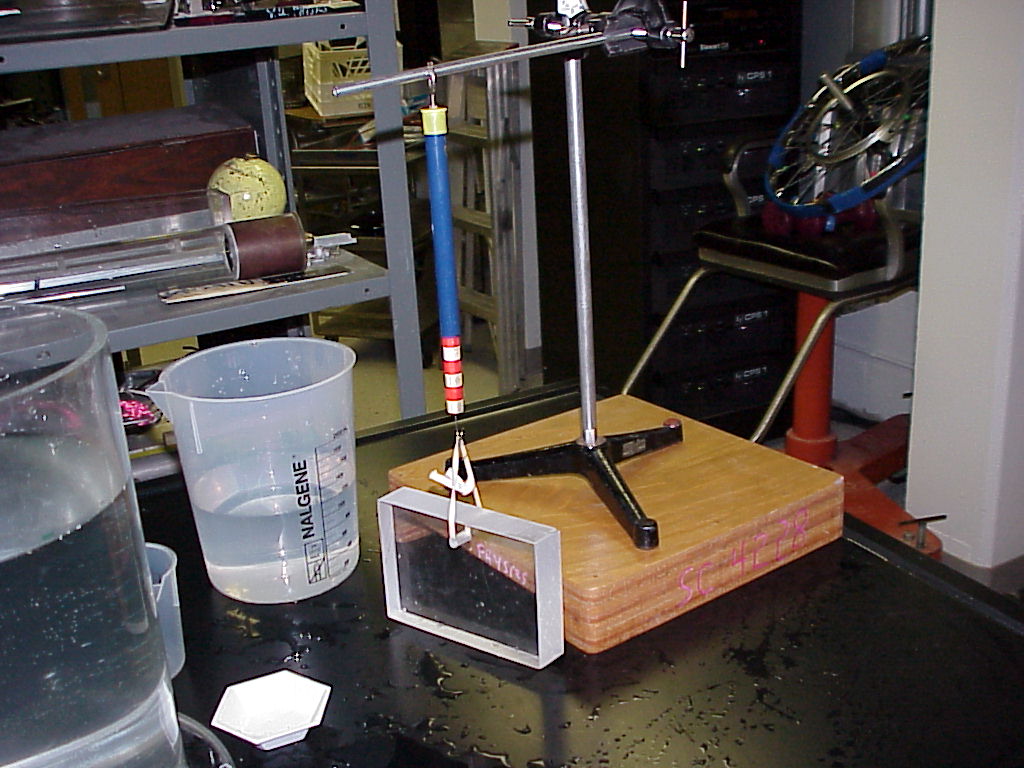
Hanging the block in the water tank (keep balance dry please!) one finds it to weigh only about 1N while submerged. Balance and Archimedes block should be in Kit (102) on [F-2-5]. The “lodestone/ petri dish boat” resides in Kit (060) in [B-2-5] . The Water Vessel is in Kit (053) on [C-1-5]. Ice cubes need to be brought from home by the lecturer. _______________________________________________________________________________________________ Part BSurface of Water in a Rotating TankOne may take a thin open- topped plastic box as seen in the following photo and place enough water inside it to fill it about half way to the top. Subsequent rotation of the box about a vertical axis through its' center will cause the waters' top surface to assume a parabolic shape with the steepness of the parabola increasing with the angular velocity of the plastic tank.One may use the battery shown (12V rechargeable) to gently spin up the tank by the motor coupled to the tank shaft pulley with a rubber band belt. The tank and frame live in [C-4-4]. 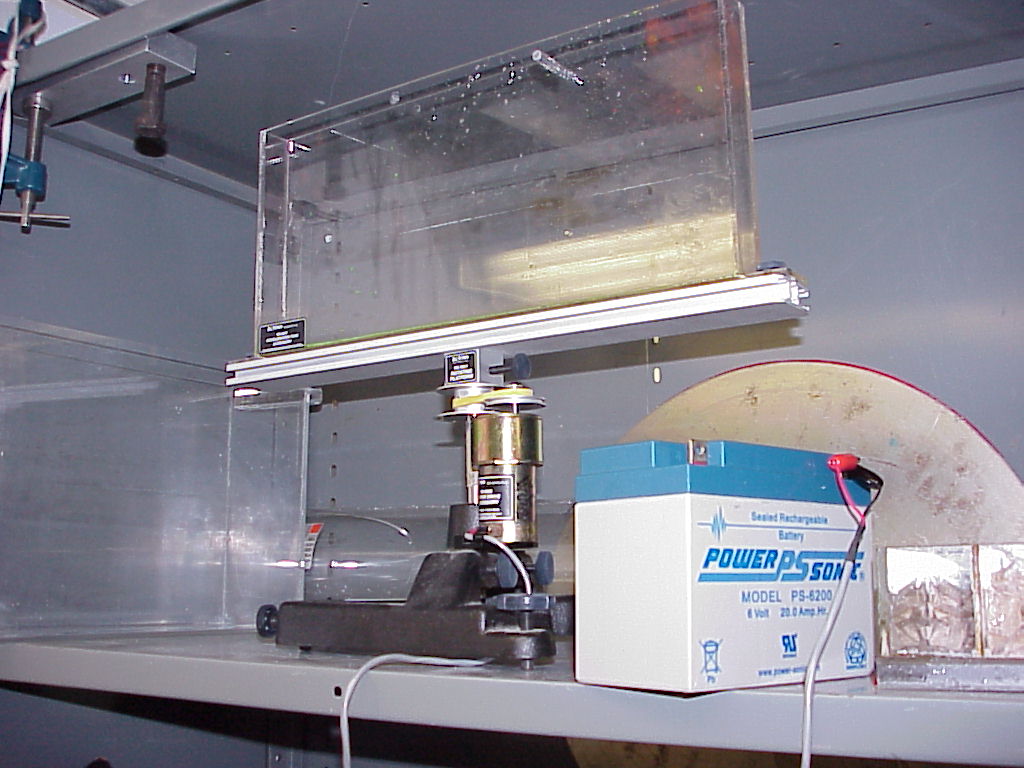
Writeup created by David A. BurbaCopyright © 2013, Vanderbilt University. All Rights Reserved. |
|||||