Physics Demo Number: 029 |
Approximate Run Time: 10 min |
|
Parallel Plate Capacitor, Charge, Mechanical Work, and Potential Difference |
||
Demo DescriptionUse a charged plastic rod to charge an overhead projector electroscope and a parallel plate capacitor. Alternatively one may substitute the electrometer from demo(165) and perhaps go to a D cell battery for charging as mentioned below. |
||
Scientific Principles
|
|
|
Equipment
|
||
|
Equipment Location
|
||
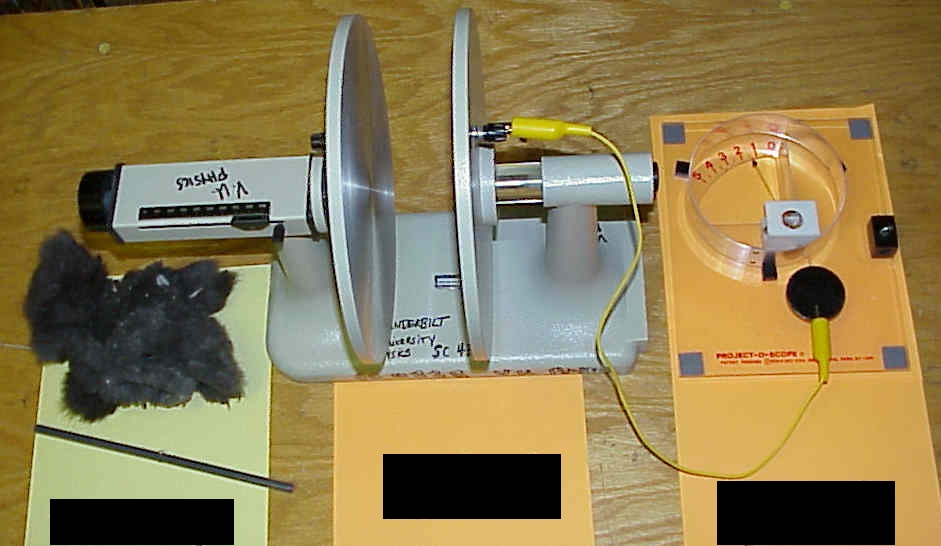
InstructionsNote that the right hand plate of the capacitor in the photo is attached to the frame by an acrylic cylinder , thus insulating it from from the frame. By charging the rubber rod with the fur shown in the left in the photo, one may use the rod to charge the electroscope and yellow-wire -connected insulated plate of the parallel- plate capacitor. Then if one slides the non-insulated plate of the capacitor closer to the charged plate the meter reading will go down. Subsequent sliding of the plates apart will cause the reading to go back up. One may make appropriate comments about work done by the observer (during separation) against the attractive electrical forces between the capacitor plates or work done on the observer (during sliding together) and the basic notion of voltage or potential difference as work per unit charge expended in moving charges from one point to another. In particular note that by doing work rubbing the rubber rod with the fur, charge is separated and the rod is left with a net negative charge. Thus one has effectively moved charge from a great distance away and established an excess of electrons on the rod. This state of affairs for the rod is described by saying that the rod is at a potential V (perhaps as big as several thousand volts). When one now drags the rod across the round black horizontal plate of the electroscope, most of the excess electrons on the rod are transfered to the electroscope system. The excess electrons arrange themselves so as to get as far away from each other as possible, thus arriving at a net charge on the needle, a net charge on the electroscope's right hand vertical plate next to the needle , a net charge on the black horizontal plate, and a net charge on the insulated plate of the capacitor. Since the needle is free to move away from the electroscope's right hand vertical plate (subject to a spring restoring force on the needle ), the needle takes up an equilibrium position at some number on the scale below it. Obviously if more rubbing of the rod and fur and more dragging of the rod across the horizontal black plate is carried out, all the charges on each of the four components of the electroscope system is increased. Hence the needle moves to a bigger number on the scale. Thus we have the basics of a working meter for measuring voltage. The fact that the readings change on varying plate separation , even though no new charge is brought up from a distance is evidence that energy is required to redistribute the charges locally. Thus one may use this simple equipment to help solidify some of the concepts involved with potentials and potential differences. The use of the Electrometer allows one to go to the lower voltages of 5 to 10 volts instead of the higher hundreds to thousands of volts, which makes for more manageable displays of desired effects. Also one may actually wet the dielectric down to prevent extraneous electrostatic effects when showing the effect of dielectrics in the capacitor as in demo(139). In other words humidity is your enemy in high voltage demos, but your friend in low volt demos. |
||
Writeup created by David A. BurbaCopyright © 2013, Vanderbilt University. All Rights Reserved. |
||