 |
 |
 |
 |
 |

 In
the Rosenthal group we study semiconducting nanocrystals, a novel material
whose optical properties and electronic structure can be precisely tuned
by controlling the size of the nanocrystal. We are specifically interested
in two applications exploiting the properties of nanocrystals: the use
of nanocrystals as the light harvesting element in photovolatic devices
and the use of fluorescent nanocrystals as biological probes for membrane
proteins involved in neuronal signaling.
In
the Rosenthal group we study semiconducting nanocrystals, a novel material
whose optical properties and electronic structure can be precisely tuned
by controlling the size of the nanocrystal. We are specifically interested
in two applications exploiting the properties of nanocrystals: the use
of nanocrystals as the light harvesting element in photovolatic devices
and the use of fluorescent nanocrystals as biological probes for membrane
proteins involved in neuronal signaling.
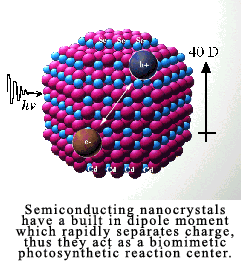 Nanocrystals
are an ideal light harvester in photovoltaic devices. The band gap can
be exquisitely tuned by controlling the size of the nanocrystal, thus
the proper choice of size and type of nanocrystal allows one to create
a photovoltaic whose absorption spectrum matches the spectral distribution
of sunlight. The nanocrystals absorb sunlight more strongly than dye molecules
or the bulk semiconductor material, therefore high optical densities can
be achieved while maintaining the requirement of thin films. Perfectly
crystalline CdSe nanocrystals are also an artificial reaction center,
separating the electron hole pair on a femtosecond timescale. Nanocrystals
have an intrinsic dipole moment originating from the top and bottom terminating
planes of Se and Cd. Carriers are rapidly localized to the surface of
the crystal where they remain for 290ns before recombining. The size-tunable
band gap, large absorption coefficients, intrinsic electron hole pair
separation, long exciton lifetime, and chemical robustness make nanocrystals
the ideal material for solar cells. The photovoltaic devices we make in
our laboratory can be fabricated inexpensively at low temperatures and
can cover large areas.
Nanocrystals
are an ideal light harvester in photovoltaic devices. The band gap can
be exquisitely tuned by controlling the size of the nanocrystal, thus
the proper choice of size and type of nanocrystal allows one to create
a photovoltaic whose absorption spectrum matches the spectral distribution
of sunlight. The nanocrystals absorb sunlight more strongly than dye molecules
or the bulk semiconductor material, therefore high optical densities can
be achieved while maintaining the requirement of thin films. Perfectly
crystalline CdSe nanocrystals are also an artificial reaction center,
separating the electron hole pair on a femtosecond timescale. Nanocrystals
have an intrinsic dipole moment originating from the top and bottom terminating
planes of Se and Cd. Carriers are rapidly localized to the surface of
the crystal where they remain for 290ns before recombining. The size-tunable
band gap, large absorption coefficients, intrinsic electron hole pair
separation, long exciton lifetime, and chemical robustness make nanocrystals
the ideal material for solar cells. The photovoltaic devices we make in
our laboratory can be fabricated inexpensively at low temperatures and
can cover large areas.
Fluorescent nanocrystals have several advantages over organic dye molecules
as fluorescent markers in biology. They are incredibly bright and do not
photodegrade. They have narrow, guaussian emission spectra enabling the
co-localization of several proteins simultaneously. Drug-conjugated nanocrystals
attach to the protein in an extracellular fashion, enabling movies of
protein trafficking. We are synthesizing drug-conjugated nanocrystals
which have high affinities and selectivities for serotonin, dopamine,
and norepinephrine receptor and transporter proteins. These are neurotransmitters
which control critical behaviors such as mood, sleep, appetite, and aggression.
With the drug-conjugated nanocrystals we will be able to map the distribution
of these proteins and be able to determine mechanisms which regulate protein
expression at the cell surface. These proteins are also drug targets for
the serotonin selective reuptake inhibitors, atypical antipsychotics,
and drugs of abuse. The drug-conjugated nanocrystals also form the basis
of a high-throughput fluorescence assay for drug discovery.
We also perform fundamental studies on semiconducting nanocrystals. We
have pioneered the use of Rutherford backscattering spectroscopy and atomic
number scanning transmission electron microscopy to determine atomic level
constitution and structure of the nanocrystals. We use ultrafast spectroscopy
to map out the ultrafast carrier dynamics of electrons and holes inside
the nanocrystals and to follow the charge transfer reactions of the nanocrystals
inside the photovoltaics.
Thanks for stopping by! Take a second to learn about what we do, and
if you have any questions, don't hesitate to contact any one of us.
Select Publications
"Sublattice Resolution Structural and Chemical Analysis of Individual CdSe Nanocrystals Using Atomic Number Contrast Scanning Transmission Electron Microscopy and Electron Energy Loss Spectroscopy" A. V. Kadavanich, T. Kippeny, M. Erwin, S. J. Pennycook, and S. J. Rosenthal. J. Phys. Chem. B, 105, 361-369 (2001).
"Ultrafast Carrier Dynamics in CdSe Nanocrystals Determined by Femtosecond Fluorescence Upconversion Spectroscopy" David F. Underwood, Tadd Kippeny, and Sandra J. Rosenthal, J.Phys. Chem. B, 105, 436-443 (2001).
"Bar-coding Biomolecules with Fluorescent Nanocrystals", S. J. Rosenthal, Nature Biotechnology, 19, 621 (2001).
"Semiconducting Nanocrystals: A Powerful Visual Aid for Introducing the Particle-in-a-Box" Tadd Kippeny, Laura Swafford, and Sandra J. Rosenthal. J. Chem. Ed. InPress.
"Charge Carrier Dynamics in CdSe Nanocrystals: Implications for the Use of Quantum Dots in Novel Photovoltaics" David F. Underwood, Tadd Kippeny, and Sandra J. Rosenthal, Eur. Phys. J. D. 16, 241, (2001).
"Materials Characaterization of Nanocrystal Based Photovoltaics", Meg Erwin, James McBride, Andreas Kadavanich, Tadd Kippeny, Stephen Pennycook, and Sandra J. Rosenthal, Eur. Phys. J D 16, 275-277 (2001)
"Surface Stoichiometry of CdSe Nanocrystals Determined by Rutherford Backscattering Spectroscopy" Jason Taylor, Tadd Kippeny, and Sandra J. Rosenthal. J. Cluster Sci. 12, 571 (2001).
"Targeting Cell Surface Receptors with Ligand-Conjugated Nanocrystals" Sandra J. Rosenthal, Ian Tomlinson, Erika M. Adkins, Sally Schroeter, Scott Adams,Laura Swafford, James McBride, Yongqiang Wang, Louis J. DeFelice, and Randy D. Blakely J. Am. Chem. Soc. 124, 4586 (2002).
"Effects of impurities on the optical properties
of poly-3- hexylthiophene thin films" Meg Erwin, James McBride,
Andreas Kadavanich, and Sandra J. Rosenthal, Thin Solid Films 409, 198
(2002).
.
"Novel polyethylene glycol derivatives of melatonin and serotonin.
Ligands for conjugation to fluorescent cadmium selenide/zinc sulfide
core shells and nanocrystals", Ian D. Tomlinson, Tadd Kippeny,
Nassir Siddiqui, and Sandra J. Rosenthal, J. Chem. Res., in press.
"Molecular and Nanocrystal Based Photovoltaics", L. Swafford and S. J. Rosenthal, in Molecular Nanoelectronics, M. Reed and T. Lee eds. American Scientific Publishers. In Press