- A Reassessment of
Collagua and Provincial Inka Ceramic Styles of Arequipa, Peru
Steve Wernke, University of Wisconsin-Madison
-
- Paper presented at the 66th Annual
Meeting of the Society for American Archaeology
April 18-22, 2001, New Orleans, Louisiana
during the symposium, "Recent Research on Local and Supra-Local
Trajectories and Intersections in the South-Central Andes",
Steve Wernke and Michael Malpass, co-organizers; Michael Malpass,
chair.
-
- ***PLEASE DO NOT CITE WITHOUT
PERMISSION OF AUTHOR***
-
- Notes:
- Many figures
below are in Adobe Acrobat .pdf format. If you don't already
have it, Acrobat Reader can be downloaded free here.
-
-
- Abstract
Explication of local ceramic styles
remains a critical research frontier in many Pacific slope drainages
of southwestern Peru. This paper presents a sequence of the Collagua
style of the Colca Valley and compares it with Chuquibamba and
other styles in the region, while exploring its relationship
to subsequent provincial Late Horizon ceramics. Analysis of data
from full-coverage survey and documentary sources from the nuclear
area of the late prehispanic Collagua ethnic señorío
provides a preliminary view of Inka imperial control of local
ceramic production, while the possible significance of the macro-regional
distribution of these provincial Inka styles is also discussed.
-
- Introduction.
In the valleys of Arequipa of southern Peru, as in other areas
of the Andes, the expanding Inka empire confronted a balkanized
political landscape composed of autonomous polities that filled
the power void left by the disintegration of Tiwanaku and Wari.
This region has only recently attracted enough scholarly attention
to begin delineating how this ethnic mosaic was reified or redefined
in the process of Inka imperial expansion and consolidation.
Household and regional-scale research in Moquegua and other areas
makes good headway on this problem by illustrating the varied
changes in domestic and political economy behind the rapid expansion
of the Inka empire (Bürgi 1993, Covey 2000, D'Altroy 1992,
Stanish 1989, Stanish 1992, Van Buren 1993, inter alia).
The research I report on here today complements this work by
providing a preliminary view of the local changes that occur
under Inka expansion at the interface between domestic and political
economy.
In this paper, I begin to define such community-scale changes
in subject-state relationships within one of the regional ethnic
polities of Arequipa: the Collaguas of the Colca valley. First
I provide a brief overview of settlement patterning during the
autonomous Collagua occupation during the Late Intermediate Period
and the subsequent Inka occupation of the valley, using data
recovered from my survey of the central Colca valley and surrounding
uplands. Second, I present a preliminary sequence of the local
Collagua ceramic style using artifacts recovered from the survey.
Finally, I analyze contextual and documentary data that together
provide insight into how the production of these local ceramics
was organized. These data, I suggest, yield a view of craft specialist
households (to use John Janusek's term) embedded within hybrid
state and local political structures, in turn providing a glimpse
of the refractory effects of imperial expansion at the community-scale
interface between domestic and political economy (Janusek 1999).
-
- Field Methodology. Community-scale studies generally use a mixed
regional and intensive survey strategy, allowing for greater
spatial coverage than site-specific intensive survey or excavation,
while providing higher resolution field data than traditional
regional survey methods (Gaffney and Gaffney 1988, Kolb and Snead
1997, Yaeger and Canuto 2000). The archaeological portion of
my dissertation field study employed a mixed-strategy of regional
and site-specific survey in the nuclear area of the Collagua
ethnic polity. I surveyed 100 square kilometers with archaeologists
Willy Yépez and Erika Simborth in the Colca valley and
surrounding puna (dry steppe) (Figs. 1, 2-3).
We recorded 161 archaeological sites with 248 field-dated occupational
components during the survey. The sites range from preceramic
lithic scatters, rockshelters and open air sites, through large
late prehispanic and early colonial habitational sites with well-preserved
architectural remains. We mapped and described all sites using
standardized field forms, and collected a representative sample
of surface artifacts. We also created large-scale maps and collected
more detailed data using additional architectural forms and more
systematic collections at selected village sites with occupations
spanning the development of the Collagua ethnic polity: the LIP,
Late Horizon, and Early Colonial (AD 1532-1570) periods.
-
- LIP and Late Horizon Period settlement
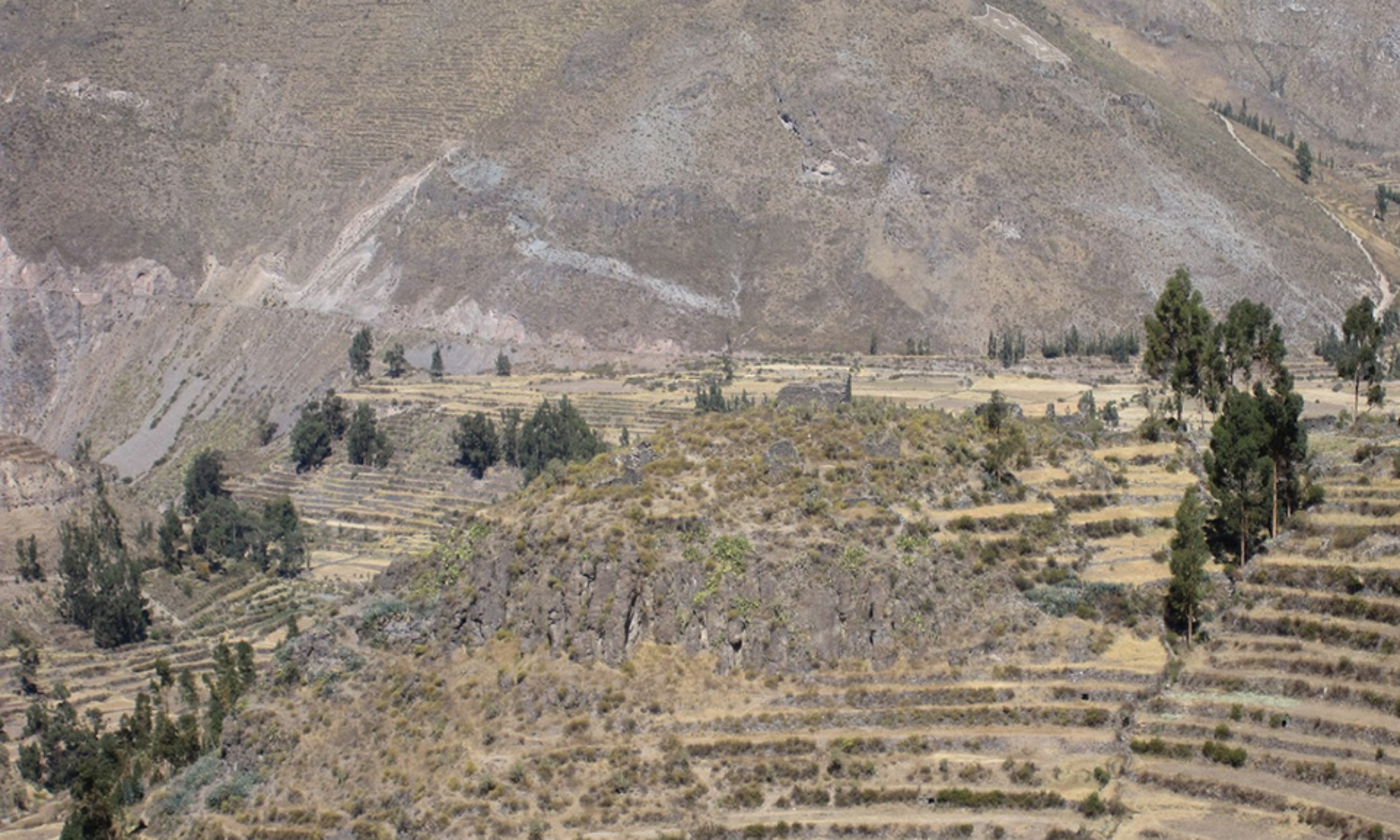
patterns. The survey data indicate
that during the Late Intermediate Period, habitational sites
of three to seven hectares in size developed in two principal
contexts: first, on the valley floor among massive agricultural
field wall complexes with defensive, storage and mortuary features
(Figs. 4-6), and
second, on the promontories of the surrounding valley sides in
association with the valley's extensive irrigated agricultural
terrace complexes (Figs. 7-8).
Settlement patterning during the Late Horizon Inka occupation
of the valley is characterized by some growth with overall locational
and organizational continuity. During the Late Horizon, no site
dominates the settlement pattern in terms of size, and all of
the major LIP settlements with elite Collagua architecture also
have rustic forms of Inka architecture. Neither this heterarchical
relationship between sites, nor the elaborate agricultural infrastructure
already established during the Late Intermediate Period (Brooks
and Olivares Ayala 1998) changed drastically under Inka occupation.
However, the appearance of single-occupation Inka sites associated
with relict corrals, artificial lagoons and other hydraulic features
on the puna slopes above the north side of the valley suggests
an intensification of pastoral production by the Inka.
The settlement pattern data (Fig.
9) therefore indicate a strategy of imperial control that
is neither clearly "direct" nor "indirect".
On the one hand, there was no major change in settlement patterning
between the LIP and the Late Horizon, and there is no single
site that could be considered a dominant administrative center.
On the other hand, the presence of cut stone masonry and large,
multi-door kallanka structures diagnostic of Inka architecture
(Hyslop 1990), suggest considerable investment in a decentralized,
but coordinated, Inka presence in this part of the valley (Fig. 9).
-
- Differentiation of Local LIP and LH
styles. Similar to the settlement
pattern data, Late Horizon ceramics found in the Colca valley
present a mixed picture of Inka administration that does not
appear to result from either clearly "independent"
or "attached" specialization. I employed both type/variant
and data matrix approaches in my analysis of the 3847 ceramic
fragments recovered from the survey. The preliminary results
of my type/variant analysis reinforce the findings of Sarah Osgood
Brooks who differentiated the local Collagua style from Chuquibamba
and other regional styles (Brooks 1998). As opposed to, for example,
the Churajón style of the valleys of southern Arequipa,
both the Chuquibamba and Collagua styles emerge from a common
Wari, rather than Tiwanaku-influenced substrate. However, Chuquibamba
more directly incorporates some of the common motifs of the Wari
Q'osqopa style just outlined in the paper by Willy Yépez
and colleagues, as well as coastal influences in the form of
specific design elements such as the eight-pointed star. Also,
the painted design elements common to both Collagua and Chuquibamba
are executed in distinct ways, with Chuquibamba motifs generally
executed with thinner lines in a lustrous (and sometimes dull)
greyish paint, as opposed to the thicker, more pronounced execution
of Collagua designs in heavy black mineral paint.
-
- Apart from differentiating Collagua from
Chuquibamba, my type/variant analysis also produced a preliminary
sequence that begins to address the perennial problem of differentiating
local Late Intermediate and Late Horizon wares. This is a stylistic
sequence of four overlapping phases: Collagua I (early LIP)-Collagua
II (middle-late LIP)-Collagua III (transitional-LH)-Collagua
Inka (Figs. 10,
11). The beginning
of the sequence is positioned by reference to radiocarbon dates
associated with Wari-influenced ceramics from a domestic terrace
at the site of Chijra, excavated by Michael Malpass and Pablo
de la Vera Cruz (Malpass and de la Vera Cruz Chávez 1988,
Malpass and de la Vera Cruz Chávez 1990). This site was
also recorded during my survey. The phases generally parallel
the three phase Chuquibamba sequence developed by de la Vera
and Augusto Cardona, and are based principally on marked changes
in form and decoration (Cardona Rosas 1993, de la Vera Cruz Chávez
1988, de la Vera Cruz Chávez 1989). Today I will focus
exclusively on the bowl and plate forms. The general trend over
the sequence in terms of form is a change from more globular
bowls, perhaps overlapping with the terminal Middle Horizon as
noted by Willy Yépez and colleagues, to more open, flat-bottomed
bowls and shallow plates of the Late Horizon (Table 1). Accompanying
this change is a shift in the placement of decoration from the
external to internal surface. Of course, this sequence must be
considered provisional in the absence of a more robust suite
of radiocarbon dates and stratigraphic excavations.
-
|
Style |
Everted lip bowls |
Cumbrous bowls |
Open bowls |
Plates |
Totals |
|
Collagua I |
11% (N=10) |
50% (N=47) |
39% (N=37) |
0% (N=0) |
100% (N=94) |
|
Collagua II |
0% (N=0) |
12% (N=22) |
76% (N=135) |
11% (N=20) |
100% (N=177) |
|
Collagua III |
0% (N=0) |
1% (N=2) |
62% (N=105) |
37% (N=63) |
100% (N=170) |
|
Collagua Inka |
0% (N=0) |
0% (N=0) |
0% (N=2) |
100% (N=563) |
100% (N=565) |
Table 1: Collagua I - Collagua
Inka bowl and plate forms (N=1006)
- There are three principal Collagua I bowl
forms: a cumbrous, slightly restricted form, a more open form
with straighter sides, and an open form with a slightly everted
lip (Figs. 11,
12, 13-14). The horizontal design fields of Collagua
I bowls are executed in black and occasionally white on a red
slip, and include curvilinear and geometric designs such as serpentine
curves, X's, S's, pendant triangles, as well as chained diamonds
and rhomboids with parallel and reticulated line fills. Collagua
I bowls also have black ticks at the rim, generally interpreted
as a Wari-influenced trait in the region. Collagua II bowls include
more open forms with rounded bases, as well as vessels with more
vertical sides (Figs. 11,
12). Designs on
Collagua II bowls, also executed in black on red, include zoomorphic
motifs, mainly representations of birds, and curvilinear designs
such as concentric arcs draping from the rim (Figs. 11, 15).
Small button-like protuberances below the rim are also common
on the exterior of Collagua II bowls (Fig. 16). Collagua III bowls, which appear to
be transitional between the LIP and Late Horizon, are open, generally
with flatter bottoms, and are decorated with curvilinear designs
such as paired wavy lines just below the rim, accompanied by
designs at the base of the interior of the plate, a pattern which
continues through the Late Horizon (Fig. 11, 17,
18).
-
- The diagnostic material from the Late
Horizon Period is dominated by shallow open plates and long-necked
amphora (aríbalos), with lesser quantities of cups,
beakers (k'eros), and one-handled pitchers typical of
Late Horizon assemblages throughout the south-central Andes (Brooks
1998, Bürgi 1993, de la Vera Cruz Chávez 1988, de
la Vera Cruz Chávez 1989, Julien 1983, Lumbreras 1974a,
Lumbreras 1974b, Malpass and de la Vera Cruz Chávez 1988,
Malpass and de la Vera Cruz Chávez 1990, Pärssinen
and Siirriäinen 1997, Stanish 1991, Tschopik 1946, Van Buren
1993, Wernke 2001). The plates can be divided into two general
categories: black on red bichromes, and polychromes. The few
published reports, along with theses and the extensive gray literature
from the region report similar plates from the Chuquibamba and
Majes/Camaná valleys to the southwest (de la Vera Cruz
Chávez 1989, Márquez and Montoro 1990); as well
as the Siguas (Yépez Alvarez, pers. comm. 1999), Yura
(Linares Delgado 1989), and Chili/Vitor/Quilca drainages to the
south (Yépez Alvarez 1991, Cardona Rosas, pers. comm.
1999). Throughout the region, the bichromes are much more common.
The more elaborately decorated polychrome plates have been preliminarily
identified as altiplano imports by previous investigators (Linares
Delgado 1989, Malpass as cited in Stanish 1991:15). This identification
was made in part because they are less common than the bichromes,
but also because they share broad similarities in the colors
and decorative motifs employed in the Sillustani Polychrome style
of the northwestern Titicaca basin, as well as the Pacajes style
of southern Titicaca and the highland drainages of extreme southwestern
Peru and northern Chile (Julien 1983, Tschopik 1946). However,
I argue that these bichromes and polychromes together represent
a provincial Inka style that I call Collagua Inka, produced in
the Colca valley and other locales throughout the Department
of Arequipa.
- Amongst the Collagua Inka bichrome plates,
the most common design elements are thin concentric lines inside
the rim, some with geometric designs or representational motifs
on the plate interior (Figs. 11,
19). These plates
also show stylistic continuities from external design fields
on Collagua style bowls, such as bird motifs, also common to
other southern provincial Inka styles (Fig. 20). Other bichrome plates display geometric
designs common to the Cuzco Polychrome style, such as dentate
patterns and chained diamonds (Fig. 21), as well as representational motifs such
as the footplow (or chakitaclla) (Fig. 22), fish, cultigens such as ají,
and camelids, all of which also appear in polychrome (Fig. 23) (D'Altroy
and Bishop 1990, D'Altroy, et al. 1994, Fernandez Baca 1971,
Pärssinen and Siirriäinen 1997, Rowe 1944).
I have recovered direct evidence for local ceramic production
in the form of potter's wheels, called muyuchiku, or falso tornos
(Hagstrum 1989) (Fig. 24-25).
Five of the six fragments of potter's wheels from the survey
were recovered from a single domestic terrace within an elite
sector of Uyu Uyu, one of the LIP to early colonial period sites
selected for more intensive study during my project (Figs. 26-27). This
area of the site is composed of a U-shaped patio group around
a large central structure with a worked stone façade typical
of high status Collagua architecture. The close association between
this patio group and the large (29 x 9 m) Inka kallanka dominating
the central plaza directly to the east also suggests a high-status
residential area (Fig. 26-27).
This contextual information suggests that during LIP and/or Late
Horizon times, ceramics were produced at large settlements such
as Uyu Uyu, perhaps associated with elite households.
-
- Documentary data relating to local
ceramic production. While these
archaeological data at the scales of artifact, site, and settlement
pattern point toward a generally "indirect" but coordinated
Inka administrative strategy, my analysis of detailed Spanish
censuses (or visitas) of the Colca Valley provides independent
evidence for the organization of local ceramic production, in
turn rendering a view of one aspect of the community-level mechanics
of Inka expansionism. These mechanics involved the reordering
of linkages between individual households and the nested hierarchy
of kin-groups, or ayllus, which in turn articulated with
the state bureaucracy of the Inka empire.
The visitas in question-from 1591, 1604, and 1617-are
from an area of the Colca valley that overlaps my archaeological
survey. The visitas record the members and landholdings
of all households within their ayllus, each in turn headed
by a kuraka (leader) and mandón (or segunda
persona-second in charge). These ayllus are organized
by low, middle, and high status designations within the Hanansaya
(upper) and Hurinsaya (lower) ranked moieties of Yanquecollaguas
(Fig. 28). On
the one hand, this hierarchical tripartite ranking suggests that
local kindreds were significantly reworked to mirror the structuring
of the royal ayllus (panacas) of Cuzco (Zuidema
1964). On the other hand, the pataca designation of the
ayllus, indicating a unit of 100 tributary households
within Inka decimal administration (Julien 1988), appears to
have been adapted to the extant number of ayllu households.
This suggests that these seemingly rigid Inka bureaucratic units
also yielded to local organization. Within this structure, the
members and landholdings of three craft specialist groups are
listed: silversmiths, weavers of sumptuary cumpi cloth,
and potters.
- For example, in the 1604 visita for the
Hurinsaya half of the village of Coporaque (one of the
villages in my survey area), pottery specialist households are
listed in two ayllus: five tributary households in Collana
ayllu (here referred to as "Indian potters"), and
six tributary households in Cayao ayllu (here referred
to as "official potters"). The fact that these potters
are embedded within the ayllu structure I just described,
and the listing of the second group as "official" potters
when no such colonial period position existed, strongly suggest
that they are descendents of Inka period pottery specialists.
This arrangement appears to reflect a level of coordination of
manufacture beyond casual household production or "independent
specialization". But yet it does not appear to represent
an attached specialist production regime, because the potters
are not listed as retainers (or yanacona)--a category
which does occur in the visitas. Furthermore, large-scale nucleated
workshop production appears unlikely since these potters represent
less than 1% of the tributary population (168 tributaries).
Rather, I suggest that these data, together with the archaeological
data I have briefly reviewed here today, illustrate an example
of "embedded" craft specialization (Janusek 1999),
in which artisans produce neither for a specific patron, as in
"attached specialization", nor independently for a
general demand population, as in "independent specialization",
but rather as part of the broader relations of reciprocity and
redistribution that connect hierarchies of ayllus.
In this paper, I have briefly sketched my research that combines
archaeological and documentary data in order to better understand
the community level politics of Inka expansionism within the
Colca valley. These combined data provide a more detailed view
of the cultural context of Inka rule than would be possible with
either data set alone. Ongoing research will continue to integrate
these data sets to further clarify the workings of Inka expansionist
politics at this critical community-level interface between domestic
and political economy.
-
- Acknowledgements:
Warm thanks to the Wenner-Gren Foundation for Anthropological
Research for supporting the research presented here through a
dissertation research grant and a Lita Osmundson fellowship.
Logistical support from the Center for Archaeological Research
in Arequipa (CIARQ) also greatly facilitated my field research.
-
- References Cited
-
Brooks, S. and M. Olivares Ayala
1998 The pre-Inca Huarancante canal, Colca Valley, Peru. Paper
presented at the 26th Annual Midwest Conference on Andean and
Amazonian Archaeology, Anthropology, and Ethnohistory, University
of Illinois, Champaign-Urbana.
Brooks, S. O.
1998 Prehistoric agricultural terraces in the río Japo
basin, Colca Valley, Peru. PhD Dissertation, University of Wisconsin-Madison.
Bürgi, P. T.
1993 The Inka empire's expansion into the coastal sierra region
west of Lake Titicaca. PhD Dissertation, University of Chicago.
Cardona Rosas, A.
1993 Características geográficas del patrón
de asentamiento para el valle de Chuquibamba - Arequipa, durante
el período comprendido entre el Horizonte Medio, y el Horizonte
Tardío. Licenciado en Arqueología, Universidad Católica
Santa María.
Cock, G.
1977-78 Los kurakas de los Collaguas: poder político y
poder económico. Historia y cultura (10):95-118.
Covey, R. A.
2000 Inka administration of the far south coast of Peru. Latin
american antiquity 11(2):119-138.
D'Altroy, T. N.
1992 Provincial power in the Inka empire. Smithsonian Institution
Press, Washington.
D'Altroy, T. N. and R. L. Bishop
1990 The provincial organization of Inka ceramic production. American
antiquity 55(1):120-138.
D'Altroy, T. N., A. M. Lorandi and V. Williams
1994 Producción y uso de cerámica en la economía
política Inka. In Tecnología y organización
de la producción cerámica prehispánica en
los Andes, edited by I. Shimada, pp. 395-441. Pontifica Universidad
Católica del Perú Fondo Editorial 1994, Lima.
- de la Vera Cruz Chávez, P.
- 1988 Estudio arqueológico en el
Valle de Cabanaconde, Arequipa. BA Thesis, Universidad Católica
Santa María.
-
- de la Vera Cruz Chávez, P.
- 1989 Cronología y corología
de la cuenca del río Camaná - Majes - Colca - Arequipa.
Licentiature Thesis, Universidad Católica Santa María.
Espinoza Soriano, W.
1987 Migraciones internas en el reino Colla. Tejedores, plumeros,
y alfareros del estado imperial Inca. Chungará 19:243-289.
Fernandez Baca, C.
1971 Motivos de ornamentación de la cerámica Inca-Cuzco,
Tomo I. Libreria Studium, S.A., Lima.
Gaffney, C. F. and V. L. Gaffney
1988 Some quantitative approaches to site territory and land use
from the surface record. In Conceptual issues in environmental
archaeology, edited by J. L. Bintliff, D. A. Davidson and E. G.
Grant, pp. 82-90. Edinburgh University Press, Edinburgh.
Hagstrum, M.
1989 Technological continuity and change: Ceramic ethnoarchaeology
in the Peruvian Andes. PhD dissertation, University of California,
Los Angeles.
Helmer, M.
1955-1956 La visitación de los Chupachos: Inca et encomendero.
Travaux de l'Institut Français d'Etudes Andines 5:3-50.
Janusek, J. W.
1999 Craft and local power: Embedded specialization in Tiwanaku
cities. Latin american antiquity 10(2):107-131.
Julien, C.
1993 Finding a fit: Archaeology and ethnohistory of the Incas.
In Provincial Inca, edited by M. Malpass, pp. 177-233. University
of Iowa Press, Iowa City.
Julien, C. J.
1983 Hatunqolla, a view of Inca rule from the Lake Titicaca region.
University of California publications in anthropology ; v. 15.
University of California Press, Berkeley.
Julien, C. J.
1988 How Inca Decimal Administration Worked. Ethnohistory 35(3):257-277.
Kolb, M. J. and J. E. Snead
1997 It's a small world after all: Comparative analyses of community
organization in archaeology. American antiquity 62(4):609-628.
LeVine, T. Y.
1987 Inka labor service at the regional level: The functional
reality. Ethnohistory 34:14-46.
Linares Delgado, L. R.
1989 Cronología y relaciones culturales pre-hispánicas
del Valle del Chili - Arequipa. Licenciado, Universidad Católica
Santa María.
Lumbreras, L. G.
1974a Los reinos post-Tiwanaku en el area altiplanica. Revista
del museo nacional 40:55-85.
Lumbreras, L. G.
1974b The peoples and cultures of ancient Peru. Smithsonian Institution
Press, Washington, DC.
Malpass, M. A. and P. de la Vera Cruz Chávez
1988 Ceramic Sequence from Chijra, Colca Valley, Peru. In The
cultural ecology, archaeology, and history of terracing and terrace
abandonment in the Colca valley of southern Peru. Technical report
to the National Science Foundation and the National Geographic
Society, vol. 2, edited by W. Denevan, pp. 204-233. Department
of Geography, Madison.
Malpass, M. A. and P. de la Vera Cruz Chávez
1990 Cronología y secuencia de la cerámica de Chijra,
valle del Colca. Gaceta Arqueológica Andina 18/19:41-57.
Márquez, M. G. and R. B. Montoro
1990 Arqueología del valle de Majes. Gaceta arqueológica
andina V(18/19):25-40.
Murra, J. V.
1978 Los olleros del Inka: Hacia una historia y arqueología
del Qollasuyu. In Historia, problema, y promesa: Homenaje a Jorge
Basadre, edited by F. Miro Quesada, F. Pease G.Y. and D. Sobrevilla,
pp. 415-423. Pontificia Universidad Católica del Perú,
Lima.
Pärssinen, M. and Siirriäinen
1997 Inka-style ceramics and their chronological relationship
to the Inka expansion in the southern Lake Titicaca area (Bolivia).
Latin american antiquity 8(3):255-271.
Rowe, J. H.
1944 An introduction to the archaeology of Cuzco. The Museum,
Cambridge, Mass.
Stanish, C.
1989 An archaeological evaluation of an ethnohistorical model.
In Ecology, settlement, and history in the Osmore drainage, edited
by D. Rice, C. Stanish and P. Scarr, pp. 303-320. vol. 545. British
Archaeological Reports, International Series, Oxford.
Stanish, C.
1991 A late pre-hispanic ceramic chronology for the upper Moquegua
valley, Peru. Fieldiana 16 (New Series). Field Museum of Natural
History, Chicago.
Stanish, C.
1992 Ancient Andean political economy. University of Texas Press,
Austin.
Tschopik, M. H.
1946 Some notes on the archaeology of the department of Puno,
Peru. Papers of the Peabody Museum of American Archaeology and
Ethnology XXVII, no. 3. Peabody Museum of American Archaeology
and Ethnology, Cambridge, MA.
Van Buren, M.
1993 Community and empire in southern Peru: The site of Torata
Alta under Spanish rule. PhD dissertation, University of Arizona.
Wernke, S.
2001 (In prep.) El Proyecto Prospección Regional Valle
del Colca. Report to the Instituto Nacional de Cultura del Peru,
Lima, Peru.
Yaeger, J. and M. A. Canuto
2000 Introducing an archaeology of communities. In The archaeology
of communities, edited by M. A. Canuto and J. Yaeger, pp. 1-15.
Routledge, New York.
Yépez Alvarez, W.
1991 Estudio de la cerámica de las fases Churajón
Tardío y Chuquibamba Tardío en el sitio arqueológico
de Umacollo, valle del Chili Arequipa. Universidad Católica
de Santa María. Submitted to Technical report.
Zuidema, R. T.
1964 The ceque system of Cuzco : The social organization of the
capital of the Inca. E.J. Brill, Leiden.
Home...