Physics Demo Number: 193
Approximate
Run Time: 10 min
Reversible Thermoelectric Demonstrator Used for Entropy Demonstration
Demo Description
The apparatus has semiconductor junctions sandwiched between two aluminum legs.
Each leg is immersed in a beaker of water.
When the leg temperatures are different enough,
a potential difference is generated capable of turning
an electrical motor and spiral disk.
Scientific Principles
When one heats a semiconductor material on one side, the majority charge carriers move toward the cooler side.One can thus create potential differences between the sides of semiconductor junctions by creating temperature differences between them.
The potential difference can be made to drive an electrical load.
In this fashion one converts heat energy in the beakers into electrical energy.
However one now only needs to use a bigger beaker to mix the hot and cold baths together and repour the two smaller baths from the mixed water to observe a new set of conditions.
The heat energy can no longer be extracted to electrical work by the unit.
Recalling that entropy may be thought of as the capacity factor for isothermally unavailable energy, one sees that the entropy of this system has increased
Equipment
- Cenco Reversible Thermoelectric Demonstrator
- Beakers
- Heat Torch
Equipment Location
- Kit 193 on [H-5-4] contains the apparatus and motor.
- Assorted steel beakers are on [H-5-4].
- Glass beakers can usually be borrrowed from next door.
- The Propane
Torch is on [H-5-3].
Instructions
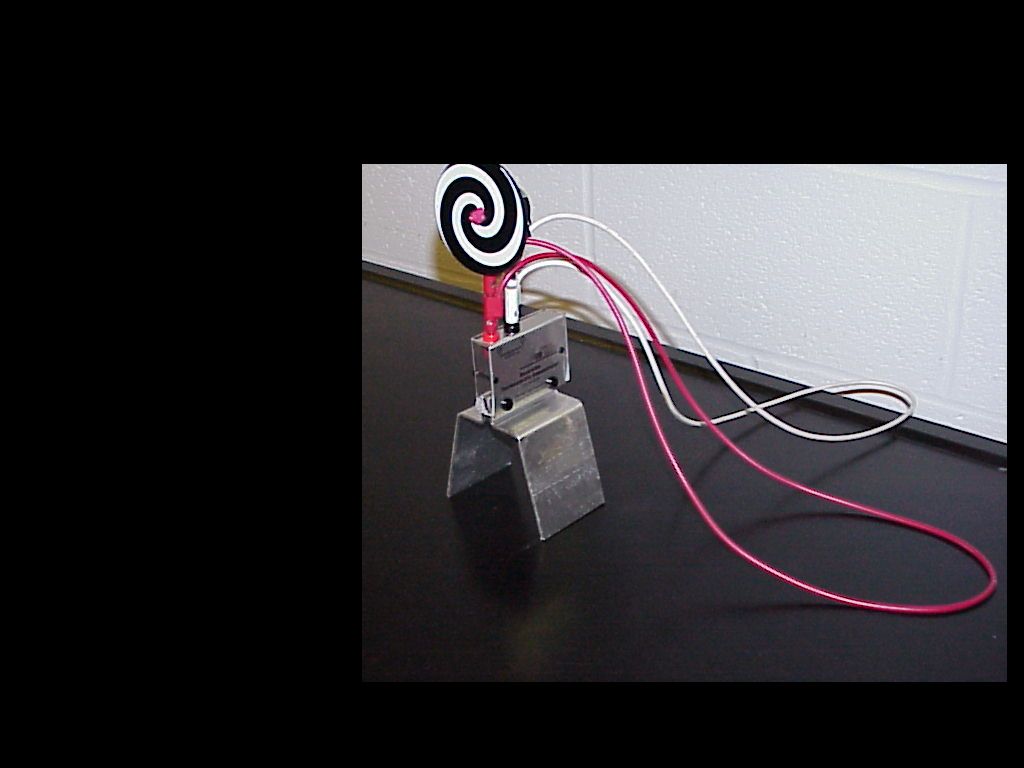
The photo shows the thermoelectric converter with the electrical load motor plugged into the top.
The second photo shows the setup for doing the experiment.

Note that there are two glass beakers to hold the water.
There is also a clamp and a stand to hold the motor-diode assembly.
One may heat the side of the hot-water beaker directly with the torch flame to warm it up.
Exercise great caution in dealing with live flames!!
The large metal beaker may be used to pour the cool and hot water together for mixing with the help of the tongs.