Physics Demo Number:170
Approximate
Run Time: 5min
Newton's Third Law With The Help of An Inclined Plane
Demo Description
A car and a block of wood are available to place on an inclined plane, either separately or simultaneously. The block by itself stays at rest. The car by itself accelerates down the plane.
The block and car (placed touching each other on the inclined plane with the block on the downhill side) move at nearly constant speed down the plane.
Scientific Principles
-
If the block is pushed down the plane by the car, then the block exerts a force up the plane on the car.
Equipment
-
Wheeled Car
-
Block of Wood
-
Smooth Platform
Equipment Location
-
Kit (170) on [E-2-4] contains the car and wood block.
-
The smooth platform is on [E-2-7] aka the top of the [E-2-x] column.
Instructions
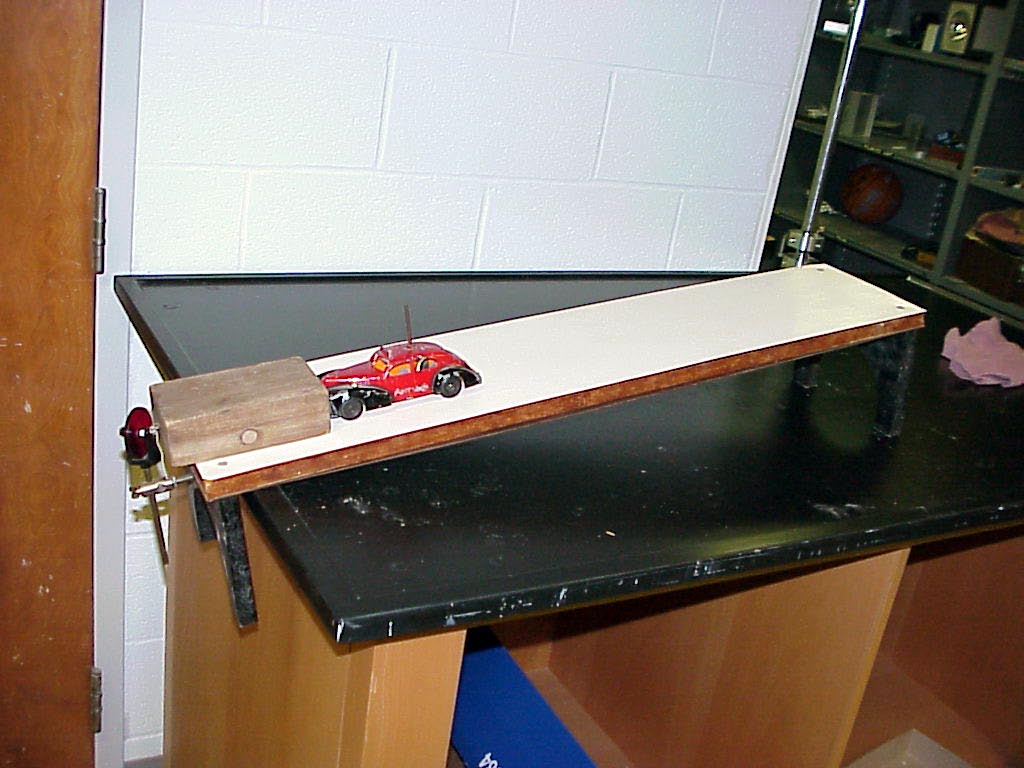
The
first picture shows the three components used in the
demonstration. They are a wheeled car, a block of wood, and a
smooth platform converted to an inclined plane by setting the legs
at one end off the lecture table.
The second picture shows a closer view of the components.
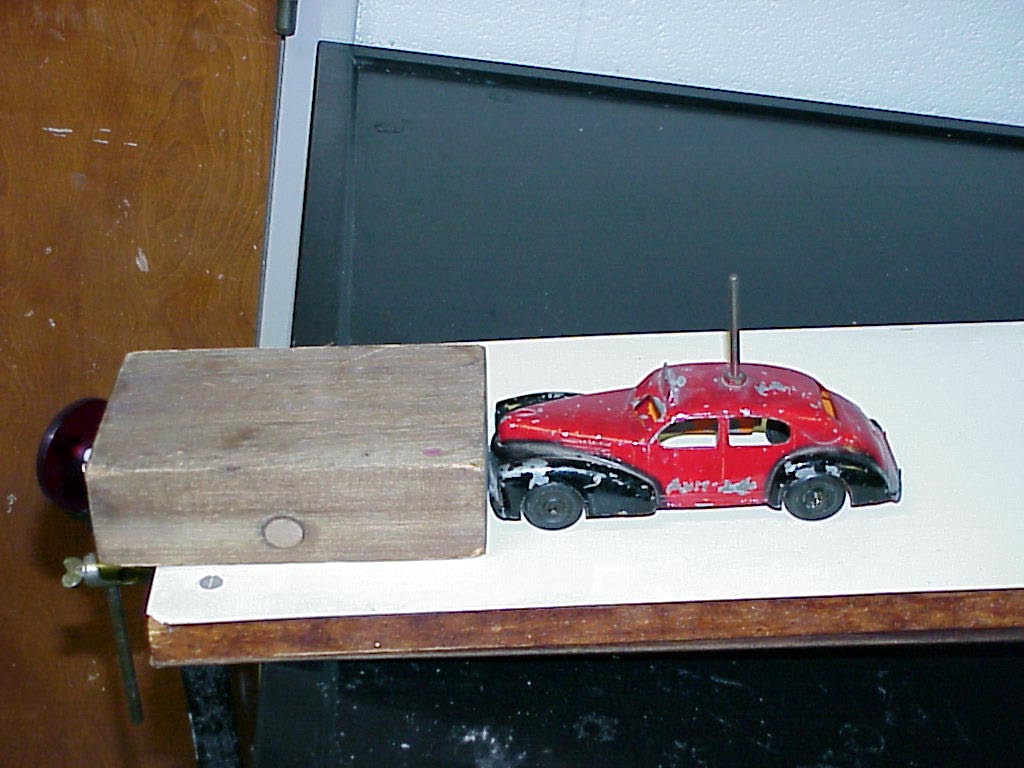
Using
these components as outlined, one finds that the block, by itself,
simply rests on the plane with no motion.
The car, by itself, rolls down the plane when released, with an acceleration.
However when the block is placed on the plane with the car behind it and the pair released , they both move slowly down the plane at constant speed, or with a small acceleration depending on friction conditions and the other variables.
Analyzing the last case as two bodies that interact via a contact force, it is clear that the block now slides down the plane at nearly constant speed since the car pushes on it DOWN the plane.
The car on the other hand moves down the plane at nearly constant speed since the block is pushing back UP the plane on the car.
This demonstration shows that the directions of the contact force on each of the two bodies are indeed opposite.
Detailed writing of the near-zero net force on each body equations would lead to conditions on the relations between masses, coefficient of friction , and plane angle that could presumably imply whether or not the magnitudes of these contact forces were indeed equal. One could appeal to the concept of a bathroom-type scale mounted between the car and block to motivate the acceptance of the equality of magnitudes of the contact force on each body.
Writeup created by David A. Burba
Copyright © 2013, Vanderbilt University. All Rights Reserved.