Physics Demo Number: 113
Approximate
Run Time: 15 min
Brownian Motion
Demo Description
A dedicated smoke cell with light source and microscope- objective video camera is used to watch jiggling of match smoke particles by air molecules.
Scientific Principles
-
Evidence of Molecules from their effect on visible smoke particles.
Equipment
-
Video Microscope Camera
-
Smoke Chamber Cell
-
Fiber Optic Tube Light Source
-
Machined Steel Base Cylinder
-
Matches (for smoke)
Equipment Location
-
All in Kit (113) on [H-4-5].
Instructions
Housed in Kit (113) on [H-4-5] are a small smoke chamber cell , a video camera (with a dedicated microscope objective), and a fiber optic light source .
One may use the smoke chamber cell to capture smoke particles as they plume upwards from a recently-extinguished match from the book of matches.
Then the video-camera microscope may be used to view the live Brownian motion of the tiny smoke particles.
One can output the video signal to an interface for projection in the classroom.
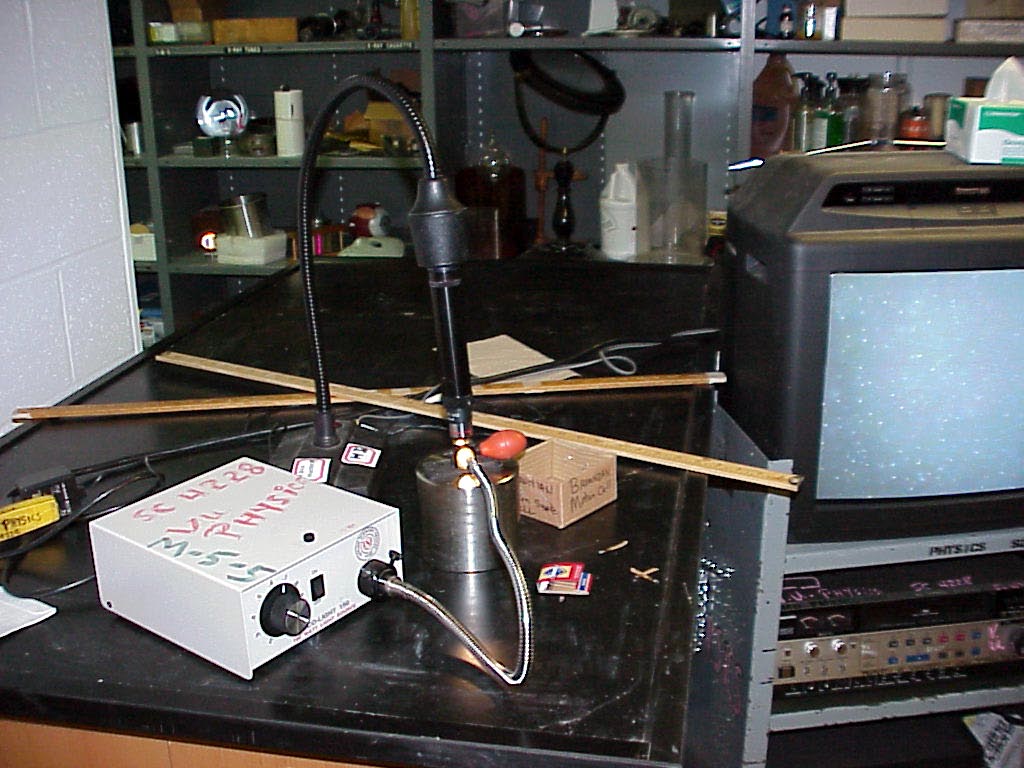
The first photo shows the demonstration operating with the tan fiber-optic tube light source as the cell 's source of illumination.
The cell is resting on a dedicated steel cylinder base which has been machined to give the correct height of the cell above the table top and some degree of stability from vibrations.
This cell base tends to optimize ease of quick setup for the microscope and light tubes.
The video camera is sending its signal to the monitor in the right of the photo.
The bright spots seen on the monitor screen are not snow, but individual illuminated smoke particles which were nicely jiggling around in random fashion under the pictured conditions of operation of the apparatus.
The next photo shows a closer view of the smoke cell, microscope objective, light tube , and base.
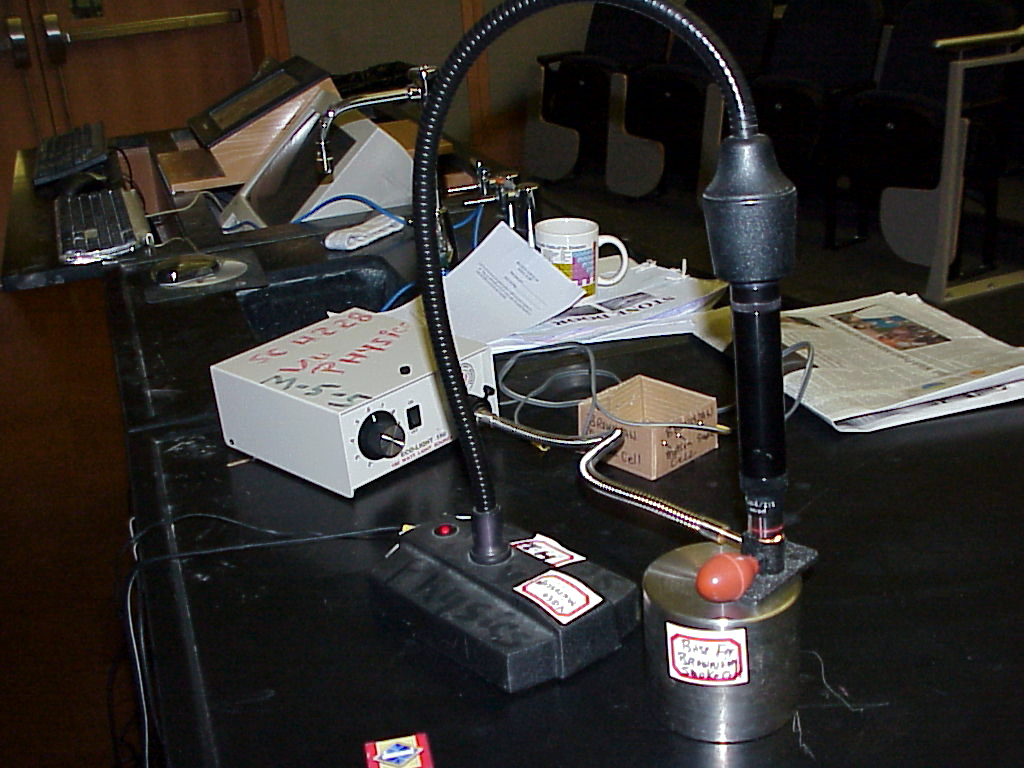
The
third photo shows the apparatus set up for use in SC4327 with the
video cable from the camera running to its input to the room VCR
projection interface, as shown:
Note that the mechanical input is the left-most one and that the current mechanical VCR setting is F-1, toggled by the mechanical round dial about a foot to the right of the video cable input and on the next rack component up.
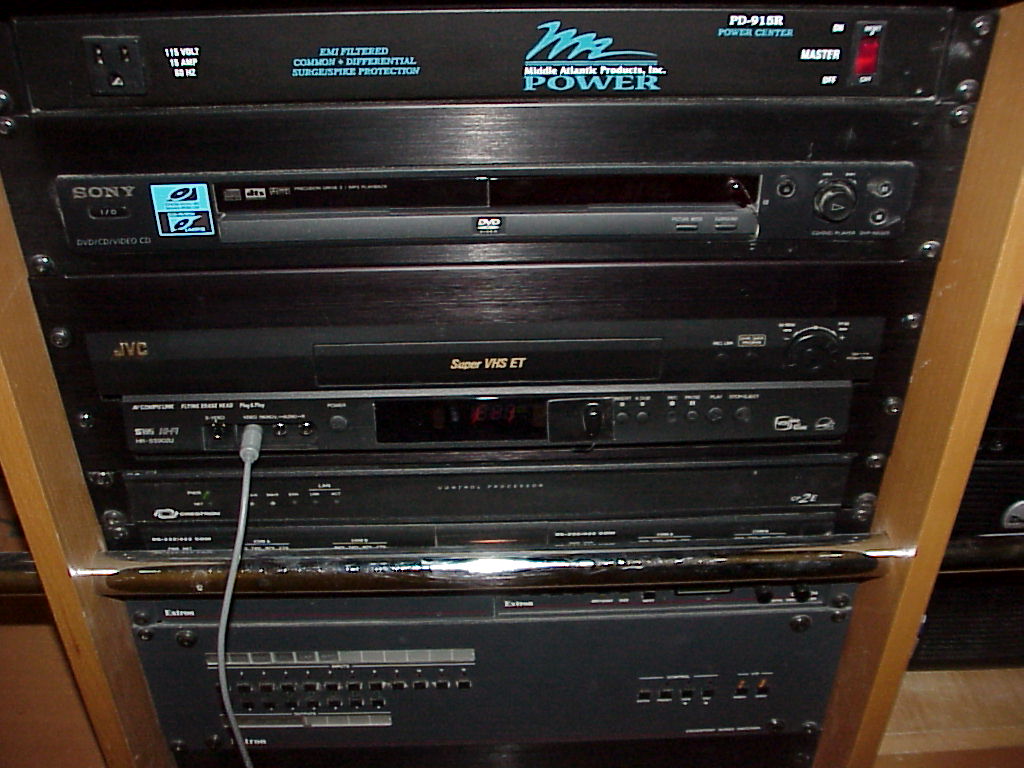
The
final photo shows the output to the big screen, with the white
dots being images of the smoke particles in the microscope.
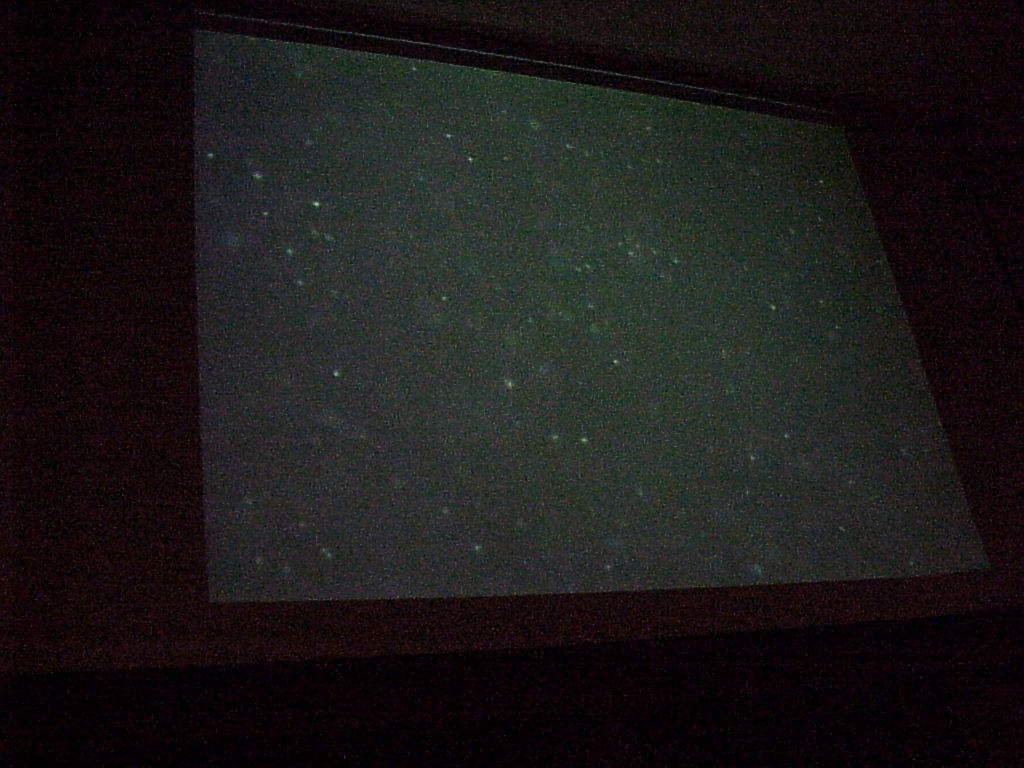
Writeup created by David A. Burba
Copyright © 2011, Vanderbilt University. All Rights Reserved.