Physics Demo Number: 108 |
Approximate Run Time: 10 min |
||||||
Polarization Of Light |
|||||||
Demo DescriptionUse various Optical Elements to produce and view polarized light.
|
|
Scientific PrinciplesLight rays can be made to act like plane polarized waves. |
|||||
Equipment
|
|
Equipment Location
|
|||||
Instructions
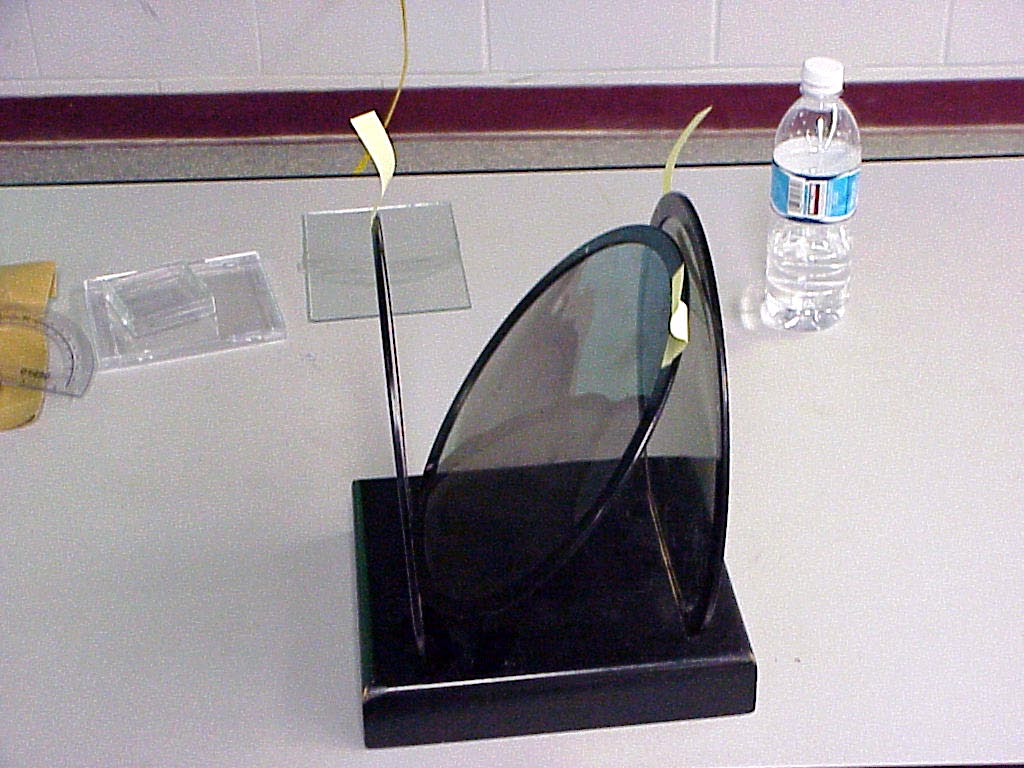
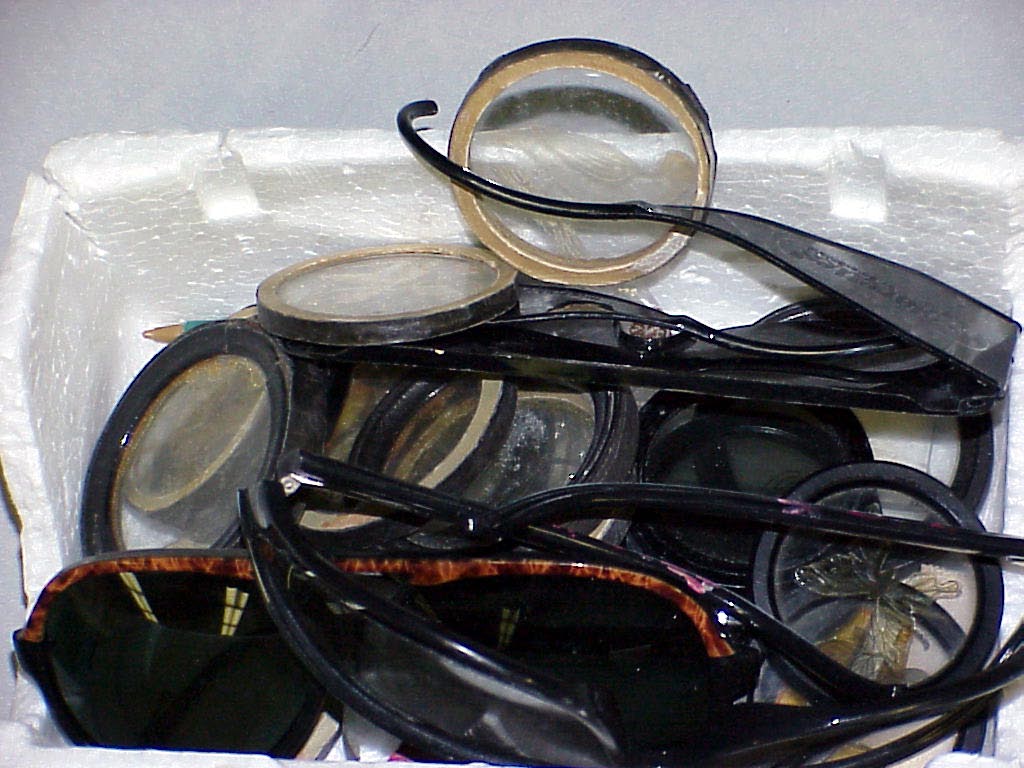
The three large Polaroid filters seen in the first photo, along with the accessories seen in the second photo all live in Kit (108) which is on [C-4-4].
|
|||||||
|
The eyeglasses are Polaroid enhanced sunglasses. The round glass disks have clearish acetate-like material mounted between plates of ordinary glass. If one's eye catches reflected light from these disks just right, one will see that various artistic figures have been created between the plates of each disk from the clearish material. The camera has indeed certainly caught such a disk with a butterfly object housed therein in the lower right corner of the second photo. There appears to be a bird of some type in the disk at the top of the photo. One may lay a Polaroid filter on the overhead and then hand-hold a second filter over the first to show that when the axes are parallel, the second filter has no additional effect on the transmitted light. However, upon rotation of the top filter slowly from its axis parallel to the bottom filter's axis, to the point that the top axis is at 90 degrees to the bottom axis, one sees the transmitted light through the two filters dwindle down to zero. If one now holds the top filter with one hand (with the filters still crossed) and inserts one of the round glass disks with the other hand , the nearly invisible critter inside the disk will become totally visible on the screen in the dark field of the crossed filters. Not only visible, but also visible in full colors. Moreover one may now rotate the glass disk about a vertical axis perpendicular to its faces and see the colors change as a function of its angular orientation. Of course one may put a clear plastic object between the crossed filters and observe stress patterns in that object. Writeup created by David A. BurbaCopyright © 2013, Vanderbilt University. All Rights Reserved. |
|||||||