Physics Demo Number: 064 |
Approximate Run Time: 5 min |
|||
Cut Mop and Inequality of Weights on Each Side of Center of Mass |
||||
Demo DescriptionA string mop (with its string head still nicely captured as a cylinder by its marketing plastic wrapper) is experimentally balanced at its center of mass. The mop handle is then cut into two pieces at the balance point. One then hangs the two halves of the mop over a pulley to see that the head containing end is heavier than the other end. |
|
Scientific Principles
|
||
Equipment & Set Up
|
|
Equipment Location
|
||
1
|
2
|
|||
3
|
4
|
|||
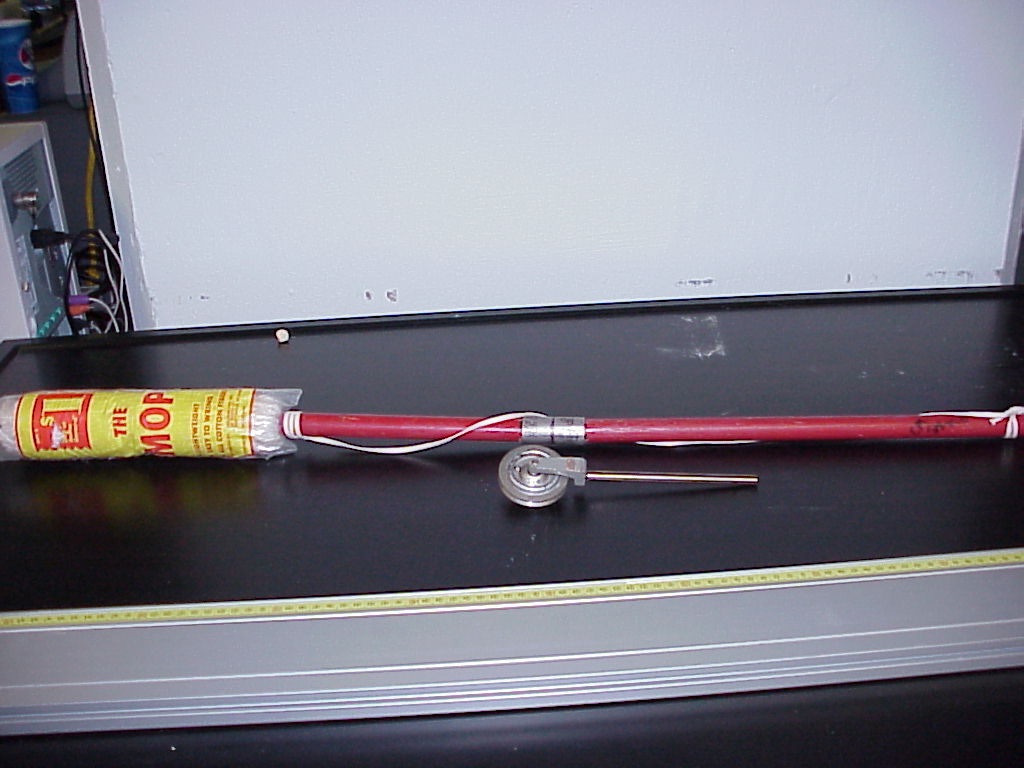
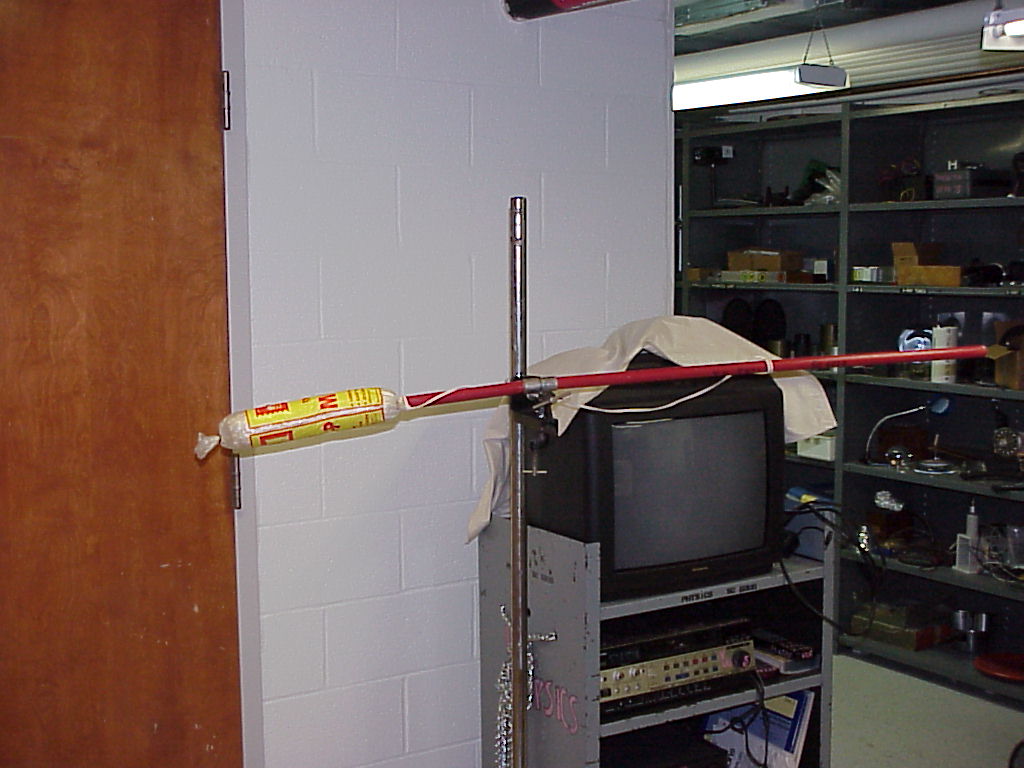
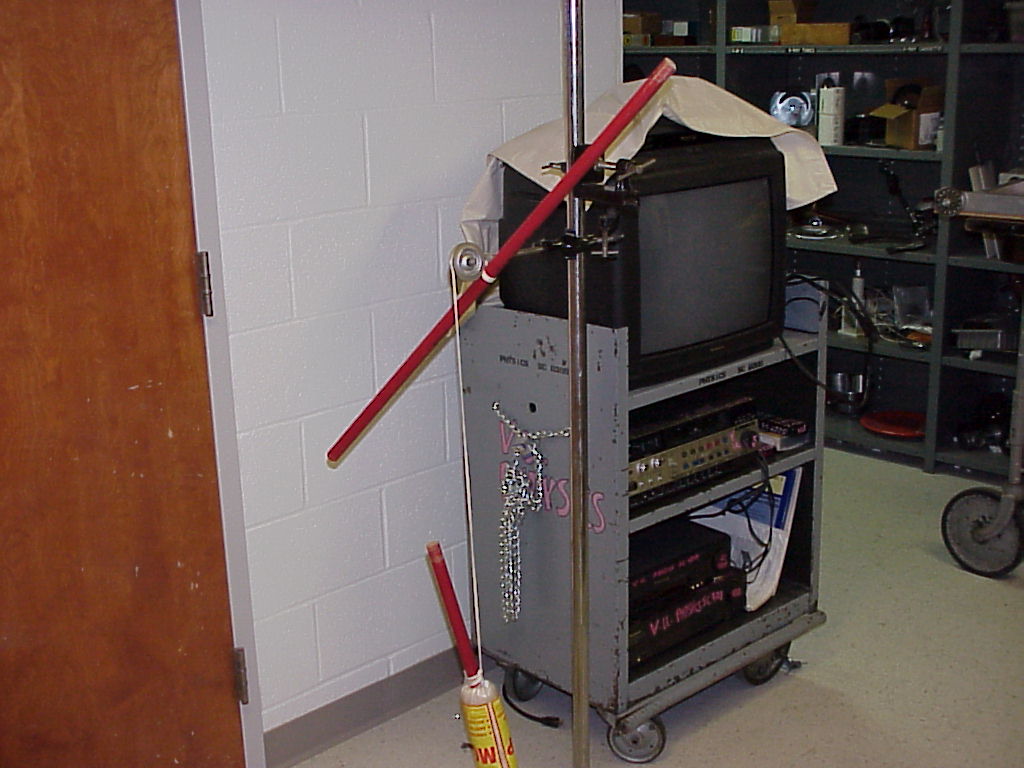
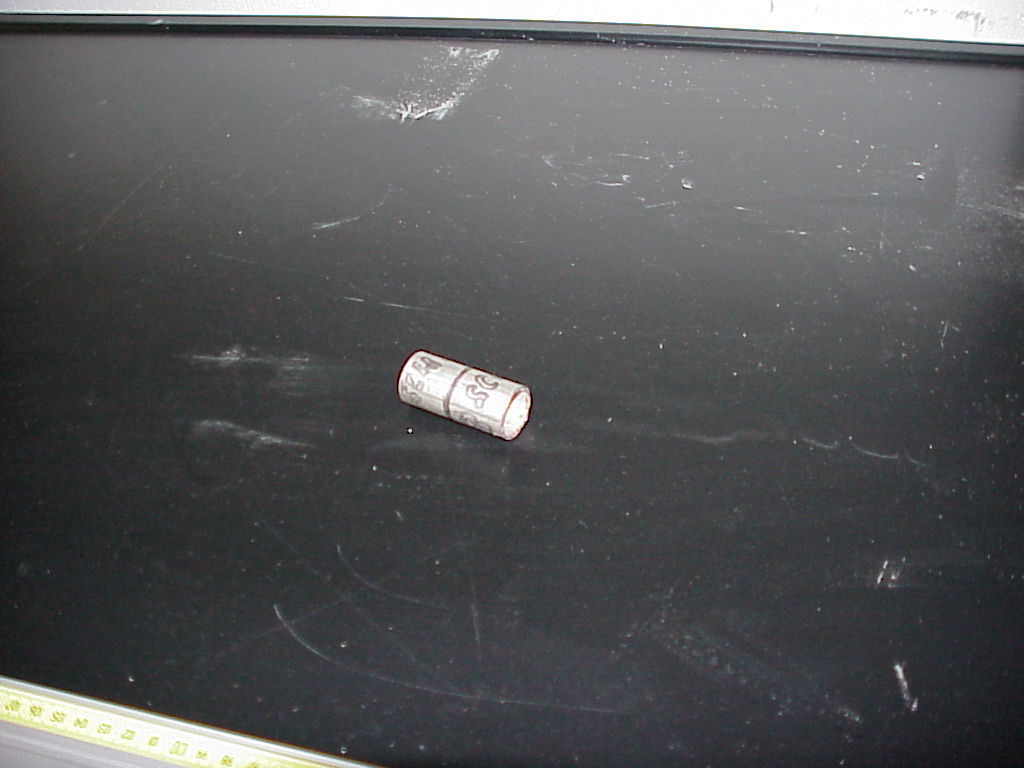
InstructionsPhoto 1 shows a mop whose Center of Mass has been determined to be at the middle of the Aluminum collar seen on the mop stick at the point where the white string disappears behind the handle. The demonstrator can show that the center of mass is here by the practical method of resting the handle on the tops of two fingers and sliding her hands together towards each other. Her fingers will come together (with the stick balanced on them) at the center of mass. Photo2 shows the mop resting in equilibrium on the center of mass collar. ( The stand was just used for the photo.) Photo3 shows conclusively that the longer part of the stick weighs less than the short part-plus mop head. Thus the center of mass does not necessarily separate equal masses on a non-uniform linear distribution of mass. One can hand-hold the pulley if desired, removing the necessity of the stand altogether. The whole demonstration could be done from scratch each term without the aid of the coupling collar (photo 4) seen in the last photo. However a new mop would have to be purchased and destroyed on each occasion, an unacceptable state of affairs from an ecological point of view. Unfortunately, by accident, the weight of the collar about matches the weight difference of the two sides of the mop. Thus one needs to be sure to remove the collar before doing the pulley-based weighing of the two sides. Removing the collar avoids cries of foul from astute observers or failure-to-make-point for the unobservant demonstrator. |
||||
Writeup created by David A. BurbaCopyright © 2013, Vanderbilt University. All Rights Reserved. |
||||