Fighting malaria by manipulating mosquitoes' sense of smell
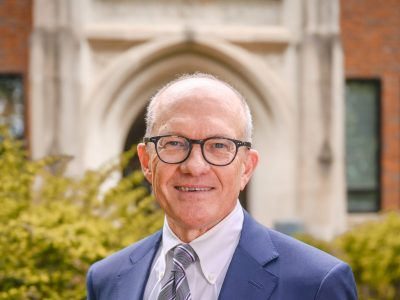
Combating the spread of malaria by manipulating the mosquitoes' sense of smell is the object of an ambitious research project, led by Vanderbilt University, that has been selected to receive $8.5 million as part of the Grand Challenges to Global Health.
6/30/2005 10:18 am
Listen to "That's Vanderbilt" interview with Larry Zwiebel (.wav or .mp3).
NASHVILLE, Tenn. -- Combating the spread of malaria by manipulating the mosquitoes’ sense of smell is the object of an ambitious research project, led by Vanderbilt University, that has been selected to receive $8.5 million as part of the Grand Challenges to Global Health.
The initiative, which was launched by the Bill and Melinda Gates Foundation, has just announced the selection of 43 “groundbreaking” research projects to improve health in developing countries that will receive a total of $436 million in support.
As part of this effort, mosquito researchers from Vanderbilt University, Yale University, the Wageningen University in the Netherlands, the Ifakara Health Research and Development Centre in Tanzania and the Medical Research Council Laboratories in the Gambia will be developing a fundamentally new approach to malaria control that relies on powerful chemical repellents and attractants deployed in ways that can both interfere with malaria mosquitoes’ ability to find human targets and lure the insects to their death.
Malaria is considered to be the most prevalent life-threatening disease in the world, with estimates of the number of new cases that range from 300 million to 660 millions cases per year. Current efforts to control this disease, which combine the use of insecticides with improved access to effective diagnosis and treatment, have great potential to save lives but face enormous challenges and cannot eradicate malaria without the development of complementary control technologies.
Recent advances in the genetics, biology, immunology and behavior of mosquitoes open up new and unexplored avenues for controlling malaria and other mosquito-borne diseases. The goal of the Vanderbilt-led research team is to pursue one of the most promising of these new avenues: developing chemical compounds that interfere with the malaria mosquitoes’ exquisite sense of smell.
The effectiveness of such an olfactory strategy has been demonstrated by a program with the African tsetse fly that has replaced the practice of treating large tracts of land with persistent insecticides with the use of scented baits. It is widely considered to be an environmental and technological success. Unlike insecticides, the chemicals involved in insect olfaction tend to be relatively non-toxic. They also tend to be specific to closely related species, so widespread application is not likely to impact other beneficial insect populations.
The researchers intend to set up a pipeline for identifying and testing non-toxic chemical odorants that attract, repel or simply confuse the mosquito’s olfactory system.
The pipeline begins with the high-tech genetic engineering and molecular biology laboratories at Vanderbilt and Yale, which will identify chemical compounds that interact strongly with receptors in the female mosquito’s antennae and appear to be related to host selection. The most promising of these mixtures will be shipped to Wageningen University where their effects on the behavior of live mosquitoes will be determined. Compounds that pass the behavioral tests will be forwarded to Tanzania, where they will be evaluated with laboratory-reared mosquitoes in a large biosphere that simulates the natural environment. Finally, odorants that have passed all these tests will be field tested in cooperating villages near Ifakara and in The Gambia under the supervision of IHDRC and MRC Laboratories’ researchers.
“By combining laboratory-based and field-based studies, we expect to establish an effective strategy for developing extremely powerful attractants and repellents for malaria mosquitoes and identifying effective methods for using them to reduce the spread of malaria,” says Laurence J. Zwiebel, associate professor of biological sciences at Vanderbilt, who is the lead investigator on the project.
The mixtures developed in the project could be useful against other disease-carrying mosquitoes, such as those that spread dengue fever and those that carry the West Nile virus. In addition the project will test a basic approach that could be directed against a number of other insect species, including agricultural pests and those that carry other human and animal diseases.
The Grand Challenges initiative was launched by the Bill & Melinda Gates Foundation in 2003, in partnership with the National Institutes of Health, with a $200 million grant to the FNIH and is a major international effort to achieve scientific breakthroughs against diseases that kill millions of people each year in the world’s poorest countries. It is funded with a $450 million commitment from Gates Foundation, $27.1 from the Wellcome Trust, and $4.5 million from the Canadian Institutes of Health Research (CIHR). The initiative is managed by global health experts at the Foundation for NIH, the Gates Foundation, the Wellcome Trust, and CIHR.
Background
THE MOSQUITO OLFACTION NETWORK
Vanderbilt University
Laurence J. Zwiebel, associate professor of biological sciences, is the project’s overall director. His laboratory has pioneered the identification of mosquito odorant receptors. Its role will be to apply the tools of genetic engineering and molecular biology to further analyze these receptors in the malaria mosquito—Anopheles gambiae—particularly the ones that respond to human odors. The researchers will use genetic engineering techniques to place mosquito smell receptors in immature frog eggs and grow them in cultures in order to test large numbers of different chemical compounds for those that interact the most strongly with the receptors that the mosquito uses for many important behaviors, most particularly to seek out human prey.
Yale University Scientists at Yale University, directed by John R. Carlson, Eugene Higgins Professor of Molecular, Cellular and Developmental Biology, will be searching for compounds that excite or block the smell receptors in mosquito antennae. His lab will apply its extensive expertise in identifying odors that activate individual insect receptors. In particular, Carlson and his colleagues will be employing a system that they developed which allows mosquito receptors to function in the antennae of Drosophila melanogaster, a tiny fruit fly whose genetics has been studied extensively. The search for odors that affect mosquitoes can be carried out much more easily using the genetically engineered fruit fly than it can in the mosquito itself. “We aim to develop a seductive mosquito perfume that will lure them into traps and also a mixture that smells so terrible to them that it drives them away,” Carlson says.
Wageningen University
The investigators at Wageningen University in the Netherlands—Associate Professor Willem Takken, co-principal investigator, and senior research scientist Bart Knols—will concentrate their research on the neuro-physiological and behavioral responses of Anopheles mosquitoes in response to candidate compounds that come from Vanderbilt and Yale. First, the activity of single compounds will be investigated. If a compound causes behavioral activity, either
attraction or repellence, it will be added to simple odor blends designed either to repel mosquitoes even in the presence of human odors, to attract them more strongly than human odors, or that simply confuse the mosquito so it does not respond to human odors. Successful blends will be passed on to Tanzania for semi-field studies.
Ifakara Health Research and Development Centre IHRDC is located in southeastern Tanzania. It is a center for biomedical, clinical and epidemiological research with a mission to conduct health research that will lessen the burden of disease in its local area, the country as a whole and East Africa at large. The Kilombero Valley, where IHRDC is located, holds the world record for reported human exposure to malaria and is one of the best studied areas of malaria transmission in Africa. IHRDC Director Hassan Mshinda and Gerry Killeen, who heads the Public Health Entomology Unit, are leading the Tanzania research group. The IHRDC team will evaluate the potency of candidate compounds and blends in an enclosed biosphere before proceeding to full field trials in nearby villages. The facility will allow the scientists to determine rapidly the way in which the mosquitoes respond to different odorant blends and different release strategies under relatively controlled and safe conditions using uninfected mosquitoes. This high-throughput but semi-natural system will point the way for the more realistic but labor intensive field trials on both sides of the African continent.
Medical Research Council Laboratories in the Gambia The MRC Laboratories in the Gambia has an international reputation for research on malaria, viral and bacterial diseases, with an emphasis on basic scientific research, clinical studies and large epidemiological studies and intervention trials. The MRC Laboratories have a track record for pioneering new mosquito control strategies in Africa, such as conducting the first successful large-scale trials of insecticide-treated bednets 25 years ago. David Conway, head of MRC Laboratories malaria research program, will lead the Gambian research team, which will conduct full-scale field trials of the most promising odorants and release methods identified by the IHRDC. These will include village-wide studies that will evaluate the effectiveness of this strategy for disrupting mosquito behavior.
Listen: Professor's year in Baghdad leads to unique course about the war in Iraq
Last fall Vanderbilt students had the rare opportunity in an interdisciplinary class called "The War in Iraq" to take an in-depth look at the facts on the ground in Iraq between 2003 and the present. Humanities 161 was co-taught by political scientist Katherine Carroll and Mike Newton, professor of the practice of law.
1/27/2010 3:21 pm
Last fall Vanderbilt students had the rare opportunity in an interdisciplinary class called "The War in Iraq" to take an in-depth look at the facts on the ground in Iraq between 2003 and the present. Humanities 161 was co-taught by political scientist Katherine Carroll and Mike Newton, professor of the practice of law. The focus was on the U.S. military and its response to a variety of challenges it has faced in Iraq. The course grew out of Carroll's year in Baghdad as an embedded professor with the U.S. Army.
January 20 marks the one-year anniversary of Barack Obama's inauguration as the 44th president of the United States. Political scientists John Geer and David Lewis agree that it's too soon to judge how Obama will fare in comparison to previous presidents but they can discuss how his transition, political appointments and other aspects of his administration are progressing so far.
1/15/2010 4:54 pm
January 20 marks the one-year anniversary of Barack Obama's inauguration as the 44th president of the United States. Political scientists John Geer and David Lewis agree that it's too soon to judge how Obama will fare in comparison to previous presidents but they can discuss how his transition, political appointments and other aspects of his administration are progressing so far.
Akers offers insider's guide for writing better screenplays
Your Screenplay Sucks doesn't mince words
Anyone who's ever dreamed of walking the red carpet at the Oscars for an award-winning screenplay might want to check out a book by William M. Akers before proceeding too far along. The Vanderbilt senior lecturer in theater is the author of "Your Screenplay Sucks: 100 Ways to Make It Great."
4/3/2009 2:57 pm
Anyone who's ever dreamed of walking the red carpet at the Oscars with an award-winning screenplay might want to check out a book by William M. Akers before proceeding too far along. The Vanderbilt senior lecturer in theater is the author of "Your Screenplay Sucks: 100 Ways to Make It Great." Akers has plenty of real-world experience with writing and "pitching" screenplays to Hollywood gatekeepers, and he's happy to share what he's learned with Vanderbilt students and other interested persons.
President's cabinet heads control the pork, VU research finds
While many people associate the word "pork" with lawmakers wasteful spending for pet projects, new Vanderbilt political science research demonstrates the importance of cabinet secretaries and their political beliefs in the distribution of lucrative federal grants.
2/16/2009 9:54 am
While many people associate the word "pork" with lawmakers wasteful spending for pet projects, new Vanderbilt political science research demonstrates the importance of cabinet secretaries and their political beliefs in the distribution of lucrative federal grants. Vanderbilt Assistant Professor of Political Science Christian Grose and Anthony Bertelli, a professor at the University of Georgia, studied the allocation of discretionary government contracts in the Labor and Defense departments from 1991 to 2002. They also examined the political leanings of the various heads of these two departments during the same time period. "Our research found that a more conservative cabinet secretary will choose states represented by conservative senators and the opposite happens when a more liberal secretary is in office," Grose said.
Have an event that you would like to have recorded for podcasting? Click here to submit your request.
TOP AUDIO
Listen: Professor's year in Baghdad leads to unique course about the war in Iraq
Last fall Vanderbilt students had the rare opportunity in an interdisciplinary class called "The War in Iraq" to take an in-depth look at the facts on the ground in Iraq between 2003 and the present. Humanities 161 was co-taught by political scientist Katherine Carroll and Mike Newton, professor of the practice of law.
Listen: Grading the Obama presidency
January 20 marks the one-year anniversary of Barack Obama's inauguration as the 44th president of the United States. Political scientists John Geer and David Lewis agree that it's too soon to judge how Obama will fare in comparison to previous presidents but they can discuss how his transition, political appointments and other aspects of his administration are progressing so far.
Akers offers insider's guide for writing better screenplays
Anyone who's ever dreamed of walking the red carpet at the Oscars for an award-winning screenplay might want to check out a book by William M. Akers before proceeding too far along. The Vanderbilt senior lecturer in theater is the author of "Your Screenplay Sucks: 100 Ways to Make It Great."
President's cabinet heads control the pork, VU research finds
While many people associate the word "pork" with lawmakers wasteful spending for pet projects, new Vanderbilt political science research demonstrates the importance of cabinet secretaries and their political beliefs in the distribution of lucrative federal grants.
Vanderbilt University | 2201 West End Avenue Nashville, TN 37235 | Phone: (615) 322-7311